

Paid by the West
4 Oct 2026 · @Ian Brown
Price floors, China's tax design, and the competitiveness the West has not addressed
I. After the money
A previous Brown Paper, "Borrowed Urgency" ended on a finding that would have been unthinkable two years ago: capital is no longer the constraint. JPMorgan's Security and Resiliency Initiative, EXIM's Project Vault, DoD's package for MP Materials and a long list of government programmes have put willing money on both sides of the market. What remains short is not finance.
The instrument of choice for that money has become the price floor. The model is the agreement DoD signed with MP Materials on 9 July 2025: a ten-year guarantee that MP will receive at least $110 per kilogram for its NdPr, with DoD paying the difference when the market falls short and taking 30% of the upside once the 10X magnet plant reaches full production. Offtakes, stockpile programmes and fixed-price arrangements across the West now borrow the same logic.
A floor answers one question: will a Western producer stay solvent if prices fall? It is a fair question, and the MP floor answers it. But it is not the question that decides whether the West can compete. That question is narrower and harder. When a Western-made magnet, motor, or product meets its Chinese equivalent in a Western market, why is the Chinese one cheaper, and how much of that difference was designed in?
This paper argues that a significant part of it was, and that this part can be identified and measured. China has built an industrial machine whose output is a price, and whose design places costs on everyone outside it. A floor protects a producer from that price. It does nothing about the machine.
To be clear about the scope: this paper does not argue that the West should cancel China's advantages of scale, efficiency or industrial capability. It identifies a narrower advantage, created by tax design, controlled access and domestic price formation. It asks whether Western policy should neutralise it, so that what remains is a contest of cost, scale, quality and execution.
II. The machine
China has no rare earth policy. It has a rare earth machine: a set of levers, each managed by the state, that reinforce one another. Seen one at a time, each looks like ordinary industrial policy. Seen together, they set the terms on which everyone else competes.
Volume. Mining and smelting quotas are calibrated to expected demand over a defined timeline. They are not arbitrary caps; they are a planning instrument, and the supply that reaches the market is the supply the state has decided it needs.
Price. The reference price forms inside China, set by Chinese buyers, within a supply envelope the quota has already defined. Section IV returns to this, because it is where the machine's output becomes visible.
Tax. Finished magnets leave China with their 13% VAT refunded. Oxide and metal leave with none refunded. The difference is a policy choice, and Section VI shows what it is worth.
Access. Since April 2025, seven medium and heavy rare earths have required export licences, with roughly half of applications approved. The October 2025 controls, suspended until 10 November 2026, would extend Chinese jurisdiction to products made anywhere containing as little as 0.1% Chinese-origin content.
Capital. State-directed finance underwrites capacity that would not survive private scrutiny. The bill is real, and it is paid by local government financing vehicles, by household savers through financial repression, and by foreign competitors absorbing the output.
Enforcement. MOFCOM has run its largest recruitment drive in nearly a decade, introduced a public reporting mechanism for strategic-mineral violations from 1 July 2026, added MP Materials and USA Rare Earth to its export control list, and arrested two Japanese nationals over alleged rare earth smuggling.
No single lever explains China's position. A quota without a price mechanism leaks; a price mechanism without licensing can be arbitraged; licensing without a tax design pushes processing offshore. Together they form a system in which the price is an output, not an input.
Not only rare earths
This paper uses rare earths because the machine is most complete there. They are one of many. The EU's Critical Raw Materials Act designates 34 critical raw materials, and within them 17 strategic raw materials whose demand is expected to outpace supply: aluminium and bauxite, bismuth, boron, cobalt, copper, gallium, germanium, lithium, magnesium, manganese, natural graphite, nickel, the platinum group metals, magnet rare earths, silicon metal, titanium and tungsten. [Check: confirm list against Annex I] China is the largest supplier to the EU of most of them, and the IEA's 2026 outlook finds it the leading refiner of 19 of the 20 strategic minerals it tracks, with an average share of around 70% (source).
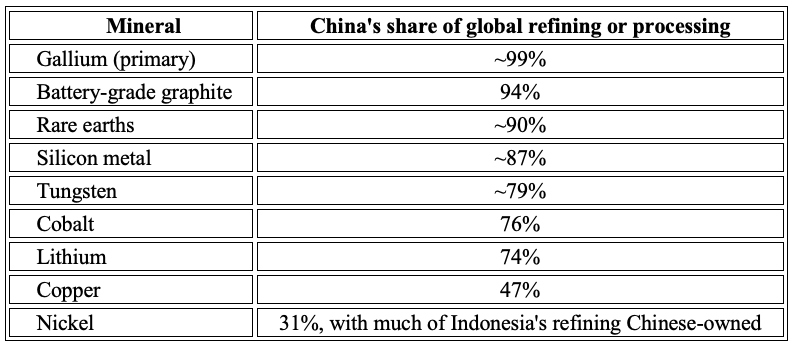
IEA figures for 2024, via BOFIT; gallium, silicon metal and tungsten from secondary compilations, to be confirmed.
The pattern is the same throughout. China mines only 2–8% of the world's copper, cobalt and nickel ore, yet refines between a third and three-quarters of each. Its control lies in processing, where the levers above operate. The IEA found that new projects outside China cost, on average, about 50% more to build, are slower to permit, and often cannot find buyers willing to sign long-term contracts (source). Since 2023, China has placed export controls on graphite, gallium, germanium, tungsten, bismuth and rare earths.
Rare earths are the example here because they carry the most asymmetric leverage of all. China refines around 90% of them, close to 99% of the heavy rare earths, and makes around 90% of the world's magnets. The material is worth little compared with what it enables: a magnet without neodymium is not a weaker magnet but a bar of iron, and no substitute exists in the motors that drive electric vehicles, wind turbines, robotics and defence systems. A small market controls a vast one.
That answers the obvious objection: that rare earths are too small to matter beside a Chinese manufacturing base that produced around 27% of the world's manufacturing value added in 2025 on World Bank data (source), around 30% on China's own figures (source), and which UNIDO projects could reach 45% by 2030 (source). Measured by value, rare earths are small. Measured by what stops without them, they sit inside the sectors where China's manufacturing advantage is growing fastest. The leverage lies in that gap, and it is why every lever of the machine is visible here at once.
III. How the machine was built
The tax lever did not start as a deliberate barrier. In the 1990s, China refunded export taxes on rare earth ores, metals and oxides; that refund was the policy that built the industry. From 2004 it was cut back, and in 2005 it was cancelled for all rare earth metals and oxides. It has never been restored.
What followed was blunter. A 10% export duty arrived in 2007, rising in 2008 to 15% on light rare earths and 25% on some heavy and value-added products, alongside export quotas that roughly halved between 2005 and 2011. In 2012, the United States, Japan and the European Union brought a joint case at the WTO. The panel ruled against China in March 2014, rejecting its environmental justification and reading the restrictions as an effort to advantage its own high-technology industry. The Appellate Body upheld the ruling in August. Quotas were scrapped at the end of 2014; the duties went in May 2015.
The West won the case. It did not win the outcome. The WTO removed the instruments it could see and left the one its own rules protect. Why it could not reach that one is set out at the end of this section.
The machine was rebuilt in the same window. The Baotou Rare Earth Products Exchange began operating on 28 March 2014, the same month as the WTO panel ruling, and the industry consolidated into two state-owned groups. As visible controls eased, China reorganised price formation and industry structure.
The refinement continues. From 2024 to 2026, Beijing has cut export rebates on solar panels and batteries to cool overcapacity. It has left the magnet rebate untouched. Whatever the tax design's origins, it is now plainly being managed as a lever, and it can be moved by notice.
The legal blind spot
When the West took China to the WTO, it targeted export quotas and export duties, and it won. China removed both. The outcome changed little, because Beijing's advantage did not depend on them. It rested on a mechanism already in its tax code and protected by the same rules: a differential VAT rebate schedule. That needs no developing-country waiver and no hidden loophole. It rests on where trade law draws the line between indirect taxes and prohibited subsidies.
Under the destination principle, goods should bear the tax of the country where they are consumed, not where they are made. The Subsidies and Countervailing Measures Agreement gives effect to it: under footnote 1 to Article 1 and item (g) of Annex I, exempting or remitting indirect taxes on an exported product, up to the amount that accrued, is not a subsidy. Every VAT system, including the EU's, relies on this to zero-rate exports so they are not taxed twice.
So China breaks no rule by refunding the 13% on finished magnets. That remission is legally indistinguishable from how Western countries export manufactured goods. The asymmetry lies in what China chooses not to do upstream. Nothing in trade law requires a government to rebate uniformly at every stage of its supply chain. China can levy VAT on oxide, decline to refund it when oxide crosses the border, and refund it only when a finished magnet leaves. A subsidy arises only where a remission exceeds the tax actually borne, and a withheld refund can never exceed anything. Nor is it an export duty of the kind struck down in 2014, because the same VAT falls on oxide sold at home. [Check: legal view on the export-duty point] The effect is to make raw material export the least attractive route, and domestic conversion the most.
That places the practice beyond the reach of trade litigation. A tiered VAT system is lawful, and the rules do not police whether an exporter absorbs or passes on upstream tax. The West cannot sue its way out of this arrangement. Unless the rules come to recognise that withholding upstream VAT on strategic inputs works as an export restriction, the answer has to be found in policy rather than dispute settlement, which is where Section IX turns.
IV. Whose price?
Every dominant producer sets its price by what its buyers will bear. The question is which buyers.
NNPC sets its official selling prices as a differential to Dated Brent. The anchor is a benchmark formed in an open international pool that neither NNPC nor its offtakers control; NNPC's discretion is the spread. Saudi Aramco sets its LPG Contract Price outright, but against what an international buyer pool will bear, and a swaps market around the CP lets those buyers hedge and push back. China sets its rare earth price against what Chinese buyers will bear. The rest of the world takes it.
Each rung down removes something. First the external anchor goes; then the foreign buyer's voice. China sits on the bottom rung.
That is not to say China's price is false. The Baotou exchange broke what was once close to a single-producer price, when Northern Rare Earth's monthly listing price effectively was the market. Price discovery is now spread across a membership of around a thousand vetted, quota-holding Chinese trading enterprises, and the price they form is real. In January 2026, the exchange launched an official rare earth price index, built from its own trades and owned, through the exchange's thirteen shareholders, by Northern Rare Earth, China Rare Earth Group, the national reserves centre and Xinhua Index, among others.
Northern still sets the level, not by announcing it but by controlling much of the supply. The exchange discovers the price; the quota and Northern decide the supply it is discovered on.
So the honest description is this. China's reference price is a genuine market price, formed by buyers who recover the full rebate on everything they export, on supply set by quota, under licensed access. It is a real price for a different market, and the rest of the world pays into that market without being part of it.
V. The floor and its gauge
The MP floor is measured against China's domestic price. For stockpiled NdPr and NdPr sold to MP's own magnet plants, the agreement references the mid-market price of NdPr oxide EXW China published by Asian Metal, a Chinese price reporter, converted from yuan to dollars at the Wall Street Journal's daily rate. The fallbacks are MySteel and BaiInfo, also Chinese. For sales to third parties, the reference is MP's own realised price. China itself is excluded as a buyer.
In July 2025, that was the only standing option. Chinese-origin oxide sold abroad was priced off the domestic SMM price, VAT included, plus a privately negotiated premium, reported at up to 35% but nowhere published. There was no continuous external price to reference, and the drafters knew it: the agreement lets DoD substitute "an internationally recognised alternative price index… ex-China" if one is ever developed.
Within six months, China had published one. SMM began a standing FOB China series for PrNd oxide in December 2025, and Baotou's official index followed in January. There are now two Chinese benchmarks, plus a price for Western-origin material that no major contract references.
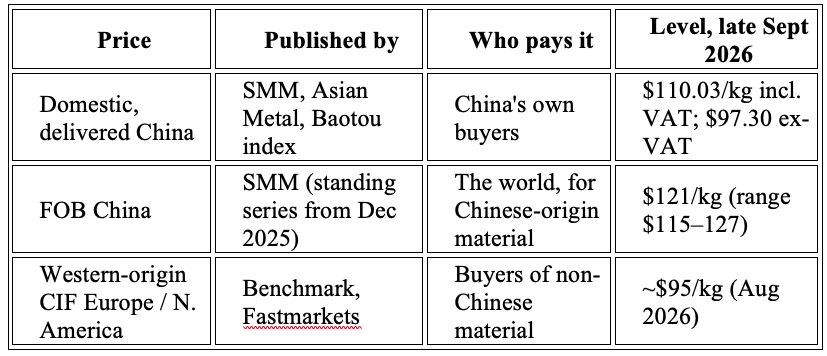
The floor is pinned to the first row: the leg the West does not pay. China can manage that leg through quota and supply, while the price Western buyers face for Chinese-origin material moves on the second, set by licensing. And the escape clause, written to wait for an ex-China index, now has to choose between a Chinese export price and a Western-origin price depressed by its own oversupply. The deal's economics hinge on a definition no one had to settle at signing. Indexed to FOB China at $121, DoD would pay nothing, and MP would owe DoD upside once 10X reaches its milestone. Indexed to Western-origin material at around $95, DoD would pay around $15/kg.
There is a further inconsistency. The agreement states $110 with no reference to VAT and applies it to two bases. On third-party sales, measured against MP's realised price outside China, it is a true $110. On stockpiled and affiliate sales, measured against a domestic Chinese price that conventionally includes 13% VAT, it is effectively $97.35 ex-VAT. One number floor two legs about 13% apart.
At signing, it barely mattered. On 9 July 2025, SMM's domestic PrNd oxide price was $55.83/kg ex-VAT, $63.09 with VAT, and the floor sat at roughly double it. It was an incentive price, most likely sized to MP's costs and to the return its lenders and shareholders needed to back a ten-year build-out, not to the market. MP had put its own NdPr production cost at around $60/kg in early 2025, with a target in the low $40s (source), and the package's separate guarantee of $140 million a year in minimum EBITDA points the same way. The floor was Western; its gauge was Chinese.
By 30 September 2026, the gap had closed. SMM's domestic price including VAT stood at $110.03, on the floor to within three cents. And the affiliate leg, the NdPr MP must allocate to its own magnet production first, is the one that grows as 10X ramps. The floor weakens by exactly China's VAT rate, as the programme succeeds.
VI. The VAT Quandary
China's VAT design gives its finished goods an advantage equal to the unrefunded VAT embedded in everyone else's.
A Chinese magnet maker buys oxide at the domestic price, VAT included and recovers the full 13% when it exports the magnet—the tax nets to zero. A magnet maker in Europe, Japan or the United States buying the same oxide pays a price that carries China's 13% with no means of recovering it, because no rebate attaches to oxide leaving China. Every exported tonne of Chinese oxide carries China's tax into the rest of the world's supply chain. Every Chinese finished magnet arrives without it.
The advantage is sized by content. It equals 13% of the Chinese-sourced oxide and metal value inside a competitor's product, and it bites hardest where rare earths dominate the cost: the magnet itself, and within magnets, the grades heavy in dysprosium and terbium. Our cost-stack work on SMM prices in August 2026 found that for an N50EH magnet, the FOB cost of the raw materials alone exceeded the ex-VAT price of the finished Chinese magnet. A Western maker paying export prices could not recover its inputs before a single conversion cost.
The gap is visible at the oxide itself. On 30 September 2026, PrNd oxide FOB China stood at $121/kg against a domestic price of $97.30 ex-VAT, a difference of $23.70. Of that, $12.73 is China's VAT, and $10.97 is the export premium. More than half of what a foreign buyer pays above China's own buyers is tax.
The two parts are different in kind. The VAT component is designed, fixed by China's own rate, and fully attributable to policy. The export premium is partly licensing and partly the thin liquidity of the export market: market structure that an honest ex-China price would expose. Further down the chain, the two compound, which is why the gap reaches 22–28% of the finished price on the heaviest magnet grades.
The distinction matters because the answer differs for each. The premium narrows as Western supply and Western price discovery grow. The VAT component does not narrow at all. It is there by design, on every tonne, for as long as Beijing chooses.
VII. The handicap
This disadvantage does not stay the same size as it starts. China's unrefunded VAT enters a Western supply chain as a cost, and from there everyone else's systems make it larger.
Every stage downstream prices are cost-plus: oxide to metal, metal to alloy, alloy to magnet, magnet to motor, motor to product. Each applies its margin to a cost base that already contains China's tax. Export the product and the destination principle takes over: the exporting country zero-rates its own VAT, but it can only remove what it levied. China's tax travels on. The next country then charges import duty and, where the buyer cannot recover it, VAT, both as a percentage of a value that already includes China's tax and the margins built on it. Nobody abroad must do anything for this structural handicap to widen. Their own tax systems, operating exactly as designed, mark it up and tax it again.
Most of the market never feels this. Around 90% of goods containing motors and magnets use Chinese motors and magnets, which leave China with their VAT refunded and arrive clean. The handicap falls on the minority that is not: products made with magnets processed outside China from Chinese material. It is invisible across most of the market, and decisive at its margin.
That margin is exactly where Western policy is now pushing buyers. Sourcing mandates, government programmes, and the US defence procurement ban that takes effect in January 2027 all route demand away from Chinese-processed supply. The handicap is therefore the price of opting out of the machine, and it rises with every mandate that requires opting out. Defence shows it most clearly. Armed forces buying in their own country cannot recover VAT; they are end consumers. The UK Ministry of Defence paid £12.8 billion in VAT it did not recover between 2019/20 and 2022/23 and confirms that those payments count towards its NATO spending. The national VAT is circular for the Treasury. China's embedded tax, and the margins stacked on it, are not. Even Europe's own fix, the VAT exemption in its €150 billion SAFE defence instrument, removes the European layer and leaves China's in place.
The effect is not mainly on what consumers pay. It is on the West's ability to compete with imported goods. A Chinese motor sold in Europe is not cheaper only because it was made more cheaply. It is cheaper partly because the European motor is carrying China's tax.
VIII. The machine's limits
None of this makes China invincible. The machine is managed, and managed things can be managed badly.
Quotas mis-calibrate. In 2022, MIIT set them against a post-COVID demand recovery that did not arrive as expected, and the 2024 price trough followed. A planning instrument is only as good as its forecast.
Capital has a bill. Subsidised capacity is not free; local government balance sheets pay for it, savers pay through suppressed returns, and an export surplus invites retaliation. The machine can run at a loss for a long time, but not forever.
And copper shows what happens when China owns the processing but not the mine. In 2026, the concentrate shortage collapsed smelter margins: the annual treatment and refining benchmark settled at zero, spot terms went deeply negative, and Chinese cathode traded $1,500–1,900 a tonne above the LME. Margin migrated upstream to the miners. Where China controls both ends of a chain, as in rare earths, it sets the price. Where it controls only the middle, China sets the price.
The lesson for the West is not that the machine will fail of its own accord. It is that its strength depends on holding every layer at once, and a counter that takes away even one changes its economics.
IX. Competing at source
If the West wants to compete, it must do two things: build its own supply chain, and neutralise, layer by layer, the advantages China built into its own—no more, no less.
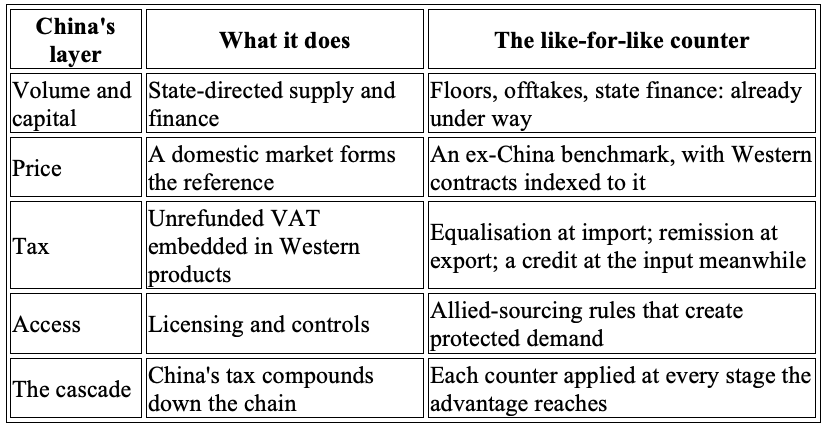
The price layer needs the West's own Brent: a benchmark formed by non-Chinese buyers and sellers, to which floors and offtakes can be indexed.
Until it exists, every Western instrument will be measured on a Chinese gauge.
Equalisation, not protection.
The tax layer is where the West has done nothing. China refunds the 13% when a finished magnet leaves and withholds it when oxide leaves. Every Western magnet made from Chinese oxide carries China's tax; every Chinese magnet arrives without it. The difference has nothing to do with skill, scale or efficiency. It is a policy choice, made in Beijing and paid in the West.
This paper proposes a levy on imported Chinese goods equal to the VAT China refunded on the magnet content inside them. Not a tariff on the car, the motor or the turbine, but on the refund embedded within it. China sets it based on its own tax rate and the product's rare-earth content, and that's it. It does not shield Western industry from Chinese competition. It removes one advantage China designed, and leaves the rest of the contest to cost, scale and quality, which is where the West says it wants to compete.
At export, the same logic runs in reverse. Western goods should be able to leave carrying no more of China's tax than a Chinese good does. The trade rules allow China to remit its own VAT on exports, because remission up to the tax that accrued is not a subsidy. They treat any other country's remission of China's tax as a prohibited export subsidy, because that country never levied it. A principle that protects one side's remission and forbids the other's is not neutral. The destination principle says goods should leave free of origin taxes; China's design keeps that promise for its own magnets and breaks it for everyone else's. Until the rules recognise that, the lawful bridge is an input credit, paid to Western processors for the Chinese tax embedded in what they buy, regardless of the finished goods' destination.
None of this will be adopted quickly, and it is likely to be dismissed when first proposed. It will be called protectionist. It is not. A protectionist tariff is set by what domestic industry wants and stays whatever the other side does. China sets this levy through its own tax design: 13% of the magnet content, because that is what Beijing refunds. If China restores the rebate on oxide or withdraws it on magnets, the levy falls to zero. It is reactive, not protective; it answers a measure rather than shielding an industry. It will be called incompatible with trade rules, though it rests on the destination principle those rules were built on. It will be called costly to consumers, which is true if the West has no supply of its own, and it must move in step with that supply rather than ahead of it.
That sequencing is the hardest part, and it is the same problem, my Brown Paper, "Everything but A General" described. Equalisation before supply exists inflates costs with nothing to buy instead. Supply before equalisation leaves new capacity stranded against a designed handicap. The price already shows it: in August 2026, Western-origin NdPr traded around $95/kg in Europe and North America, below the $110 floor and below China's own domestic price, because too little Western downstream exists to buy it. The West has built some supply without the market to absorb it. Competing at source means moving supply, price discovery and equalisation together, under someone with the authority to move them together. The case here is not for a particular mechanism. The advantage exists, can be measured, and operates as a deliberately maintained structural advantage.
X. Coda: November
On 10 November 2026, the suspension of China's October 2025 export controls lapses unless Beijing chooses to extend it. Reactivation is the default; it requires no decision. [Check: second suspension clock, 10 or 27 November]
It is a useful reminder of what kind of advantage the West faces. Export controls and rebate rates are both levers moved by notice. Neither requires legislation, negotiation or a court. The machine can widen the gap at will and narrow it when narrowing suits. A floor set in 2025 cannot see either move coming, because it is measured against the price the machine produces.
The West has the money. "Borrowed Urgency" argued that it still lacks the authority. This paper argues that even with both, it cannot compete on price until it answers what China built at source: the price it forms, the tax it designed, and the structure that holds them together. Rare earths are the clearest case, not the only one; the same three questions apply to graphite, gallium, tungsten and the rest of the strategic list. Floors keep Western producers alive. Winning takes more: a price of the West's own, demand downstream, and an answer to the advantage China designed. The aim is not to cancel China's strengths, but to neutralise the one it built into everyone else's costs and let the rest of the contest be decided on merit.
Author’s note
This paper is a personal analysis intended to stimulate discussion. It does not constitute legal, investment or trade-policy advice. Interpretations of trade rules, tax treatment and policy mechanisms are the author’s own. Publicly available sources have been used throughout, and any errors or omissions remain the author’s responsibility.
Sources
Rare Earth Exchanges: cost curve for US rare earth production
China's public policies toward rare earths, 1975–2018 (Mineral Economics)
BOFIT: China retains dominance of critical raw material production (IEA data)
Critical minerals and rare earths by country, 2026 (IEA data)
European Parliament Think Tank: tax challenges facing the European defence union
SMM rare earth oxide series SMM-RE-OX-001, -101, -103 and -104, subscriber data, 9 July 2025 to 30 September 2026