


Paid by the West
The West has spent two years securing supply. It has not yet asked whether that supply can compete. Rare earths, the case this paper works through, show why it must. China's rare earth price is not a market outcome the West can put a floor under; it is the output of an integrated industrial machine that controls volume, price formation, tax, access and capital at the same time. A floor addresses one of those levers, and the machine measures it with its own gauge. Supply without competitiveness only creates a market the West cannot win.
4 Oct 2026 · @Ian Brown
Price floors, China's tax design, and the competitiveness the West has not addressed
I. After the money
A previous Brown Paper, "Borrowed Urgency" ended on a finding that would have been unthinkable two years ago: capital is no longer the constraint. JPMorgan's Security and Resiliency Initiative, EXIM's Project Vault, DoD's package for MP Materials and a long list of government programmes have put willing money on both sides of the market. What remains short is not finance.
The instrument of choice for that money has become the price floor. The model is the agreement DoD signed with MP Materials on 9 July 2025: a ten-year guarantee that MP will receive at least $110 per kilogram for its NdPr, with DoD paying the difference when the market falls short and taking 30% of the upside once the 10X magnet plant reaches full production. Offtakes, stockpile programmes and fixed-price arrangements across the West now borrow the same logic.
A floor answers one question: will a Western producer stay solvent if prices fall? It is a fair question, and the MP floor answers it. But it is not the question that decides whether the West can compete. That question is narrower and harder. When a Western-made magnet, motor, or product meets its Chinese equivalent in a Western market, why is the Chinese one cheaper, and how much of that difference was designed in?
This paper argues that a significant part of it was, and that this part can be identified and measured. China has built an industrial machine whose output is a price, and whose design places costs on everyone outside it. A floor protects a producer from that price. It does nothing about the machine.
To be clear about the scope: this paper does not argue that the West should cancel China's advantages of scale, efficiency or industrial capability. It identifies a narrower advantage, created by tax design, controlled access and domestic price formation. It asks whether Western policy should neutralise it, so that what remains is a contest of cost, scale, quality and execution.
II. The machine
China has no rare earth policy. It has a rare earth machine: a set of levers, each managed by the state, that reinforce one another. Seen one at a time, each looks like ordinary industrial policy. Seen together, they set the terms on which everyone else competes.
Volume. Mining and smelting quotas are calibrated to expected demand over a defined timeline. They are not arbitrary caps; they are a planning instrument, and the supply that reaches the market is the supply the state has decided it needs.
Price. The reference price forms inside China, set by Chinese buyers, within a supply envelope the quota has already defined. Section IV returns to this, because it is where the machine's output becomes visible.
Tax. Finished magnets leave China with their 13% VAT refunded. Oxide and metal leave with none refunded. The difference is a policy choice, and Section VI shows what it is worth.
Access. Since April 2025, seven medium and heavy rare earths have required export licences, with roughly half of applications approved. The October 2025 controls, suspended until 10 November 2026, would extend Chinese jurisdiction to products made anywhere containing as little as 0.1% Chinese-origin content.
Capital. State-directed finance underwrites capacity that would not survive private scrutiny. The bill is real, and it is paid by local government financing vehicles, by household savers through financial repression, and by foreign competitors absorbing the output.
Enforcement. MOFCOM has run its largest recruitment drive in nearly a decade, introduced a public reporting mechanism for strategic-mineral violations from 1 July 2026, added MP Materials and USA Rare Earth to its export control list, and arrested two Japanese nationals over alleged rare earth smuggling.
No single lever explains China's position. A quota without a price mechanism leaks; a price mechanism without licensing can be arbitraged; licensing without a tax design pushes processing offshore. Together they form a system in which the price is an output, not an input.
Not only rare earths
This paper uses rare earths because the machine is most complete there. They are one of many. The EU's Critical Raw Materials Act designates 34 critical raw materials, and within them 17 strategic raw materials whose demand is expected to outpace supply: aluminium and bauxite, bismuth, boron, cobalt, copper, gallium, germanium, lithium, magnesium, manganese, natural graphite, nickel, the platinum group metals, magnet rare earths, silicon metal, titanium and tungsten. [Check: confirm list against Annex I] China is the largest supplier to the EU of most of them, and the IEA's 2026 outlook finds it the leading refiner of 19 of the 20 strategic minerals it tracks, with an average share of around 70% (source).
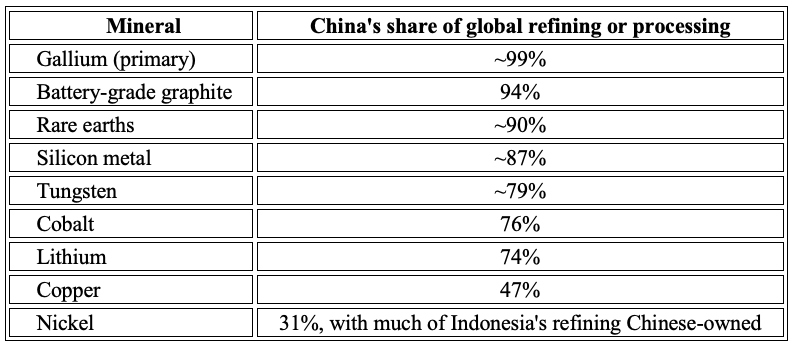
IEA figures for 2024, via BOFIT; gallium, silicon metal and tungsten from secondary compilations, to be confirmed.
The pattern is the same throughout. China mines only 2–8% of the world's copper, cobalt and nickel ore, yet refines between a third and three-quarters of each. Its control lies in processing, where the levers above operate. The IEA found that new projects outside China cost, on average, about 50% more to build, are slower to permit, and often cannot find buyers willing to sign long-term contracts (source). Since 2023, China has placed export controls on graphite, gallium, germanium, tungsten, bismuth and rare earths.
Rare earths are the example here because they carry the most asymmetric leverage of all. China refines around 90% of them, close to 99% of the heavy rare earths, and makes around 90% of the world's magnets. The material is worth little compared with what it enables: a magnet without neodymium is not a weaker magnet but a bar of iron, and no substitute exists in the motors that drive electric vehicles, wind turbines, robotics and defence systems. A small market controls a vast one.
That answers the obvious objection: that rare earths are too small to matter beside a Chinese manufacturing base that produced around 27% of the world's manufacturing value added in 2025 on World Bank data (source), around 30% on China's own figures (source), and which UNIDO projects could reach 45% by 2030 (source). Measured by value, rare earths are small. Measured by what stops without them, they sit inside the sectors where China's manufacturing advantage is growing fastest. The leverage lies in that gap, and it is why every lever of the machine is visible here at once.
III. How the machine was built
The tax lever did not start as a deliberate barrier. In the 1990s, China refunded export taxes on rare earth ores, metals and oxides; that refund was the policy that built the industry. From 2004 it was cut back, and in 2005 it was cancelled for all rare earth metals and oxides. It has never been restored.
What followed was blunter. A 10% export duty arrived in 2007, rising in 2008 to 15% on light rare earths and 25% on some heavy and value-added products, alongside export quotas that roughly halved between 2005 and 2011. In 2012, the United States, Japan and the European Union brought a joint case at the WTO. The panel ruled against China in March 2014, rejecting its environmental justification and reading the restrictions as an effort to advantage its own high-technology industry. The Appellate Body upheld the ruling in August. Quotas were scrapped at the end of 2014; the duties went in May 2015.
The West won the case. It did not win the outcome. The WTO removed the instruments it could see and left the one its own rules protect. Why it could not reach that one is set out at the end of this section.
The machine was rebuilt in the same window. The Baotou Rare Earth Products Exchange began operating on 28 March 2014, the same month as the WTO panel ruling, and the industry consolidated into two state-owned groups. As visible controls eased, China reorganised price formation and industry structure.
The refinement continues. From 2024 to 2026, Beijing has cut export rebates on solar panels and batteries to cool overcapacity. It has left the magnet rebate untouched. Whatever the tax design's origins, it is now plainly being managed as a lever, and it can be moved by notice.
The legal blind spot
When the West took China to the WTO, it targeted export quotas and export duties, and it won. China removed both. The outcome changed little, because Beijing's advantage did not depend on them. It rested on a mechanism already in its tax code and protected by the same rules: a differential VAT rebate schedule. That needs no developing-country waiver and no hidden loophole. It rests on where trade law draws the line between indirect taxes and prohibited subsidies.
Under the destination principle, goods should bear the tax of the country where they are consumed, not where they are made. The Subsidies and Countervailing Measures Agreement gives effect to it: under footnote 1 to Article 1 and item (g) of Annex I, exempting or remitting indirect taxes on an exported product, up to the amount that accrued, is not a subsidy. Every VAT system, including the EU's, relies on this to zero-rate exports so they are not taxed twice.
So China breaks no rule by refunding the 13% on finished magnets. That remission is legally indistinguishable from how Western countries export manufactured goods. The asymmetry lies in what China chooses not to do upstream. Nothing in trade law requires a government to rebate uniformly at every stage of its supply chain. China can levy VAT on oxide, decline to refund it when oxide crosses the border, and refund it only when a finished magnet leaves. A subsidy arises only where a remission exceeds the tax actually borne, and a withheld refund can never exceed anything. Nor is it an export duty of the kind struck down in 2014, because the same VAT falls on oxide sold at home. [Check: legal view on the export-duty point] The effect is to make raw material export the least attractive route, and domestic conversion the most.
That places the practice beyond the reach of trade litigation. A tiered VAT system is lawful, and the rules do not police whether an exporter absorbs or passes on upstream tax. The West cannot sue its way out of this arrangement. Unless the rules come to recognise that withholding upstream VAT on strategic inputs works as an export restriction, the answer has to be found in policy rather than dispute settlement, which is where Section IX turns.
IV. Whose price?
Every dominant producer sets its price by what its buyers will bear. The question is which buyers.
NNPC sets its official selling prices as a differential to Dated Brent. The anchor is a benchmark formed in an open international pool that neither NNPC nor its offtakers control; NNPC's discretion is the spread. Saudi Aramco sets its LPG Contract Price outright, but against what an international buyer pool will bear, and a swaps market around the CP lets those buyers hedge and push back. China sets its rare earth price against what Chinese buyers will bear. The rest of the world takes it.
Each rung down removes something. First the external anchor goes; then the foreign buyer's voice. China sits on the bottom rung.
That is not to say China's price is false. The Baotou exchange broke what was once close to a single-producer price, when Northern Rare Earth's monthly listing price effectively was the market. Price discovery is now spread across a membership of around a thousand vetted, quota-holding Chinese trading enterprises, and the price they form is real. In January 2026, the exchange launched an official rare earth price index, built from its own trades and owned, through the exchange's thirteen shareholders, by Northern Rare Earth, China Rare Earth Group, the national reserves centre and Xinhua Index, among others.
Northern still sets the level, not by announcing it but by controlling much of the supply. The exchange discovers the price; the quota and Northern decide the supply it is discovered on.
So the honest description is this. China's reference price is a genuine market price, formed by buyers who recover the full rebate on everything they export, on supply set by quota, under licensed access. It is a real price for a different market, and the rest of the world pays into that market without being part of it.
V. The floor and its gauge
The MP floor is measured against China's domestic price. For stockpiled NdPr and NdPr sold to MP's own magnet plants, the agreement references the mid-market price of NdPr oxide EXW China published by Asian Metal, a Chinese price reporter, converted from yuan to dollars at the Wall Street Journal's daily rate. The fallbacks are MySteel and BaiInfo, also Chinese. For sales to third parties, the reference is MP's own realised price. China itself is excluded as a buyer.
In July 2025, that was the only standing option. Chinese-origin oxide sold abroad was priced off the domestic SMM price, VAT included, plus a privately negotiated premium, reported at up to 35% but nowhere published. There was no continuous external price to reference, and the drafters knew it: the agreement lets DoD substitute "an internationally recognised alternative price index… ex-China" if one is ever developed.
Within six months, China had published one. SMM began a standing FOB China series for PrNd oxide in December 2025, and Baotou's official index followed in January. There are now two Chinese benchmarks, plus a price for Western-origin material that no major contract references.
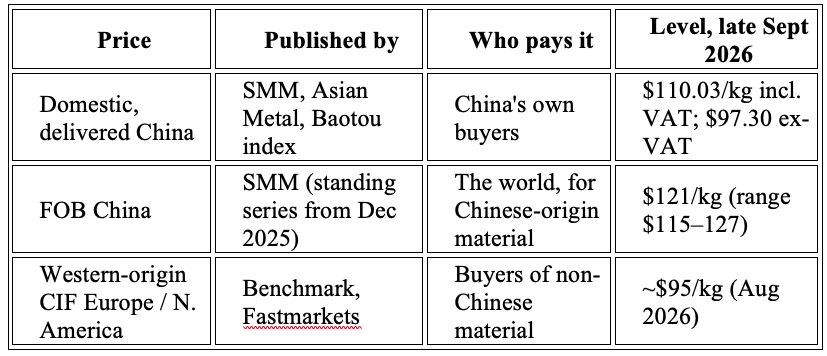
The floor is pinned to the first row: the leg the West does not pay. China can manage that leg through quota and supply, while the price Western buyers face for Chinese-origin material moves on the second, set by licensing. And the escape clause, written to wait for an ex-China index, now has to choose between a Chinese export price and a Western-origin price depressed by its own oversupply. The deal's economics hinge on a definition no one had to settle at signing. Indexed to FOB China at $121, DoD would pay nothing, and MP would owe DoD upside once 10X reaches its milestone. Indexed to Western-origin material at around $95, DoD would pay around $15/kg.
There is a further inconsistency. The agreement states $110 with no reference to VAT and applies it to two bases. On third-party sales, measured against MP's realised price outside China, it is a true $110. On stockpiled and affiliate sales, measured against a domestic Chinese price that conventionally includes 13% VAT, it is effectively $97.35 ex-VAT. One number floor two legs about 13% apart.
At signing, it barely mattered. On 9 July 2025, SMM's domestic PrNd oxide price was $55.83/kg ex-VAT, $63.09 with VAT, and the floor sat at roughly double it. It was an incentive price, most likely sized to MP's costs and to the return its lenders and shareholders needed to back a ten-year build-out, not to the market. MP had put its own NdPr production cost at around $60/kg in early 2025, with a target in the low $40s (source), and the package's separate guarantee of $140 million a year in minimum EBITDA points the same way. The floor was Western; its gauge was Chinese.
By 30 September 2026, the gap had closed. SMM's domestic price including VAT stood at $110.03, on the floor to within three cents. And the affiliate leg, the NdPr MP must allocate to its own magnet production first, is the one that grows as 10X ramps. The floor weakens by exactly China's VAT rate, as the programme succeeds.
VI. The VAT Quandary
China's VAT design gives its finished goods an advantage equal to the unrefunded VAT embedded in everyone else's.
A Chinese magnet maker buys oxide at the domestic price, VAT included and recovers the full 13% when it exports the magnet—the tax nets to zero. A magnet maker in Europe, Japan or the United States buying the same oxide pays a price that carries China's 13% with no means of recovering it, because no rebate attaches to oxide leaving China. Every exported tonne of Chinese oxide carries China's tax into the rest of the world's supply chain. Every Chinese finished magnet arrives without it.
The advantage is sized by content. It equals 13% of the Chinese-sourced oxide and metal value inside a competitor's product, and it bites hardest where rare earths dominate the cost: the magnet itself, and within magnets, the grades heavy in dysprosium and terbium. Our cost-stack work on SMM prices in August 2026 found that for an N50EH magnet, the FOB cost of the raw materials alone exceeded the ex-VAT price of the finished Chinese magnet. A Western maker paying export prices could not recover its inputs before a single conversion cost.
The gap is visible at the oxide itself. On 30 September 2026, PrNd oxide FOB China stood at $121/kg against a domestic price of $97.30 ex-VAT, a difference of $23.70. Of that, $12.73 is China's VAT, and $10.97 is the export premium. More than half of what a foreign buyer pays above China's own buyers is tax.
The two parts are different in kind. The VAT component is designed, fixed by China's own rate, and fully attributable to policy. The export premium is partly licensing and partly the thin liquidity of the export market: market structure that an honest ex-China price would expose. Further down the chain, the two compound, which is why the gap reaches 22–28% of the finished price on the heaviest magnet grades.
The distinction matters because the answer differs for each. The premium narrows as Western supply and Western price discovery grow. The VAT component does not narrow at all. It is there by design, on every tonne, for as long as Beijing chooses.
VII. The handicap
This disadvantage does not stay the same size as it starts. China's unrefunded VAT enters a Western supply chain as a cost, and from there everyone else's systems make it larger.
Every stage downstream prices are cost-plus: oxide to metal, metal to alloy, alloy to magnet, magnet to motor, motor to product. Each applies its margin to a cost base that already contains China's tax. Export the product and the destination principle takes over: the exporting country zero-rates its own VAT, but it can only remove what it levied. China's tax travels on. The next country then charges import duty and, where the buyer cannot recover it, VAT, both as a percentage of a value that already includes China's tax and the margins built on it. Nobody abroad must do anything for this structural handicap to widen. Their own tax systems, operating exactly as designed, mark it up and tax it again.
Most of the market never feels this. Around 90% of goods containing motors and magnets use Chinese motors and magnets, which leave China with their VAT refunded and arrive clean. The handicap falls on the minority that is not: products made with magnets processed outside China from Chinese material. It is invisible across most of the market, and decisive at its margin.
That margin is exactly where Western policy is now pushing buyers. Sourcing mandates, government programmes, and the US defence procurement ban that takes effect in January 2027 all route demand away from Chinese-processed supply. The handicap is therefore the price of opting out of the machine, and it rises with every mandate that requires opting out. Defence shows it most clearly. Armed forces buying in their own country cannot recover VAT; they are end consumers. The UK Ministry of Defence paid £12.8 billion in VAT it did not recover between 2019/20 and 2022/23 and confirms that those payments count towards its NATO spending. The national VAT is circular for the Treasury. China's embedded tax, and the margins stacked on it, are not. Even Europe's own fix, the VAT exemption in its €150 billion SAFE defence instrument, removes the European layer and leaves China's in place.
The effect is not mainly on what consumers pay. It is on the West's ability to compete with imported goods. A Chinese motor sold in Europe is not cheaper only because it was made more cheaply. It is cheaper partly because the European motor is carrying China's tax.
VIII. The machine's limits
None of this makes China invincible. The machine is managed, and managed things can be managed badly.
Quotas mis-calibrate. In 2022, MIIT set them against a post-COVID demand recovery that did not arrive as expected, and the 2024 price trough followed. A planning instrument is only as good as its forecast.
Capital has a bill. Subsidised capacity is not free; local government balance sheets pay for it, savers pay through suppressed returns, and an export surplus invites retaliation. The machine can run at a loss for a long time, but not forever.
And copper shows what happens when China owns the processing but not the mine. In 2026, the concentrate shortage collapsed smelter margins: the annual treatment and refining benchmark settled at zero, spot terms went deeply negative, and Chinese cathode traded $1,500–1,900 a tonne above the LME. Margin migrated upstream to the miners. Where China controls both ends of a chain, as in rare earths, it sets the price. Where it controls only the middle, China sets the price.
The lesson for the West is not that the machine will fail of its own accord. It is that its strength depends on holding every layer at once, and a counter that takes away even one changes its economics.
IX. Competing at source
If the West wants to compete, it must do two things: build its own supply chain, and neutralise, layer by layer, the advantages China built into its own—no more, no less.
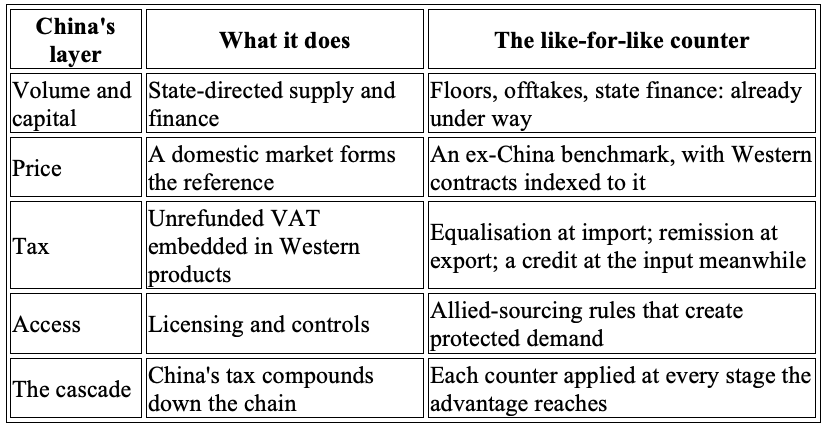
The price layer needs the West's own Brent: a benchmark formed by non-Chinese buyers and sellers, to which floors and offtakes can be indexed.
Until it exists, every Western instrument will be measured on a Chinese gauge.
Equalisation, not protection.
The tax layer is where the West has done nothing. China refunds the 13% when a finished magnet leaves and withholds it when oxide leaves. Every Western magnet made from Chinese oxide carries China's tax; every Chinese magnet arrives without it. The difference has nothing to do with skill, scale or efficiency. It is a policy choice, made in Beijing and paid in the West.
This paper proposes a levy on imported Chinese goods equal to the VAT China refunded on the magnet content inside them. Not a tariff on the car, the motor or the turbine, but on the refund embedded within it. China sets it based on its own tax rate and the product's rare-earth content, and that's it. It does not shield Western industry from Chinese competition. It removes one advantage China designed, and leaves the rest of the contest to cost, scale and quality, which is where the West says it wants to compete.
At export, the same logic runs in reverse. Western goods should be able to leave carrying no more of China's tax than a Chinese good does. The trade rules allow China to remit its own VAT on exports, because remission up to the tax that accrued is not a subsidy. They treat any other country's remission of China's tax as a prohibited export subsidy, because that country never levied it. A principle that protects one side's remission and forbids the other's is not neutral. The destination principle says goods should leave free of origin taxes; China's design keeps that promise for its own magnets and breaks it for everyone else's. Until the rules recognise that, the lawful bridge is an input credit, paid to Western processors for the Chinese tax embedded in what they buy, regardless of the finished goods' destination.
None of this will be adopted quickly, and it is likely to be dismissed when first proposed. It will be called protectionist. It is not. A protectionist tariff is set by what domestic industry wants and stays whatever the other side does. China sets this levy through its own tax design: 13% of the magnet content, because that is what Beijing refunds. If China restores the rebate on oxide or withdraws it on magnets, the levy falls to zero. It is reactive, not protective; it answers a measure rather than shielding an industry. It will be called incompatible with trade rules, though it rests on the destination principle those rules were built on. It will be called costly to consumers, which is true if the West has no supply of its own, and it must move in step with that supply rather than ahead of it.
That sequencing is the hardest part, and it is the same problem, my Brown Paper, "Everything but A General" described. Equalisation before supply exists inflates costs with nothing to buy instead. Supply before equalisation leaves new capacity stranded against a designed handicap. The price already shows it: in August 2026, Western-origin NdPr traded around $95/kg in Europe and North America, below the $110 floor and below China's own domestic price, because too little Western downstream exists to buy it. The West has built some supply without the market to absorb it. Competing at source means moving supply, price discovery and equalisation together, under someone with the authority to move them together. The case here is not for a particular mechanism. The advantage exists, can be measured, and operates as a deliberately maintained structural advantage.
X. Coda: November
On 10 November 2026, the suspension of China's October 2025 export controls lapses unless Beijing chooses to extend it. Reactivation is the default; it requires no decision. [Check: second suspension clock, 10 or 27 November]
It is a useful reminder of what kind of advantage the West faces. Export controls and rebate rates are both levers moved by notice. Neither requires legislation, negotiation or a court. The machine can widen the gap at will and narrow it when narrowing suits. A floor set in 2025 cannot see either move coming, because it is measured against the price the machine produces.
The West has the money. "Borrowed Urgency" argued that it still lacks the authority. This paper argues that even with both, it cannot compete on price until it answers what China built at source: the price it forms, the tax it designed, and the structure that holds them together. Rare earths are the clearest case, not the only one; the same three questions apply to graphite, gallium, tungsten and the rest of the strategic list. Floors keep Western producers alive. Winning takes more: a price of the West's own, demand downstream, and an answer to the advantage China designed. The aim is not to cancel China's strengths, but to neutralise the one it built into everyone else's costs and let the rest of the contest be decided on merit.
Author’s note
This paper is a personal analysis intended to stimulate discussion. It does not constitute legal, investment or trade-policy advice. Interpretations of trade rules, tax treatment and policy mechanisms are the author’s own. Publicly available sources have been used throughout, and any errors or omissions remain the author’s responsibility.
Sources
Rare Earth Exchanges: cost curve for US rare earth production
China's public policies toward rare earths, 1975–2018 (Mineral Economics)
BOFIT: China retains dominance of critical raw material production (IEA data)
Critical minerals and rare earths by country, 2026 (IEA data)
European Parliament Think Tank: tax challenges facing the European defence union
SMM rare earth oxide series SMM-RE-OX-001, -101, -103 and -104, subscriber data, 9 July 2025 to 30 September 2026
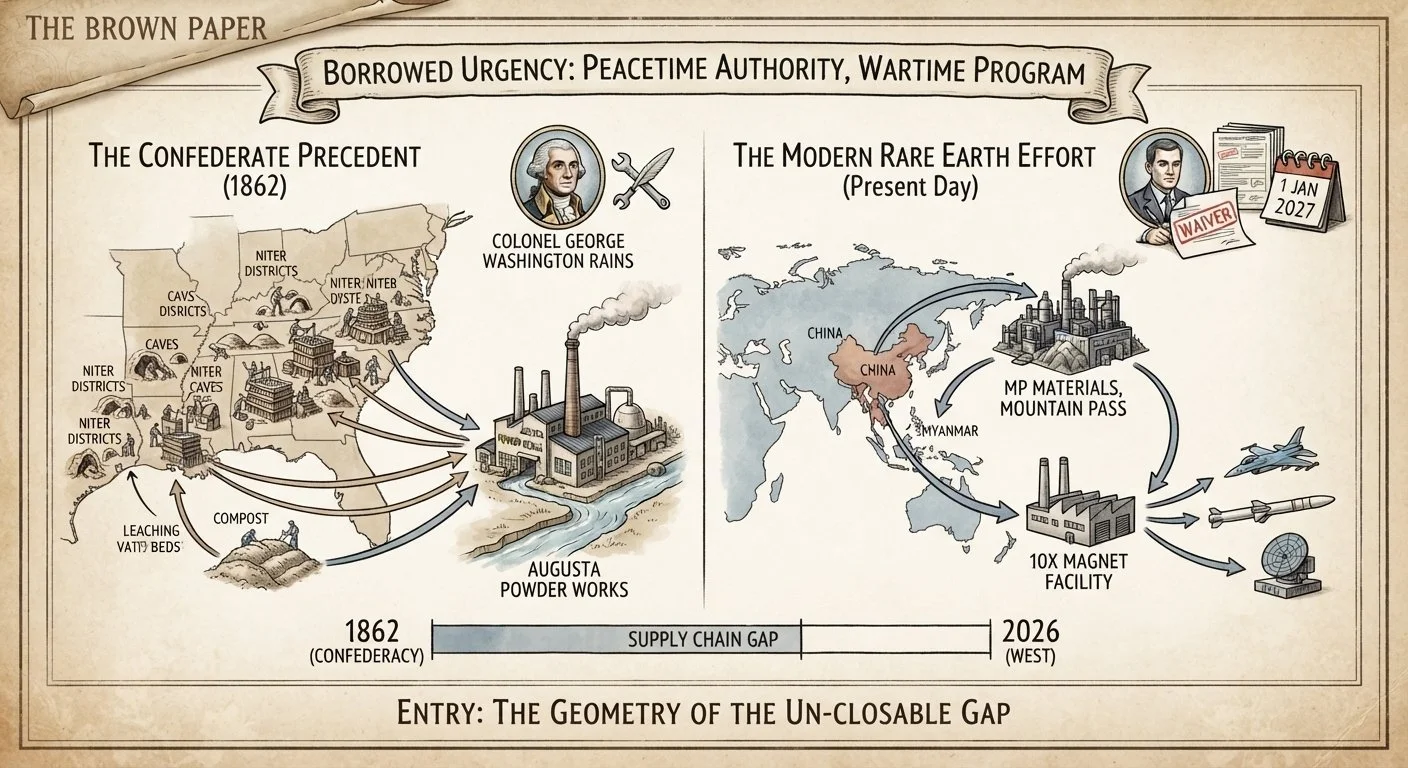
Borrowed Urgency: The West trying to run a wartime program on peacetime authority
NATO is rearming at Cold War pace; the rare earth supply chains behind that rearmament are not keeping up. Reading a 2019 account of how the Confederacy solved an almost identical shortage in gunpowder against the modern case, this essay asks what is actually missing — and finds it is not capital, but someone willing to be Jefferson Davis. The authority now being used to close the gap is borrowed rather than owned outright: available when invoked, but never quite equal to the wartime mandate it imitates. Until someone is given that authority outright, the West remains hostage to the granularity of its own entrenched risk-management processes.
I. Introduction
The West is re-arming, and at a pace with no obvious precedent since the Cold War it is often said to be repeating. NATO's 2025 Hague summit committed member states to spending five per cent of GDP on defence by 2035 — three and a half per cent on core requirements, a further one and a half on broader security and industrial resilience. That commitment has not been left to erode the way the alliance's earlier two per cent target did for a decade after it was set: in 2025 alone, for the first time in NATO's history, every member state met or exceeded that older floor, and European allies and Canada raised defence spending by twenty per cent in real terms in a single year. Germany amended its own constitution — the Basic Law's debt brake, a fiscal restraint the post-Cold War political class had treated as close to sacred — specifically to fund the increase. Global military spending, on IMF figures, is projected above $2.6 trillion for 2026: the fastest sustained rearmament since the Cold War itself.
That is a demand-side mobilisation, committed through the most binding instruments a modern democracy has available to it: treaty obligation and constitutional amendment. The hardware it funds — missiles, radar, drones, submarines, the vehicles and systems that consume neodymium-iron-boron magnets by the tonne — is exactly the demand this essay's supply-side argument concerns. The instrument actually securing the material inputs for that hardware is not a matching wartime footing but a borrowed one: the Defense Production Act of 1950, modelled on the War Powers Acts of 1941 and 1942, invoked for the current rare earth effort not because a war has been declared but because the statute written for one has never required it to be. The authority is real. It has simply never shed the condition of its own renewal — reauthorised by Congress more than fifty times, left dormant for two decades before its 1980s revival, and, in its present use, contingent on continuing appropriations in a way no wartime mobilisation examined in this essay ever had to survive. The gap between how the West is arming itself and how it is supplying itself is what this essay means by borrowed urgency, and it is worth tracing where that gap comes from before turning to the historical case that gives it its sharpest shape.
For decades before the American Civil War, Great Britain supplied high-quality, inexpensive gunpowder, which made domestic production unprofitable. British powder flowed freely into American ports, and there was no commercial reason to build a domestic industry capable of replacing it — until relations turned, at which point Britain stopped selling. That pattern repeated twice, in the Revolution and again in 1812, each time leaving American forces to scramble for a domestic supply that decades of cheap British imports had given nobody any reason to build.
A friend recently sent me a paper that traces what happened when this pattern played out a third time, on a larger scale, with much higher stakes: Derek Taylor's Creating Southern Thunder: The Evolution of Confederate Gunpowder Production during the American Civil War, published in The Welebaethan in 2019. Taylor's subject is narrow and specific — how a nation with almost no domestic powder-making industry, cut off from its principal supplier at the outbreak of war, built one of the most advanced gunpowder works of the nineteenth century within roughly a year. It is not a paper about critical minerals and does not claim to be.
China's dominance of rare earth processing did to Western investment what British powder mills did to American: not through concealment or sabotage, but simply by being good enough and cheap enough, for long enough, that building a costlier domestic alternative made no business sense until the supply was no longer guaranteed.
This piece is not an argument that the two situations are the same, or that history offers a template to be applied mechanically. It attempts to identify where the cross-references hold, where they break down, and what—if anything—can be usefully learned from a case where the underlying problem was resolved and a case where, yet, it has not.
II. Binary Criticality
That dependency was never a matter of degree. Both gunpowder and the modern magnet are composite materials, inert without their scarce ingredient regardless of how much of the finished product that ingredient physically comprises. Saltpetre made up roughly three-quarters of the Confederate charge by weight; neodymium makes up barely a quarter of a modern magnet's. That difference is beside the point. Gunpowder without saltpetre is not weakened gunpowder — it does not exist. A magnet without neodymium is not a weaker magnet — it is a bar of iron. In both cases, the whole supply chain stands or falls on the one input that cannot be substituted, sourced elsewhere, or done without, irrespective of what share of the bill of materials it occupies.
III. The Trent Affair and the Senkaku Precedent
The parallel sharpens further once you look at how Britain's leverage over that supply was used. In November 1861, a U.S. Navy warship stopped the British mail packet Trent and removed two Confederate envoys, James Mason and John Slidell, bound for Britain to seek support for the Southern war effort. Britain's response was immediate and specific: an embargo on gunpowder materials destined for the United States, backed by the threat of war. Washington released both men within weeks. Britain never recognised the Confederacy as a result, and the underlying dispute over the South's status went nowhere — the embargoes only achieved purpose was securing the release. It was pressure applied through a critical-material chokepoint, deployed to force a specific, narrow outcome, then withdrawn once that outcome was achieved.
A century and a half later, a similar sequence played out between China and Japan. In 2010, Japan detained a Chinese fishing boat captain near the Senkaku Islands. China responded by restricting rare earth exports to Japan—the same instrument, aimed at the same kind of target: not a demand for territorial concession, but leverage applied through a chokepoint to force the release of a detained national. Japan released the captain. Nothing about the underlying dispute moved. The lesson embedded in both episodes is the same: a critical-material dependency is a lever that can be pulled for reasons unrelated to the material itself, and the country holding the dependency does not need to win the argument to win the immediate confrontation.
IV. Davis's Veto — Diagnosing the Bottleneck
In January 1862, the Confederate Congress drafted a bill to subsidise private manufacturers willing to expand gunpowder and saltpetre production: a fifty per cent government advance against a twenty-five per cent investment by the manufacturer, contingent on a good faith promise to deliver. Jefferson Davis, the Confederacy's president, vetoed the first draft. His objection was not fiscal caution — it was a diagnosis. Saltpetre was already scarce, and subsidising more powder mills without first securing more of the raw material feeding them would create more manufacturing capacity competing over the same shortfall. The Confederacy, Davis judged, did not need more mills. It needed more saltpetre. Congress responded not by overriding him but by agreeing with the diagnosis: the Nitre and Mining Bureau was established on 11 April 1862, redirecting government effort toward acquisition specifically, ahead of any further investment in manufacturing.
What makes the veto worth dwelling on is not that Davis was right, though the subsequent record suggests he was — it is that he was faced with two plausible-sounding responses to the same shortage and chose correctly between them. More mills and more raw material both look, on the surface, like reasonable answers to “we don't have enough gunpowder.” Only one of them addressed where the constraint sat.
That is the question worth asking of the modern case, and it is answerable now rather than only in hindsight. Recognition of the rare earth dependency is not in doubt — it has been stated at every level from departmental briefings to a Presidential one. Nor is capital in doubt; multiple financing instruments, across multiple governments, have been committed to multiple projects. What is less settled is whether that capital is landing on the actual constraint. A tonne of mined ore and a tonne of separated, magnet-grade oxide are not the same kind of scarcity, any more than raw nitrous earth and refined saltpetre were the same kind of scarcity in 1862 — and financing the wrong one, however generously, produces the same result Davis was trying to avoid: more capacity built against a bottleneck that was never where the money was aimed.
The veto was not a rejection of private-sector engagement — it redirected where that engagement should be aimed. The mechanism Davis insisted on, once pointed at raw material acquisition rather than manufacturing capacity, worked: Isaac St. John, superintendent of the newly formed Nitre and Mining Bureau, organised the South into nitre districts, brought private producers under coordinated control, and by September 1864 had generated 1,735,531 pounds of domestically-produced saltpetre — insufficient against total demand, but real, measurable private engagement achieved through risk-sharing rather than replaced by government alone.
The U.S. International Development Finance Corporation states the identical theory of action as its own founding purpose: to mobilise private capital by derisking investment in markets the private sector otherwise avoids, explicitly including Africa, where much of the modern critical-minerals resource base sits. Years into that mandate, the result Davis achieved within two years of a standing start has not been matched. Africa's share of global exploration investment has fallen, not risen, over the past two decades. European commercial banks continue withdrawing from African mining rather than being drawn back in. And in the clearest available case, government and sovereign capital — a Qatari fund, a U.S. development finance agency, an export credit bank — are doing the work the mobilisation theory says private capital should be doing instead, not standing behind it.
Here the parallel, which has held closely up to this point, breaks — and the break is worth stating as plainly as the similarities, because it is doing real explanatory work of its own.
Davis's veto was not only a correct diagnosis. It was a risk judgment made at the level of the whole war effort, by someone whose mandate was the outcome itself rather than any single link in the chain leading to it. Josiah Gorgas, chief of the Confederate Ordnance Bureau, exercised the same kind of judgment in creating the Nitre Bureau and handing it to a man he personally trusted; George Rains, superintendent of the Augusta Powder Works, exercised it again at the level of engineering practice, overriding established method the moment his own on-site judgment said the risk lay elsewhere — steam instead of water, his own crystallising wheel instead of straight raking, reverting his finishing-process innovation the moment it underperformed. At every level of Taylor's account, someone with standing looked at where they personally believed the risk actually sat and acted on that belief directly. Nothing in the process validated their judgment before they were permitted to act on it. Their authority was the validation.
No equivalent role exists anywhere in the modern chain this essay has traced. Risk is not ignored — it is assessed exhaustively. But every assessment happens at the granular level, by parties each scoped to a narrow fragment of the whole. A credit committee assesses counterparty risk to a single loan; a compliance function assesses the risk of a single registry filing; a board assesses its own fiduciary exposure; counsel assesses litigation risk clause by clause. Each of these assessments, taken on its own terms, is careful and defensible. None of them is the question Davis was answering. Nobody in the structure is mandated to ask, let alone empowered to act on, whether the cumulative pace of all this careful, granular validation is itself the risk that matters most — whether the sum of locally sensible caution adds up to missing a fixed, external deadline entirely. That question currently has no owner. A system built entirely from node-level risk assessors, however diligent each node is individually, will reliably produce an outcome that is locally prudent and globally slow, because minimising risk at every point in a chain is not the same operation as minimising risk to the chain's actual purpose. Rains's Confederacy never had to reconcile those two things, because Gorgas's mandate collapsed them into one question, answered by one person, at every level examined here. The modern effort has re-fragmented that question into as many pieces as there are institutions in the chain—and, in doing so, has made the deadline itself an orphan: tracked by everyone, owned by no one.
V. Three Tiers: Gorgas, St. John, Rains
If Davis's problem was diagnosing which link in the chain was short, Gorgas, St. John, and Rains together answer a different question: once diagnosed correctly, what does it take to close the gap? Gorgas held the authority to redirect the whole war effort. St. John built the acquisition apparatus beneath him. Rains built the execution capacity beneath that. All three were necessary; none was sufficient alone. The modern case that maps onto this structure most cleanly is not the kind of fragmented, multi-counterparty offtake arrangement common elsewhere in current rare earth financing, but the U.S. Department of Defense's intervention in MP Materials — a single, vertically integrated program that, unlike much of what passes for strategy in this sector, was built by one buyer dealing with one company across the whole chain at once.
The mapping holds at each level. Gorgas's role — the authority to intervene directly, overriding the market's own allocation of capital — belongs to DoD itself, which in July 2025 took an equity stake in MP Materials and restructured the relationship from ordinary customer to guarantor of last resort. St. John's role — acquisition of the specific raw material in short supply, not simply more general capacity — belongs to the $150 million loan earmarked specifically for expanding heavy rare earth separation at Mountain Pass, targeting dysprosium, terbium, and samarium rather than more NdPr mining the country already had. And Rains's role — patient capital and technical execution insulated from ordinary market discipline — belongs to MP Materials itself: Mountain Pass, the existing Texas magnetics operation, and the new 10X facility, financed by a $1.0 billion commitment from JPMorgan Chase and Goldman Sachs and underwritten by a ten-year $110/kg NdPr price floor, a separate $140 million annual minimum-EBITDA guarantee, and a DoD commitment to purchase the whole of 10X's magnet output for a decade. Nothing in this file resembles Rains's mandate as closely as that structure does.
And unlike most of the capital catalogued elsewhere in this essay, this mechanism is demonstrably paying out rather than merely standing ready. MP Materials disclosed $42.3 million in Price Protection Agreement income in the first quarter of 2026 and a further $17.6 million in the second — real, quarter-specific transfers from the floor to the company, narrowing as market price recovered rather than newly triggered by a collapse. Whatever else can be said about the pace of this effort, the price floor is not a paper commitment. It is functioning exactly as designed.
There is a case, on this evidence, that the deal's creation was itself a Davis-shaped act in the narrower sense this essay has used that term: someone at DoD made a personal judgment that NdPr price risk was real enough to warrant absorbing it directly, by guarantee, rather than waiting for the market to validate the concern first. That is a genuine data point against the pattern described in Section IV — proof that the capacity for this kind of authority has not vanished entirely from the modern apparatus, even if it remains rare.
But the case for crediting MP Materials as a full modern Rains has two real limits, and both matter more than the one point in its favour.
The first is the same execution-tier gap found everywhere else in this file. The $150 million loan funds heavy rare earth separation capacity that does not yet exist — it is new construction, not an existing line being scaled. Read plainly, DoD's own structure concedes that the United States had no meaningful domestic capability in exactly the fraction of the chain Davis would have identified as the actual constraint. The light rare earth side of the picture — NdPr mining and separation — is real and operating. The heavy rare earth side, the harder and more strategically sensitive half, is still being built from near zero, on the same timeline as everything else this essay has found wanting.
The second is structural, and it is the sharper of the two. Taylor is explicit that St. John divided the South into fourteen separate nitre districts specifically because geographic diversification reduced the risk of production being interrupted by a single attack. The MP Materials program is the deliberate opposite: one mine, one company, one integrated facility complex carrying the entire weight of the strategy DoD has built around it. That concentration is not, in the usual sense, a choice at all. Mountain Pass is not simply the strongest of several producing options DoD might have backed — it is, at the time of writing, the only operating rare earth mine in North America. Other prospects exist. Bear Lodge in Wyoming, NdPr-enriched and further along than most, has spent years working through permitting and financing while still proving a novel extraction process at demonstration rather than commercial scale. Round Top in Texas holds one of the country's largest heavy rare earth resources by total tonnage — upward of a billion tonnes of rhyolite — but at a grade of only a few hundred parts per million, so the same scale that makes the deposit notable also means mining and processing a correspondingly enormous volume of rock for every kilogram of rare earth recovered; the operator is targeting commercial production only from 2028. Bokan Mountain in Alaska holds a genuine heavy rare earth deposit in a location remote enough to complicate any near-term development. Elk Creek in Nebraska remains an advanced exploration project, not a mine. Each carries its own specific barrier to economic exploitation — capital, chemistry, permitting, grade, or geography — and none is close enough to production to function as an alternative today. St. John distributed his effort across fourteen districts that were each already yielding saltpetre. The modern effort has, for now, nothing comparable to distribute across. The single point of failure this essay has identified is not a preference for concentration over dispersion — it is the absence, at present, of anywhere else to concentrate, at the centre of the one part of this file's evidence that most resembles Rains's mandate.
Va. Process Risk: The Old Method and the New
The pattern here is close to Rains's, with one real difference. Rains adapted an already proven process from Waltham Abbey, the Royal Gunpowder Mills near London, via Major Fraser Baddeley's pamphlet—an industrial method imported wholesale. His “new method” replaced a laborious six-day purification process with continuous raking machinery, cutting refinement to a single day while producing a purer crystal; Rains then improved on it further with his own crystallising wheel, pushing purity to what he claimed was beyond that of the most celebrated powder factories of the age.
ReElement Technologies' chromatographic platform has a similar structure at smaller scale: the company was formed as a subsidiary of American Resources Corporation specifically to commercialise column chromatography developed in Professor Linda Wang's Purdue laboratory, taking an exclusive license to the technology — still owned by Purdue, not ReElement — in January 2021. But where Baddeley's method was already proven at full industrial output before Rains adopted it, Wang's was proven only at laboratory scale. ReElement's own purity results, first achieved in 2022, and its stated commercial capacity represent the company's own scale-up work, not a transplant of something already running elsewhere at the volumes now being claimed.
Here the comparison tilts, briefly, in the modern case's favour. Rains was importing a method already validated at industrial scale; ReElement is proving its method at that scale for the first time, under its own risk, rather than importing something already working elsewhere at the volumes now being claimed. That is a harder position to succeed from. It is too early to credit this as a settled achievement — ReElement's figures remain company-reported, without the kind of independent corroboration Taylor can cite for Rains's saltpetre purity. Rains's own history is not uniformly a success story either: his combined dusting-glazing-drying innovation was abandoned after too much powder was rejected on re-inspection, and he reverted to the established method. But it is worth stating plainly, in a piece otherwise concerned with where the West is behind: this may be one place it is not.
VI. Scale and Patience: The Nitre Beds
Not every part of the Confederate response was manufacturing or acquisition in the ordinary sense. Alongside mining existing saltpetre caves, St. John's Bureau pursued a slower, more deliberate method: growing it. Nitre beds — compost mounds of rotted animal manure, urine, and vegetable matter, built to a standard fifteen-foot-long, eight-foot-wide, five-foot-high specification and watered weekly to keep the decomposition active — were a genuine attempt to manufacture a new domestic resource base rather than extract from what the land already held. It was not a shortcut. Joseph LeConte, the chemistry professor whose pamphlet supplied the Bureau's nitre-bed method, put the ripening period at roughly eighteen months; other accounts describe the beds as needing up to two years before they could be leached of usable saltpetre.
That is the clearest illustration in Taylor's account of a problem distinct from diagnosis or acquisition: timing. St. John's own assessment, recorded by September 1864, was direct about the consequence. Total domestic saltpetre production had reached 1,735,531 pounds — a real, substantial achievement for a standing start. Still, the compost piles' prolonged ripening period meant they remained largely unusable within the actual span of the war. The counterfactual is stated plainly in the same account had the war continued another year or two, the nitre plantations would have produced an estimated three to four million pounds, roughly double to triple what was actually achieved. The investment was not wrong. The diagnosis was not wrong. The organisation was not wrong. The clock ran out first.
That is the precise shape of risk this essay's modern case now faces, and it is worth stating without embellishment because the parallel needs none. The heavy rare earth separation capacity described in the previous section — the $150 million loan behind Mountain Pass's expansion — is new construction, not an existing line being scaled, and new industrial capacity of this kind does not commission on demand. Permitting, equipment procurement, commissioning, and qualification each carry their own minimum duration, largely independent of how much capital or political will stands behind them. Nothing about that timeline reflects poor diagnosis or insufficient resourcing. It reflects the same mechanism Taylor documents: a correctly identified, correctly resourced response to a real shortage, running against a calendar it does not control and cannot accelerate simply by wanting to.
The nitre beds did not fail. They did not finish in time to matter for the war they were grown to help win. Whether the heavy rare earth capacity now under construction across this file's evidence finishes in time to matter for the deadlines closing in during November and January is not yet known — but the Confederacy's own experience is a specific, dated warning against assuming that correct diagnosis and genuine investment are sufficient answers to a question that is, in the end, about arithmetic and a calendar neither side is fully able to move.
VII. Conclusion
This has been a comparison of process, not of outcome, and that distinction is worth restating plainly before drawing any conclusion from it. The Confederacy's story is finished; the rare earth story is not. Augusta never failed operationally—the Confederacy did not lose a single battle for want of powder—and the war was lost regardless, for reasons that had nothing to do with saltpetre. That fact forecloses one kind of argument this essay is not entitled to make: that resolving a recognised material dependency guarantees the larger strategic outcome. It does not, and the Confederate case proves it. What the case can offer instead is narrower and fully earned: a documented instance of triage, and a standard against which triage can be tested.
That triage had three parts, not one. Davis correctly diagnosed which link in the chain was short, redirecting effort from manufacturing capacity to raw material acquisition. St. John then distributed that acquisition across fourteen separate nitre districts specifically to deny a single point of failure. And the mechanism used to engage private producers—a government advance calibrated to reduce their capital risk, not replace their participation—worked, generating over 1.7 million pounds of domestically produced saltpetre by September 1864. Diagnosis, resilience, and mobilisation- all three- inside roughly two years, starting from a nation with almost no industrial base at all.
Measured against that standard, the modern effort passes unevenly, and the unevenness is the finding. On diagnosis, there are real signs of triage working: the DoD's intervention in MP Materials is aimed specifically at the constraint Davis would have recognised — a loan earmarked for heavy rare earth separation, not simply more mining capacity, backed by a price floor and an EBITDA guarantee built to keep capital in place regardless of what the market rewards. On distribution, the same case fails by design: one mine, one company, one facility complex carrying the weight the Confederacy spread deliberately across fourteen districts. And on mobilisation, the picture is not what it was even eighteen months ago. Capital is no longer the missing ingredient, on either side of the market. JPMorgan's Security and Resiliency Initiative direct capital into the supply side — up to $1.5 trillion over ten years, with a dedicated $10 billion Strategic Investment Group already funding companies like Perpetua Resources directly. EXIM's Project Vault addresses the demand side of the same equation — a $10 billion government loan matched by roughly $2 billion in private capital from OEMs and trading houses, structured around guaranteed offtake and fixed pricing rather than production financing. Add Vulcan Elements' $1.4 billion partnership and DoD's own package to MP Materials, and the picture is the same from every angle. Whatever is constraining this effort, it is not the absence of willing money on either side of the transaction.
What remains unresolved is time, and specifically the relationship between the capital now committed and the calendar it is meant to beat. The requirement itself is not new — the restriction traces to the 2018 NDAA, was implemented in regulation the following year, and was strengthened again in 2021. Only its final form is recent: a 2024 rule extending it to the full mine-to-magnet chain, with compliance required from 1 January 2027, and — in July 2026 — an executive order tightening the waiver process that had let the requirement go substantially unmet for years. Whether that order functions as a genuine Davis-style act or as one more layer of the same procedural apparatus this essay has already described is not yet settled. Waivers were not eliminated, only routed through a higher bar — a formal mitigation plan, or direct escalation to the National Security Council — which is either the closing of an escape hatch or the addition of one more validating step, depending on how it is used once the deadline arrives. It is also worth being precise about what the underlying law requires, since coverage often flattens the point: the statute excludes material from four named states — Russia, China, North Korea, and Iran — not non-US material generally. Supply from any allied jurisdiction qualifies. That is the structural opening every non-Chinese rare earth project discussed in this essay sits inside — not a requirement that the West build everything itself, but one that routes demand toward whichever allied suppliers can deliver, wherever they happen to be. China's own suspension of its October 2025 export controls lapses on 10 November 2026, with a second suspension clock lapsing seventeen days later—52 and 35 days, respectively, before the defence ban binds. Whether the current cycle of capital and political will actually close that capacity gap in time is not, in the relevant sense, an open question at all: on the government's own optimistic projections, domestic magnet output reaches barely a tenth of national demand by the end of 2026, and no industrial process compresses the remaining distance into the few months left before the deadline binds. What remains genuinely unresolved is not whether the gap closes — it will not — but what happens after the deadline arrives and finds it still open: whether the tightened waiver process holds under real pressure or becomes one more accommodation in a pattern with a decade of precedent behind it. This essay is being written before that second test, not the first. The first has already been decided by arithmetic. The second remains to be seen — and will be decided by whether anyone is finally willing to be Davis, rather than simply louder about the deadline Davis would have moved to meet.
Acknowledgement
This essay exists because of Paul Rainbow — a retired mining engineer, and a friend with whom I share a longstanding interest in the rare earth sector — who sent me Derek Taylor's Creating Southern Thunder: The Evolution of Confederate Gunpowder Production during the American Civil War, published in The Welebaethan in 2019, correctly judging that I would be fascinated by it. Every fact drawn from the Confederate nitre and gunpowder programme in this piece — Davis's veto, the respective roles of Gorgas, St. John, and Rains, the nitre beds and their ripening period — comes from Taylor's research. I am grateful to both: to Paul, for the introduction, and to Taylor, for the scholarship it introduced me to. Any error in how that history has been applied to the present rare earth case is mine alone, not theirs.
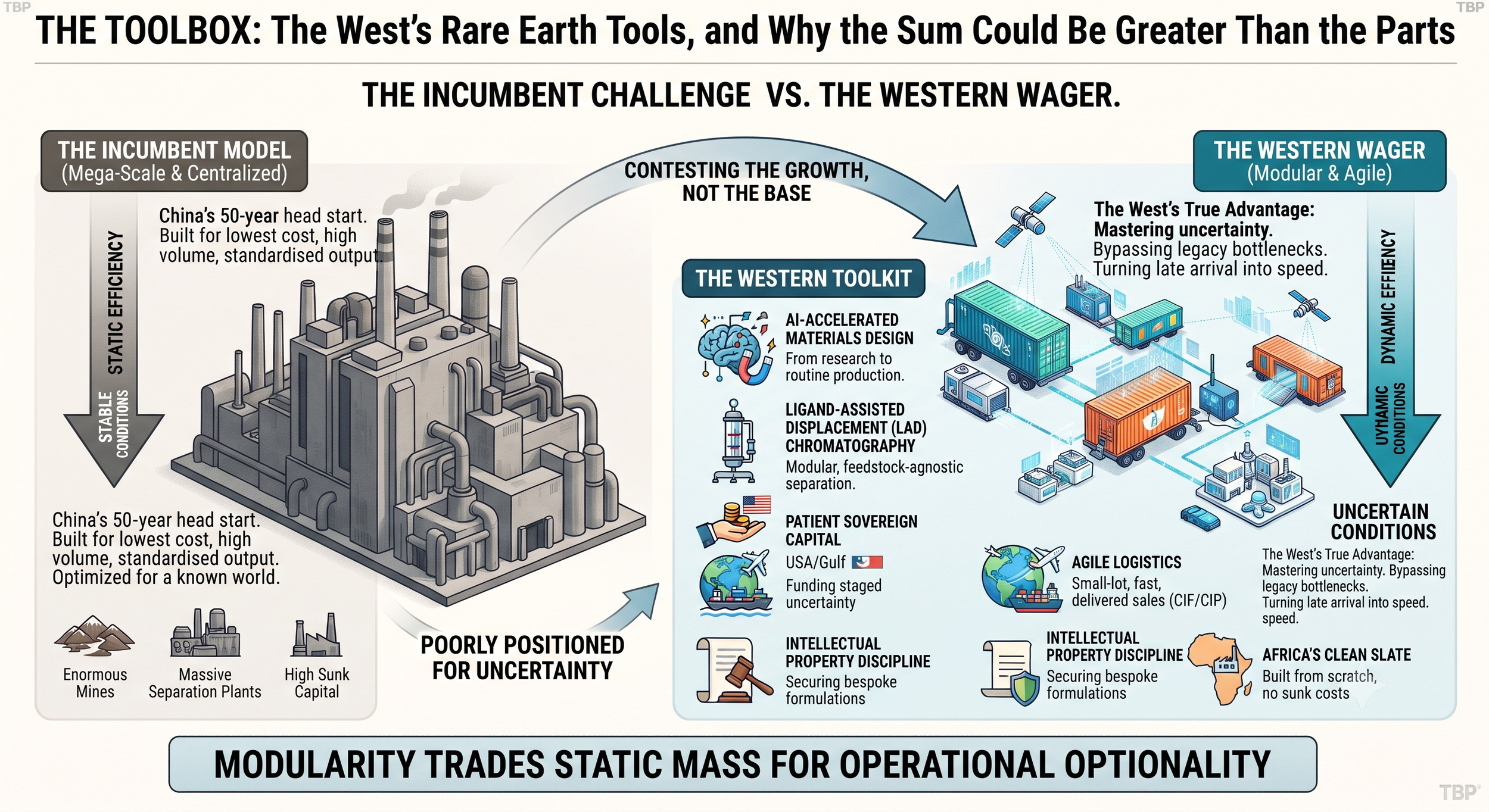
The Toolbox: The West's Rare Earth Tools, and Why the Sum Could Be Greater Than the Parts
Western industrial policy has long foundered on the attempt to out-build an incumbent holding a fifty-year head start. But what if the game is being played on the wrong board?
This paper suggests that the West's true advantage lies not in replicating massive, centralized mega-plants, but in mastering uncertainty. By mobilizing any combination of the Western toolkit—from AI-accelerated materials design and ligand-assisted displacement chromatography to patient sovereign capital, intellectual property discipline, and agile logistics—operators can bypass legacy bottlenecks entirely. Unburdened by sunk capital costs, a distributed, modular approach trades static mass for speed and operational optionality, turning late arrival into a decisive structural edge.
Much of the Western commentary on critical minerals reads as resigned. China's lead is treated as a fact to be managed, not a position to be contested, with a defensible niche about as much ambition as anyone claims.
Some of that pessimism is earned. The West did not choose this position. It drifted here over decades of chasing lowest-cost production wherever it existed, while China built the mining and processing base no one else bothered to build. That is a self-inflicted vulnerability, not something to be argued away.
There is a second problem alongside the first, however: insufficient thought has gone into what the rest of the world is good at, and what happens when those strengths are used together rather than separately. Capital markets willing to fund years of uncertainty. Patent systems that protect discoveries. Research — Purdue's chromatography, Japan's magnet science — solving a different problem than China's, rather than attempting to beat China at its own. Sovereign capital, American and Gulf alike, willing to back builds that have not yet proven themselves. The logistics and financial sophistication to sell a differentiated product instead of raw material at the mine gate. None of this alone offsets a fifty-year head start. Assembled deliberately, it is a genuine counter.
This paper does not propose a blueprint for Western critical minerals policy, nor does it claim that any single development — AI-accelerated formulation, modular separation, Africa's clean slate, Japan's patent discipline, Gulf sovereign capital — will reshape the industry alone. It asks one question: has anyone examined these developments together, rather than in isolation, and considered what they amount to as a system rather than a list?
1. The Frame
Western critical minerals policy is, in practice, an attempt to build a smaller version of China: the same objective — lowest unit cost, maximum utilisation, standardised output — at a fraction of the scale. On time and on cost, that bet is unlikely to pay off. China's midstream took decades and hundreds of billions of dollars in state capital to build; no five-year Western programme replicates that arithmetic
The relevant question is not how the West out-Chinas China. It is which architecture fits which segment of demand. Large, integrated, standardised plants are the right instrument where markets, feedstocks, and customers are stable — China's model, built for the world it was built in. Modular, flexible architecture is the right instrument where they are not. That is the frame the rest of this paper follows: not that modularity is superior, but that it suits a growth segment China's infrastructure is poorly positioned to pursue.
That distinction makes this paper's premise a genuine contest rather than a retreat into a defensible niche. The growth this paper concerns exists under different conditions than China's incumbent base — uncertain feedstock, fast-differentiating customers, unsettled policy. Those conditions are where the Western toolkit has an advantage on its own terms: AI-accelerated formulation, modular and feedstock-agnostic separation, capital markets willing to underwrite staged uncertainty, a legal system capable of protecting discoveries, and the logistics and financial sophistication to turn a physical commodity into a differentiated commercial offering. None of this requires the claim that the West could out-produce China on standardised NdFeB, and the paper makes no such claim. It requires only that the growth pool's conditions favour what the West does well — a direct contest for genuine share, fought on ground the incumbent's model is not built to hold.
2. The Growth, Not the Base
The more useful contest is not for China's incumbent base but for the growth. Bloomberg Intelligence's Rare Earths 2026 Outlook Deep Dive, published March 2, 2026, projects China's share of the global NdPr market falling from roughly 90% in 2024 to about 69% by 2030, a 21 percentage point decline, as non-Chinese output more than quadruples over the same period. That near-term growth is not speculative: Bloomberg names the producers directly, citing Lynas's Malaysian refinery ramping toward 10,500 tonnes a year and MP Materials rising to roughly 7,300 tonnes — both expansions already under construction, not capacity assumed into existence. Total NdPr demand is projected to grow around 7% a year through the decade, to roughly 97,000 tonnes by 2030, fifty percent above 2024 consumption, and even with all that new non-Chinese supply, a global shortfall of up to 36% remains a live scenario in Bloomberg's own modelling. The growth being captured is not share taken from an incumbent determined to keep it. It is filling a gap that would otherwise go unmet — a more durable basis for a strategy than direct competition for existing customers.
That forecast, however, is a projection built on currently announced capacity, largely using the same toolkit China itself uses, simply relocated: conventional solvent extraction, mega-plant economics, sited in Australia and Texas rather than Baotou. This is also what occurred the last time this played out. After the 2010 China-Japan rare earth dispute, a comparable wave of non-Chinese investment went into projects such as Lynas, several of which struggled once Chinese exports resumed and prices normalised, because competing with China on China's own terms — cost per tonne of standardised oxide — favours whichever party holds fifty years of accumulated scale. This cycle has a better chance of holding the line Bloomberg projects, and a genuine chance of exceeding it, because the toolkit itself has changed. AI-accelerated formulation and modular, feedstock-agnostic separation are not a cheaper way of running China's game; they are built around a category of demand — fast, bespoke, OEM-specific supply — that China's mega-scale infrastructure is structurally poor at serving regardless of price, because serving it requires reconfiguring for small, differentiated runs rather than standardised campaigns. Analysts routinely identify five-to-ten-year lead times as the principal execution risk standing between announced Western capacity and delivered tonnes. A staged, modular build is designed specifically to compress that timeline: smaller initial commitments reach output sooner, with expansion added once demand is proven rather than gated behind one large upfront construction programme. This is the mechanism by which the West's actual trajectory could outrun Bloomberg's base case — not because more resources exist than the forecast assumes, but because the new toolkit executes faster than the conventional one on which the forecast is implicitly built. This is a forward call the paper is making, not a figure anyone has yet published.
On Bloomberg's own trajectory, non-Chinese NdPr supply must add between 4,000 and 6,500 tonnes of new capacity every year between now and 2030, rising annually rather than remaining flat. Whether that pace is achievable is a separate question this paper does not resolve, but it is the figure to hold against any claim that the forecast itself is conservative.
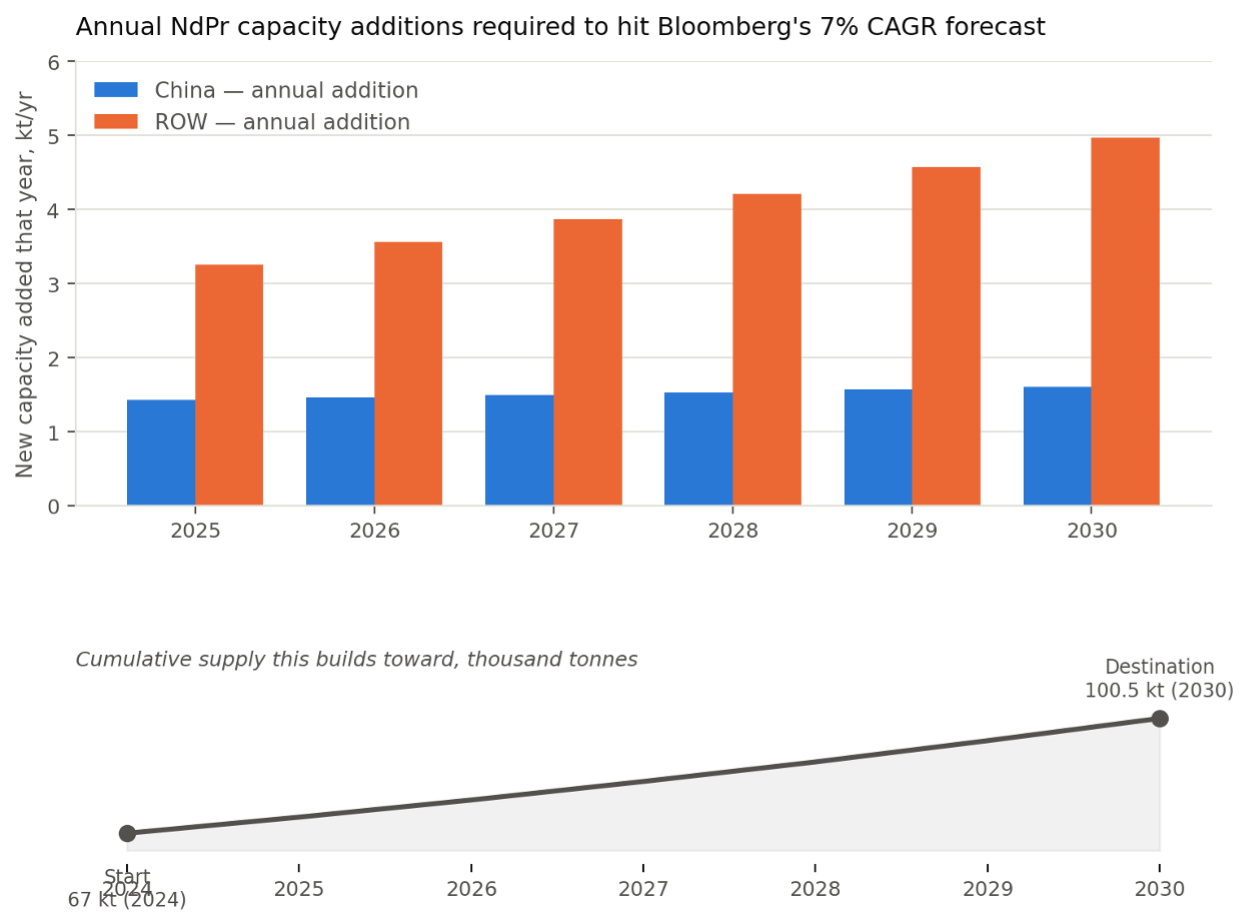
Annual NdPr capacity additions required, China vs rest of world, 2025-2030, with the cumulative total supply trajectory from 67kt to 100.5kt shown below
The volumes worth capturing carry a second advantage the tonnage figures alone do not show: they should carry meaningfully higher margin than the Chinese commodity output alongside which they sit. The Pentagon's guaranteed price floor for MP Materials — $110/kg for NdPr and Dy, against a Chinese benchmark price that has recently run in the $60s to $80s — is a policy-engineered premium for security of supply, not a reflection of production economics; a producer selling into that floor captures margin a Chinese commodity producer never sees on the same tonne. The bespoke, OEM-specific segment carries the same property for a different reason: a customer paying for a formulation built to its exact duty cycle, delivered on its own timeline, from a traceable non-Chinese source, is not shopping on lowest price the way a buyer of standardised NdFeB is. A modest gain in volume share, concentrated in these categories, is worth a disproportionately larger gain in the profit pool than the tonnage figure alone would suggest.
3. The Refinery Lens
A refinery is not profitable because it processes crude oil. It is profitable because it never stops re-optimising: crude selection, configuration, catalyst choice, product slate, customer mix, maintenance timing. The plant functions as an optimisation engine rather than a conversion plant, and the value it creates comes as much from the choices it preserves as from the barrels it runs.
The same distinction applies to rare earth processing. Conventional thinking treats mine, concentrate, separated oxide, metal, and magnet as a chain in which each stage simply adds value. The more accurate frame is that each stage creates optionality — an opportunity to reconfigure, redirect, or hold a choice open — and that optionality carries value independent of the tonnes moving through it.
4. Two Architectures, not a Hierarchy
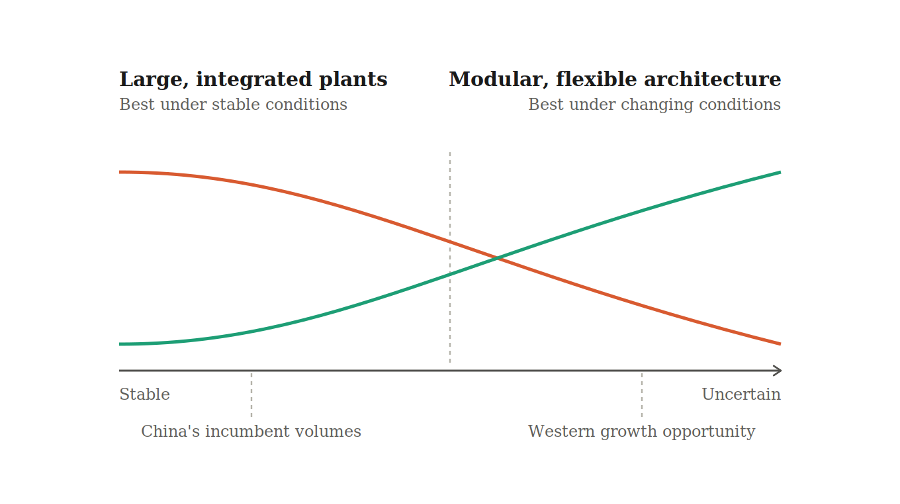
Large integrated plants are the best fit under stable conditions; modular architecture is the best fit under uncertain conditions. The two cross at a midpoint. China's incumbent volumes sit on the stable side; the West's growth opportunity sits on the uncertain side.
China's model — enormous mines, enormous separation plants, deep downstream integration, high utilisation — is the correct answer to a stable, high-volume, standardised problem. The physics favours it: a single large vessel requires less steel, fewer pumps, and fewer instruments per tonne processed than the modular equivalent, and lower heat losses besides. Surface area scales more slowly than volume. This is a genuine advantage, and a paper that passes over it in order to sell modularity is not being straightforward with its reader.
Modular architecture does not out-compete that model on its own terms. It answers a different question: what happens when the market, the feedstock, or the customer is not stable? Large plants optimise for static efficiency — strong performance under known, steady conditions. Modular systems optimise for dynamic efficiency — continued performance as conditions change. Neither is universally correct. The relevant question is which conditions apply, and Western rare earth demand — uncertain feedstock, uncertain policy, a fast-differentiating customer base — is currently of the second kind.
5. What Modularity Actually Buys
The relevant distinction is not cheap capital versus expensive capital. It is capital cost versus capital deployment. A staged build — a smaller initial outlay, with additional tranches committed as demand is proven — is not cheaper than one large plant; it is easier to finance, and it preserves choices that a single up-front commitment would foreclose.
Those choices take several forms: operational (running modules independently), commercial (different products for different customers), feedstock (processing varied inputs), and expansion (adding capacity in fine increments rather than the coarse steps a mega-plant requires — fine-tuning output rather than shutting down the equivalent of an entire medium-sized refinery to reduce capacity by a third). The common thread is that a modular system trades some theoretical peak efficiency for continued value across changing conditions, which is a sound trade only when conditions are, in fact, changing.
6. Where the Growth Actually Is
AI-accelerated materials design is turning bespoke magnet formulation into a production input rather than a research programme. National laboratories and university groups are already using physics-informed machine learning to design compositions with reduced — not eliminated — critical-element content, tuned to a specific performance envelope rather than a generic worst case. The relevant mechanism is inverse design: rather than proposing a composition and testing it, one specifies the target properties, and the model proposes compositions that satisfy them. Multiple compositions can typically satisfy the same target, which is an inconvenience for a research programme but an advantage for a flexible producer, who can execute whichever valid composition its current feedstock and process configuration render cheapest to run.
This is not yet routine industry infrastructure. It is arriving, not arrived, and the paper should say so rather than overstate its case. The direction, however, is genuine, and it points toward a category of demand: OEMs holding their own proprietary formulation, at real production volume, rather than purchasing whatever generic grade the market offers. Not one-off orders, but a new and recurring category of customer.
The proper framing of the payoff is speed and fit, not a blanket cost advantage. Where an OEM's actual duty cycle requires less heavy rare earth than a commodity grade is engineered to withstand — because commodity grades must be built for the worst case, and most buyers never encounter the worst case — a lean, application-specific formulation costs less to produce. Where an application requires more than a commodity grade delivers, the bespoke formulation costs more, and the case rests on performance and turnaround rather than price. Both are genuine claims. They are not the same claim, and the paper keeps them separate rather than compressing them into "far cheaper than China."
This paper's forward call is that the specialised, formulation-specific segment does not remain a niche once speed and acceptable cost are both in place; it grows considerably as a share of the total magnet market. No analyst currently tracks that division for magnets in the way the market is tracked for additive manufacturing, so this is a forecast rather than a reported trend, and it should be presented as such. It is, however, a forecast with a precedent. Additive manufacturing, the clearest recent case of a customisation cost curve crossing a viability threshold, is running at roughly 20 to 24% CAGR through the early 2030s across most forecasts, against 6 to 11% for the permanent magnet market itself — two to three times the growth rate of the host industry in which it sits. The mechanism analysts cite is specific and transferable: HP's Multi Jet Fusion platform is now described as reaching per-part costs competitive with injection moulding at volumes below 10,000 units — not one-off production, not mass manufacturing, but the same OEM-scale band this paper has described throughout. When a flexible process ceases to carry a premium against the standardised alternative at that volume, the standardised alternative begins losing share within that band. There is no reason to assume rare earth magnets are structurally different from every other manufactured good in this respect, and good reason, given how much of current demand is over-engineered relative to actual duty cycle, to expect the effect to be larger here than in most.
7. The Hinge: Separation Has to Meet the Recipe
An AI-generated formulation is useful only if something can produce it without a punishing changeover cost. This is where the separation layer matters, and it is arguably the paper's central and most original claim: the value lies neither in AI alone, which supplies only the ideal specification, nor in flexible separation alone, which supplies only capacity, but in the meeting of the two. AI removes the over-engineering margin built into commodity production. Flexible, modular separation removes the retooling penalty that would otherwise render a lean, precise composition uneconomical outside huge, standardised batches
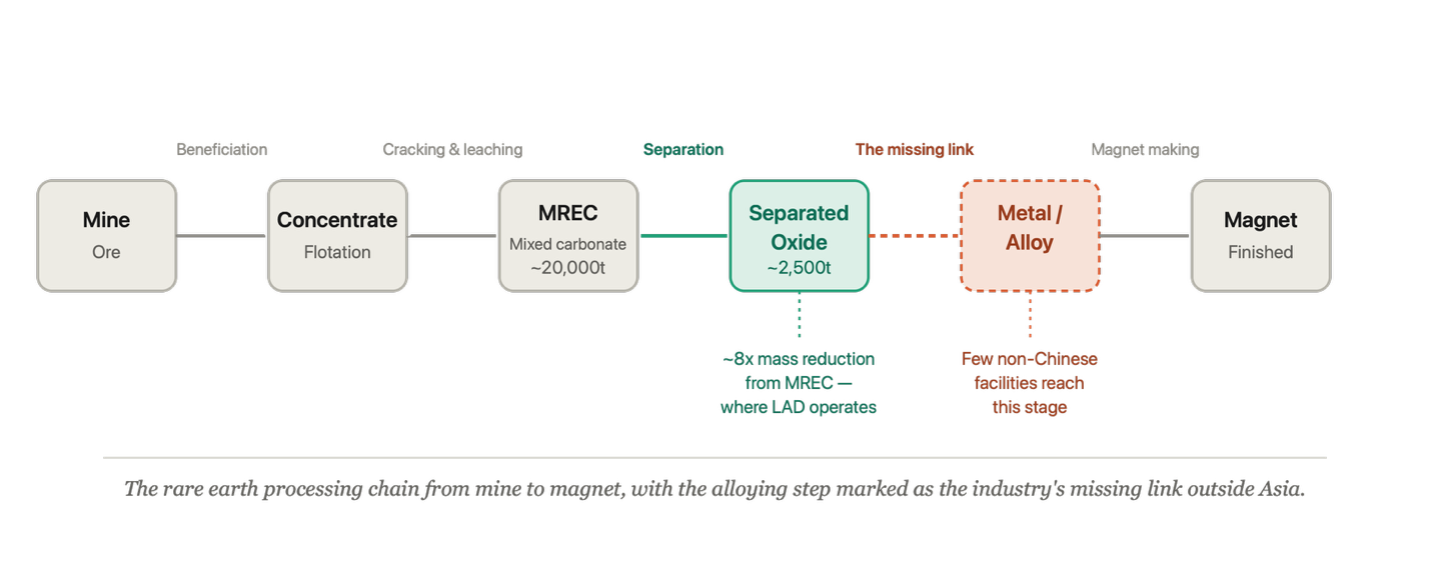
8. The Technical Case: Separation
Purdue-developed Ligand-Assisted Displacement (LAD) chromatography, commercialised by ReElement Technologies, is the concrete case in point. The claim is that a handful of chromatography columns can replace the hundreds or thousands of mixer-settler stages a solvent-extraction cascade requires — modular, feedstock-agnostic (ore concentrate, recycled magnets, battery material), and deployable in units small enough to site at a mine or a manufacturing plant.
The history here cuts both ways. China itself used ion-exchange chromatography first, in the 1950s and 1960s, before replacing it with solvent extraction because SX cost roughly a tenth as much at industrial scale. Chromatography lost that argument in China more than fifty years ago. What survives in China's current toolkit is chromatography as a polishing step for the hardest separations — an added cost layered on top of an SX-dominated base, not a substitute for it. The Western wager is not that China missed chromatography as a technology. It is that China correctly rejected the first generation of it on cost grounds, and that LAD represents a different chemistry, betting it has solved the capital problem that sank the earlier version.
There is evidence the wager is succeeding, and it is worth citing evidence of the strongest kind: a disclosed commercial transaction, rather than a company's own claim about itself. Vulcan Elements, a magnet manufacturer, has agreed to purchase critical minerals from ReElement at a price both companies describe as significantly below the $110/kg floor the Department of Defense guaranteed to MP Materials for NdPr and Dy — an arm's-length price set by an independent buyer. Add a Pentagon investment aimed at gallium and germanium production, together with a fifty-times lab-to-demonstration scale-up now moving into a 400,000-square-foot Indiana facility, and the trajectory is genuine. It is not yet proof at China-comparable continuous tonnage; even sympathetic outside coverage still frames this as contingent on the technology scaling as promised. The transaction is citable; the superlative is not.
9. The Missing Link: Alloying
Separation is not the whole chain. Oxide must be reduced to metal and alloyed to the target recipe before it becomes a magnet, and that step is almost as concentrated in Asia as separation itself — only a small number of non-Chinese facilities currently carry oxide through to alloy. A flexible separation platform does not complete the loop by itself.
There is a reassuring aspect to this, however: alloying and casting is conventional metallurgy — vacuum induction melting, strip casting — rather than a novel chemistry requiring a Purdue-scale breakthrough to exist outside China. Building that capacity is a capital and industrial-engineering problem, not a research problem, which means it has a shorter path than separation did. Naming this gap explicitly, rather than passing over it, is what keeps the claim of a "finished magnet" honest.
10. Africa: Built from Scratch, With the Right Tool
The clearest historical parallel for what is at stake is not another mineral but oil. Nigeria produced crude for decades and still ended up importing refined product, because refining capacity concentrated in the US Gulf Coast, Rotterdam, and a handful of other hubs built up over a century of capital and infrastructure that no producer country could easily replicate. The value remained where the refineries already stood, not where the crude originated. It took one determined individual and several billion dollars for Nigeria to break that pattern in its own case, and only within the past couple of years.
Critical minerals refining does not carry that same inertia, at least outside China. The processing capacity that would need to exist for Africa to be shut out of this value chain in the manner it was shut out of oil refining has not yet been built anywhere in the West — the empty space and the tool to fill it are arriving at the same time. A modular, feedstock-agnostic chromatography platform that can be installed in an existing building, rather than requiring a purpose-built mega-plant, is what turns "no sunk costs" from a historical observation into something actionable: whoever builds first here is not obliged to replicate a fifty-year-old capital structure.
This is not hypothetical. Since February 2025, ReElement Technologies and Novare Holdings — a South African investment firm with operations across South Africa, Nigeria, Mozambique, Mauritius, and Zambia — have been developing a $100 million partnership to build Africa's first integrated critical minerals refining platform, using the same LAD chromatography on which this paper is built, with facilities planned near mining sites in South Africa's Gauteng province, the Lobito Corridor in Zambia or Angola, and potentially Lagos, to serve Nigeria's lithium deposits. Novare's relationship with ReElement extends beyond that single deal: it went on to anchor ReElement's $150 million capital raise for the Marion, Indiana facility in June 2025, prompting ReElement's own chief executive to describe the two builds as a single strategy — African capital investing in America's best technology, with that same technology delivering value back to Africa in turn. This is one integrated capital and technology relationship spanning both continents, not two separate wagers.
There is no public confirmation of construction progress on the African leg since the original announcement. The likely explanation is not that capital was withdrawn toward the United States instead, since the same investor stands behind both builds, but that the institutional landscape for African critical minerals projects shifted beneath the original plan. Washington's own Africa strategy escalated sharply in the same window: a December 2025 National Security Strategy recast the US-Africa relationship around "trade, not aid" in the context of critical minerals competition with China; a $553 million DFC loan for the Lobito Atlantic Railway followed that same month; a US-African Union Strategic Investment Working Group was established in January 2026; and a February 2026 Critical Minerals Ministerial produced new bilateral frameworks together with a Glencore-backed consortium deal in the Democratic Republic of Congo. A private plan drawn up before any of this existed may simply be realigning toward the corridor that has since become the anchor of US Africa policy, rather than having been abandoned.
The clearer illustration of why execution matters more than resource ownership lies on the other side of the continent. China's Shenghe Resources completed its acquisition of Peak Rare Earths in September 2025, taking full control of Tanzania's Ngualla deposit, one of the largest and highest-grade undeveloped NdPr resources anywhere, and larger in NdPr content than Longonjo. Despite a commitment made in May 2025 to begin construction in December 2025, no construction date or production timeline had been confirmed under Chinese ownership as of the middle of 2026. This is more consistent with control than with competition: securing the option to keep a major deposit out of Western supply chains without necessarily hastening its development. It sharpens, rather than undermines, this paper's argument. Owning the rock was never the difficult part. Converting it into product quickly is the difficult part, and that is the terrain on which a modular, staged-capital build is designed to compete.
11. Short Chains, Small Lots
China holds a second structural advantage in proximity. Baotou, built around the Bayan Obo mining district, is a deliberately engineered cluster: separation, metal production, magnet materials, and now motor and robotics manufacturers, all sited together under a specific provincial plan running through 2035. Short physical and organisational distance between stages reduces logistics cost and permits tight iteration between adjacent stages in a way no single plant can replicate on its own. Replicating that arrangement in Africa would mean committing to the same decades-long, centralised capital bet this paper has already ruled out on grounds of time and cost. Modularity achieves the same underlying benefit — short chains, rapid iteration — through multiplication rather than concentration: numerous separation nodes distributed at the mines themselves, which is precisely what the ReElement-Novare siting plan already does.
That distributed model rests on a freight-economics case that stands independently of any argument about clustering. Moving 20,000 tonnes of mixed rare earth carbonate concentrate, rather than the roughly 2,500 tonnes of separated oxide it becomes, represents close to an eightfold reduction in the mass that must survive the expensive portion of the journey — rail, port handling, ocean freight. Separating material at the mine means the logistics chain need only carry the tonne that ultimately matters.
That reduction in mass also changes which mode of transport becomes viable. Air freight on established routes — Luanda has genuine cargo capacity via Dubai, with Emirates alone operating roughly 120 tonnes a week into the airport and a transit onward of two to five days — becomes economically trivial once the cargo consists of separated oxide rather than raw concentrate. A few dollars per kilogram in freight cost amounts to a rounding error against oxide values running from roughly $60/kg for NdPr toward $900/kg for terbium. A week door-to-door to Japan, the United States, or Europe, via Dubai or a European hub, is a realistic proposition, and it removes distance from Africa as an objection almost entirely: an African separation facility is no longer at a logistical disadvantage relative to one in the United States or Europe, provided the value-adding step occurs locally rather than shipping raw concentrate abroad.
That speed produces a cash-flow benefit on both sides of the trade, not merely an operational one. A supplier collecting revenue within a week, rather than six to eight, ties up less working capital in goods in transit and reduces exposure to price movements between production and sale. A buyer facing a reliable one-week lead time need not hold the same level of safety stock it would carry against a six-to-eight-week supply chain, which matters for a material this costly to warehouse. It is also what allows the AI-plus-modular-production speed argument to be complete rather than theoretical: a fast, bespoke formulation delivers its full value only if delivery is fast as well.
12. Speed as a Hedge
Structuring the sale as CIF — or, for air freight, the technically correct equivalent, CIP — rather than FOB captures that value commercially, rather than leaving it to the buyer to arrange independently. The seller books freight margin in addition to product margin, converts the promise of rapid delivery into an enforceable contract term rather than a capability the buyer must simply trust, and removes the friction of an unfamiliar shipping route for a customer attempting to diversify away from an established Chinese relationship. Under CIF or CIP terms, risk transfers to the buyer at the point of loading rather than on arrival: the seller is bundling and pricing freight and insurance rather than carrying risk for the entire journey, and the commercial benefit to the buyer lies in convenience and a known landed cost rather than in the transfer of risk.
Speed matters more here than in most commodities for a specific reason, and it is not a general point about risk appetite. The instrument almost every other physical commodity trade uses to bridge this particular gap does not yet exist for rare earths. No listed NdPr futures contract exists outside China: pricing runs on Chinese spot exchanges and published index assessments rather than a liquid, exchange-traded market. CME Group announced in early 2026 that it was developing the first such contract, describing it as the missing piece of the puzzle for the sector as a whole, though as of this writing no launch date has been confirmed, and this should be verified against whatever is true by the time this is read. For an oil cargo, a price movement during a six-week voyage is something party can hedge away in the futures market without touching the physical trade. For a rare earth cargo, there is nothing with which to hedge. A CIF quote struck against the day's index price, for a shipment that will not land for six to eight weeks, amounts to an uncovered bet that the market will not move significantly in the interim, and NdPr has moved 40% within a matter of months before. A CIP quote struck the same way, landing within roughly a week, barely qualifies as a bet at all, since there is scarcely time for the index to move. Speed here is not an approximation of a hedge. At a week's transit, it performs the hedge's actual function, in a market that otherwise lacks one.
There is a further, more specific commercial opening in current market pricing, distinct from the hedging point. Fastmarkets and SMM data from April 2026 show FOB China neodymium oxide trading near $183/kg against CIF Rotterdam near $255/kg, a premium of roughly 39%, considerably larger than freight and insurance alone would explain. Industry analysis of the equivalent cerium spread states explicitly that the gap reflects not only logistics, but the additional procurement complexity introduced by China's export licensing regime — a scarcity premium for material that has cleared Chinese export controls, rather than a shipping cost. A non-Chinese producer carries no such friction and could plausibly offer delivered pricing at a genuine discount to the current CIF Rotterdam benchmark while still earning a normal margin at origin — a second, purely commercial reason for non-Chinese supply to be price-competitive, distinct from any strategic premium for provenance.
13. Financing the Model
That absence of a futures market also explains why single, large offtake agreements have become the default financing structure across this sector: MP Materials selling into the Pentagon's price floor, Shenghe's claim on the entirety of Ngualla's output. With no futures market to provide lenders revenue certainty, a locked-in offtaker is the only substitute currently on offer. This is precisely why the diversified, small-lot model described in this section requires the kind of deep-pocketed equity discussed below: it is not simply a matter of replacing one customer with many, but of doing so in a market with no financial hedge to rely on while that diversified base establishes itself.
Small-lot, fast, delivered sales also change the kind of customer a producer requires. Once shipping cost no longer forces concentration into a single large buyer, there is no logistical reason to sell an entire mine's output to one offtaker. A producer can instead serve many customers in parallel, each paying for precisely what it needs, without granting any single buyer the leverage that comes from taking the entire output. This is the commercial payoff of the logistics argument as a whole: better margins, distributed across a diversified book, rather than one blended bulk discount.
That model carries a genuine cost, however. A single large offtake agreement is the simplest way to provide lenders with the revenue certainty against which a debt package is underwritten — the role that Shenghe's full Ngualla offtake, or the DoD floor, plays for MP Materials. Trading that certainty for a diversified, higher-margin buyer base makes financing more difficult, not less, at least until a track record is established. Deep-pocketed equity must substitute for that certainty: sponsors capable of absorbing completion risk and cost overruns without a locked-in anchor contract standing behind the debt. Gulf sovereign capital offers a current example of precisely this kind of patient equity. The Qatar Investment Authority has moved from a $180 million stake in the critical-minerals investment firm TechMet to a $500 million position in Ivanhoe Mines' operations in the Democratic Republic of Congo, with a November 2025 memorandum of understanding that names downstream refining and smelting capacity explicitly as an area of collaboration — alongside Saudi Arabia's Manara Minerals and the United Arab Emirates' International Resources Holding pursuing comparable positions, and Qatari royal-linked vehicles such as Al Mansour Holding active at even larger scale across the continent. These funds characteristically take minority financial stakes rather than operational control, which is precisely the profile of patient capital a lender wants standing behind a project rather than a strategic operator competing for control of it.
14. The Precedent: What Japan Already Proved
The notion that AI is required to prove that lean, application-specific composition works understates the record. Japanese firms proved the concept commercially more than a decade before AI entered the picture. Grain boundary diffusion — placing heavy rare earth only where it is needed, rather than alloying it through the entire magnet — was developed by Shin-Etsu and Hitachi Metals and commercialised as early as 2014, holding coercivity and remanence steady while reducing dysprosium content by several percentage points. Japan required no model to identify the waste in the dysprosium budget; the country found it by hand and then defended the discovery. Proterial, Hitachi's successor, together with Seiko Epson and TDK, holds hundreds of active patents in this space between them, and that fortified position is now cited explicitly as the model the United States and Europe are attempting to emulate.
What Japan never solved is the layer with which this paper is concerned. Japanese magnet excellence rests on continued dependence on externally separated feedstock, which is why Japan financed Lynas from 2010 to 2011, following China's export restrictions that exposed the gap. Composition optimisation has been proven for over a decade. Flexible, non-Chinese separation capacity to supply it is still being built, only now.
Nor is this uncontested ground. Chinese researchers state plainly that the next competitive front lies in materials engineering rather than mining, employing machine learning for precisely the kind of microstructure and composition work this paper describes, and stating that the contest has shifted from extraction to processing science. China possesses the resources and the manufacturing base to move quickly on whatever its own laboratories discover. The Western advantage does not lie in inventing superior chemistry to China's. It lies in converting a given formulation, discovered anywhere, into sovereign, OEM-scale product fastest, because a production system built from the outset around changeover as its default mode can achieve this in a way a system sized and financed for continuous, standardised campaigns structurally cannot, regardless of which country's scientists discovered the recipe first.
15. Durability: Securing What AI Finds
Japan's advantage was never simply the discovery; it was the discipline of patenting and defending it for two decades. The AI-accelerated version of this strategy is durable only if it comes with the same discipline, and there is a live legal complication that should be acknowledged rather than assumed away. No major jurisdiction currently permits an AI system to be named as an inventor, and the United States revised its own guidance on how much AI involvement an invention may carry and remain patentable as recently as November 2025. In practice, this means the formulations on which this paper is built are patentable where a human can demonstrate documented conception — reviewing, selecting, and refining what the model proposes — and may not be where the process runs from input to output with no human judgment recorded along the way. This is a discipline a company must choose to apply; it is not an automatic feature of using AI, and it is a condition for durability rather than an afterthought.
16. The Objection, Named
Optionality carries a price, and the paper is stronger for naming it before a reader does. Modular systems carry duplicated overhead, lower peak utilisation, and a slower cost-learning curve than a mega-plant run at full output — not a deficiency to be explained away, but the cost of a system built for adaptability rather than throughput, in the same way a four-wheel-drive vehicle costs more than a saloon. The premium is worth paying where feedstock, customer, and policy conditions are genuinely uncertain, which describes the West's position now. It ceases to be worth paying once conditions mature and stabilise, which describes closer to where China has operated for a decade. Naming both sides of that line is what keeps the argument analysis rather than advocacy.
17. The Groves Precedent
Leslie Groves, in the Manhattan Project, purchased optionality with speed and effectively unlimited capital, funding gaseous diffusion, electromagnetic separation, and plutonium production in parallel, at considerable duplicative cost, because the value of not committing to a single path exceeded the cost of pursuing three simultaneously under wartime uncertainty. The modular rare earth build purchases the same optionality with time and staged capital instead of speed and unlimited capital. A different currency, but the same trade.
18. Close
Nothing in this paper should be read as a single prediction that stands or falls as a whole. It presents a set of independent opportunities, each genuine on its own terms: AI-accelerated inverse design becoming routine production infrastructure rather than a research programme; modular chromatography solving, at commercial scale, the capital problem that defeated ion exchange fifty years ago; the alloying gap closing through ordinary industrial investment rather than a further scientific breakthrough; Africa's separation build-out outpacing resource ownership through execution speed; small-lot logistics and Gulf sovereign capital financing a diversified commercial model in place of a single anchor offtaker; Japanese-style patent discipline applied to whatever the AI discovers. None of these depends on the others being true. The West's position could be constructed from three of them, or five, or all six landing to varying degrees across different companies and geographies; the argument does not require a clean sweep.
None of this constitutes a claim that any single one of these developments will reshape the industry on its own; that was never the argument. It is a suggestion that they have mostly been analysed in isolation — AI treated as a materials-science story, modularity as an industrial-design story, Africa's build-out, Japan's patents, and Gulf capital each covered by whoever happens to follow that particular subject. Read together, they compound rather than sit side by side: Japan's proof that composition optimisation is commercially genuine, met by AI that converts a decade of careful engineering into a routine calculation; a modular separation platform built to execute whatever that calculation produces; Africa and Gulf capital supplying the clean slate and the patient money to build it quickly, in parallel rather than in sequence. The claim is not that any single piece changes the outcome. It is that the interaction between pieces still being tracked separately may be where the true position lies.
The argument does require more than none of them, however. Should every one of these wagers fail to materialise — should the AI remain a laboratory exercise, should LAD chromatography meet the same obstacle that defeated the first generation of ion exchange, should the alloying capacity never be built, should Africa's facilities remain announcements, should the financing never arrive, should formulations be discovered but never protected — the result would not be failure so much as a return to the default pace: Bloomberg's base case, five-to-ten-year lead times, incremental share gains measured in single percentage points a year, and China's incumbent advantage compounding for another decade largely undisturbed. Not catastrophic, but slow, and slow is its own kind of answer, given how much of this paper's case rests on speed being the one advantage the West can genuinely claim.
The West's capacity is being built at the very moment AI is converting bespoke formulation from a research programme into a routine production input. That timing constitutes the opportunity, rather than a coincidence to note in passing building modular rather than monolithic infrastructure is what allows it to be captured rather than merely observed. It follows a pattern already visible elsewhere. Mobile money did not catch up with fixed-line banking across parts of Africa; it bypassed the generation incumbents were occupied defending. The West's lateness in rebuilding a rare earth midstream may follow the same pattern: nothing sunk to defend, at precisely the moment the industry's underlying logic is shifting from who can run the largest campaign to who can convert a recipe into product fastest, for a customer that commodity production was never built to serve.
The objective was never to minimise the cost of production. It is to maximise the lifetime value of the enterprise under uncertainty, value created not only through process efficiency but through the choices kept open along the way. Which of those choices are ultimately exercised remains an open question. This paper maps what some of the choices are, it does not guarantee that anyone takes them
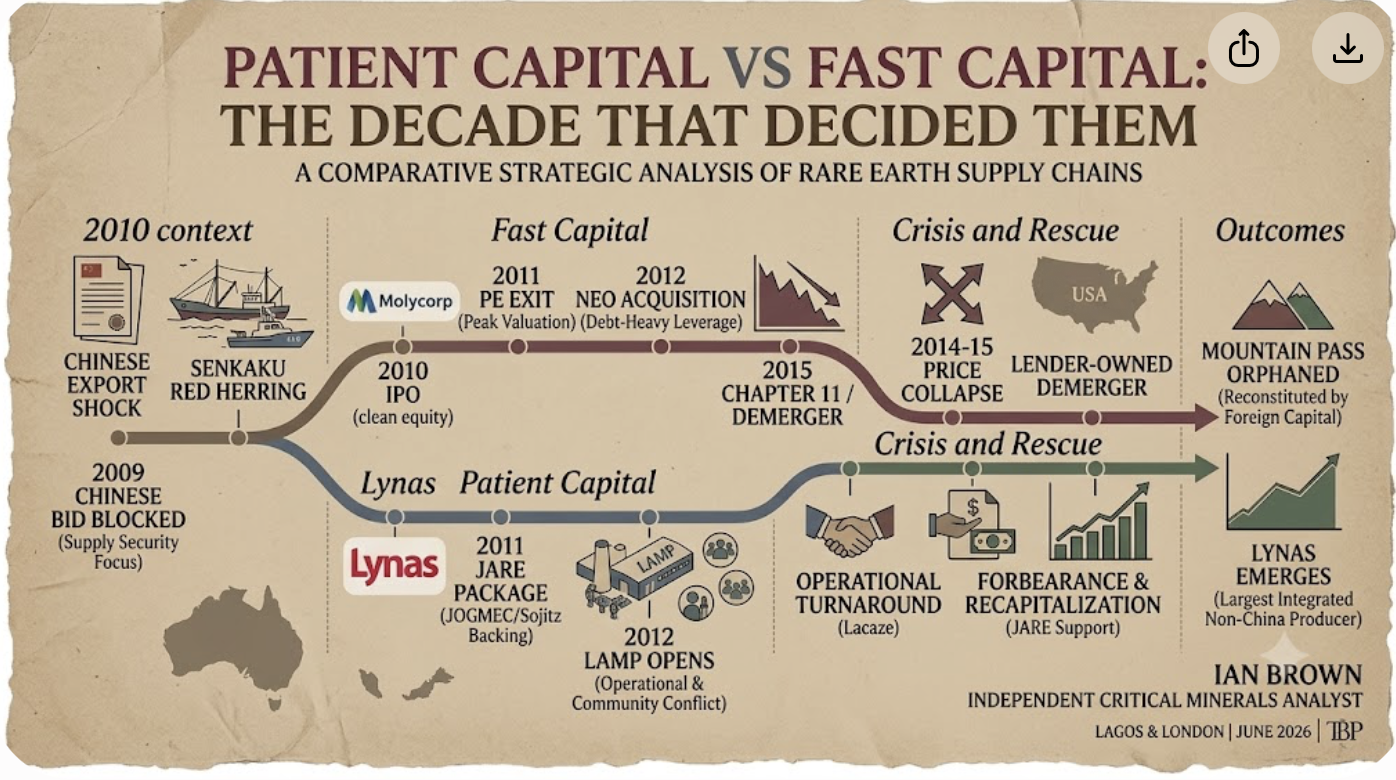
PATIENT MONEY VS. FAST MONEY MOUNTAIN PASS, MOUNT WELD, AND THE DECADE THAT DECIDED THEM
Mountain Pass and Mount Weld — the only two rare earth producers outside China operating at real scale today, and the only two that faced the identical 2010 shock and came out the other side.
One filed for bankruptcy. The other survived a worse collapse and is now the sector benchmark. The usual story blames China. The filings tell a more interesting one: a private equity windfall cashed out at the peak, a patient financing offer left to lapse, a $650 million bet placed against a WTO complaint that had already been filed — and, on the other side of the world, a lender holding the identical legal instrument who chose to extend a company's life rather than take it over.
As of today, there are only two rare earth producers outside China operating at meaningful integrated scale: MP Materials, which owns the Mountain Pass mine in California, and Lynas Rare Earths, which mines at Mount Weld in Western Australia and processes in Malaysia. Both companies trace their modern origins to the same trigger — the 2010 Chinese export shock — and both nearly didn't survive it. One did. One didn’t and had to be rebuilt from bankruptcy by the very kind of foreign capital its collapse is often blamed on.
This is the story of how two companies, facing an identical crisis in the same year, ended up as the last two standing — and why survival had almost nothing to do with the crisis itself, and everything to do with what each company did with the capital available to it, before, during, and after the shock. Nothing in what follows requires assuming any intent on anyone's part. It is an account of effects: what each capital structure did when tested, regardless of what anyone wanted or foresaw.
PART ONE: THE SHARED SHOCK
THE QUOTA CUT AND THE FISHING BOAT
In July 2010, China's Ministry of Commerce announced a 40% cut to global rare earth export quotas — a general, worldwide policy, not one aimed at any single country. Two months later, on September 7, 2010, a Chinese trawler — the Minjinyu 5179 — collided with two Japan Coast Guard vessels near the disputed Senkaku/Diaoyu Islands after ignoring orders to leave the area. Japan arrested the captain and held him under domestic law, a departure from its usual practice of simply expelling Chinese boats. China escalated diplomatically — summoning Japan's ambassador six times, suspending high-level exchanges, detaining four Japanese nationals — and, starting around September 21, rare earth exports to Japan slowed sharply for roughly two months.
Whether the export slowdown was a deliberate, targeted act of retaliation for the boat incident, or simply Japan being caught in an already-planned global quota cut that Chinese customs agents may have enforced with extra zeal during a live diplomatic row, is genuinely disputed rather than settled. Chinese industry publications show the Ministry of Commerce's quota decision predates the collision by two months, and Japanese officials and businesses were reportedly already aware of the planned global cut by mid-August 2010 — before the collision occurred. Analysis of Japanese customs data has also found no uniform, Japan-specific drop in imports consistent with a targeted embargo, as distinct from Japan being swept up in a worldwide reduction.
The point holds on the Japanese side as well as the Chinese one. Sojitz's talks with Lynas did not begin because of the Minjinyu 5179 — the two companies had already been in discussions before the collision, and signed a formal Strategic Alliance Agreement on November 24, 2010, two and a half months after the incident and building on contact that predated it. Japan's broader diversification push tells the same story: Japanese trading houses were already investing in non-Chinese rare earth sources — Sumitomo and Toshiba in Kazakhstan, Marubeni in South Africa, Sojitz and Toyota Tsusho in Vietnam — before the boat incident occurred, part of a "China risk" strategy already underway. The JARE package that would rescue Lynas in March 2011 was the acceleration of a diversification strategy already in motion, not a reaction invented over a single afternoon near the Senkakus.
This matters because the boat incident is, by a wide margin, the single most-cited piece of evidence for the claim that China "weaponized" rare earths against the West — invoked in the Wall Street Journal, the New York Times, and countless policy papers since. The more careful evidence suggests the causal story is at minimum overstated, and quite possibly backwards on both sides: a Chinese policy already in motion, and a Japanese response already under construction, both layered under a genuine but separate diplomatic crisis that intensified their visible effects at the margins without necessarily being their cause. The fishing boat incident, on this reading, appears to be a red herri
THE WTO COMPLAINT AND ITS OUTCOME
In March 2012, the United States, the European Union, and Japan jointly filed a complaint with the WTO's Dispute Settlement Body, arguing that China's export quotas on rare earths, tungsten, and molybdenum violated its trade obligations. China defended the restrictions as resource conservation and environmental protection measures. In 2014, the WTO ruled against China. China dropped the quota system entirely in 2015.
The complaint targeted the general export-restriction regime, not the 2010 Senkaku episode specifically — a useful distinction, since a great deal of popular writing conflates two separate claims: that China's rare earth policy violated international trade law (true, and formally adjudicated) and that the policy was a deliberate act of geopolitical coercion tied to a single incident (contested, and not what the WTO was ever asked to rule on). The West has a real, legally established grievance against China's export-restriction regime of that era. It is a narrower grievance than the one most retelling assumes.
The two companies at the center of this account made their defining capital decisions inside this five-year window — Molycorp's Neo acquisition financing in May 2012, two months after the WTO complaint was filed; Lynas's JARE package in March 2011, before it. What follows is the story of both.
PART TWO: MOLYCORP
I. THE 2008 BUYOUT: CORRECTLY SPOTTING THE ASSET
Mountain Pass did not begin its modern life as Molycorp — it began as a distressed, forgotten unit of Chevron. In September 2008, in the depths of the global financial crisis, a private consortium — Resource Capital Funds (RCF), led by mining investor Ross Bhappu; Pegasus Capital Advisors; The Goldman Sachs Group; Traxys North America; and Carint Group — bought the mine and the Molycorp name for $82 million, after an 18-month negotiation with Chevron, and contributed a further $110 million in development capital. Total investment: roughly $200 million.
The connection came through Traxys CEO Mark Kristoff, whose father had been a Molycorp marketing executive decades earlier. Bhappu's own diligence was straightforward and, in hindsight, prescient: he went directly to rare earth customers and asked about their China exposure and was told they were "100% dependent on the Chinese" and feared supply being cut off within years. This was a correct, well-researched read of a genuine strategic vulnerability, made while the asset was cheap and unfashionable.
The trade paid off explosively. When Molycorp went public in July 2010 at $14 a share, RCF's 34% stake alone was worth roughly $880 million. By February 2011, with the stock above $74, the consortium's original $200 million had become paper profits of approximately $2.3 billion — one of the fastest windfalls in private equity history. The consortium began selling into that peak the same month, well before Phase 2 of Mountain Pass's expansion was even complete.
This matters for what follows because it establishes, clearly, that the failure to come was not a failure of insight. The 2008 buyers identified a genuine strategic asset, priced correctly by nobody else at the time, for exactly the reason later invoked to justify a decade of policy attention: American dependence on a single, contestable foreign supplier. What the 2008 consortium did not do — because it was never their job to do it — was stay in long enough, or structure their exit responsibly enough, to see that thesis through to a durable outcome. Their mandate was to return capital to their own investors, and by early 2011 they had already substantially done so.
II. THE PRE-NEO POSITION: A SURVIVABLE BET
Molycorp went public in July 2010, raising $378.6 million in a clean equity offering at $14 per share — no debt attached. What followed in the final months of that year is a more revealing story than it first appears, and it requires one piece of geology first. Any given rare earth ore body produces a fixed, naturally-determined mix of elements that has little to do with what the market wants — the industry calls this the balance problem. At Mountain Pass specifically, lanthanum and cerium make up more than 80% of the ore's total rare earth content, while neodymium and praseodymium — the scarce, magnet-grade elements everyone was racing to secure — make up only about 16%, yet account for roughly 80% of the ore's value. Lanthanum and cerium are so structurally oversupplied industry-wide that producers routinely must find a home for them almost as a disposal problem, separate from whatever strategic story is being told about the valuable fraction.
Molycorp's two late-2010 agreements split cleanly along this line and were complementary rather than competing. In November 2010, Molycorp signed a straightforward commercial supply agreement with US catalyst manufacturer W.R. Grace & Co. for lanthanum and cerium through 2015 — a resumption, in substance, of a decades-old relationship, since rare earths from Mountain Pass had been supplying the fluid catalytic cracking industry since the 1970s under the mine's earlier ownership. This was a simple, no-financing customer relationship for the abundant fraction of the ore. Then, at or around the same September–November 2010 window as China's export disruption to Japan — though the earliest document that can be confirmed is a memorandum of understanding signed December 10, 2010 — Molycorp was separately offered something structurally different for the scarce, valuable fraction: Sumitomo Corporation agreed to assemble a $130 million financing package — $100 million to purchase Molycorp common stock, plus $30 million in low-interest debt — in exchange for a seven-year supply commitment of NdPr oxide, the neodymium-praseodymium mix, alongside continuing cerium and lanthanum volumes. Sumitomo was seeking backing from a Japanese government entity for the deal, giving it substantially the same architecture as the JOGMEC/Sojitz package that would rescue Lynas four months later: patient, state-adjacent capital tied to guaranteed long-term offtake of the material that mattered strategically.
The Sumitomo relationship did not end quickly or cleanly. The deal, originally planned to close in February 2011, instead dragged for most of the year: Sumitomo had to split the $100 million equity commitment into two $50 million tranches and sought discounted pricing to help lock in its own downstream Japanese customers, and as late as June 2011 was still publicly saying it would close only "once it has secured Japanese customers." The deal was finally, mutually terminated around September 2011 — not a quick decision made in the flush aftermath of the IPO, but the slow expiry of a relationship over most of a year, ended once Molycorp judged the capital no longer necessary. A parallel December 2010 letter of intent with Hitachi Metals to jointly build a US NdFeB magnet manufacturing plant collapsed on a similar timeline, the parties unable to agree on the joint venture's valuation.
There is a direct contradiction buried in this sequence, worth stating plainly. Bhappu's 2008 diligence — the entire premise on which the RCF-led consortium had justified its investment — was built on going to rare earth customers and hearing that they were "100% dependent on the Chinese" and afraid of losing access within years. Sumitomo's 2010 approach was a Japanese customer showing up to solve precisely that fear, with patient capital attached, on a seven-year horizon. Letting that relationship lapse in 2011 did not just forgo a source of financing — it walked away from curing the exact vulnerability that had made Mountain Pass worth $200 million to RCF in the first place. The company that had been bought specifically because customers were desperate for a non-Chinese alternative let the customer offering to formalize that alternative wait a year and then leave.
The two ends of this fork are visible in the record, and both are covered in full below: Lynas took the equivalent Japanese offer and remained independent. Molycorp let its own lapse, and its founding asset later ended up partly under Chinese ownership. The choice made in this single, largely forgotten thread tracks the entire later divergence.
This was not a debt-free position — the Q1 2011 Series A Mandatory Convertible Preferred ($199.6 million) and the 3.25% Convertible Senior Notes due 2016 were both already outstanding — but it was a materially lighter, more liquid capital structure than what followed, built substantially from public equity markets rather than the patient, relationship-based capital that had been offered and allowed to lapse. Had Molycorp continued this base alone, a share-price collapse when rare earth prices corrected would have been likely — but not an existential threat. Equity holders can absorb a severe drawdown, and the company still exists the next day; secured creditors with a covenant breach or missed payment can end it. Mountain Pass standalone had the first kind of risk, not the second — and it had already been offered, and had let expire, exactly the kind of capital, for exactly the material that mattered, that would later prove the difference between survival and collapse at the company that accepted it.
III. THE NEO ACQUISITION: CONVERTING A SURVIVABLE RISK INTO AN EXISTENTIAL ONE
In March 2012, Molycorp announced a $1.3 billion acquisition of Neo Material Technologies — a Toronto-based rare earth processor with mine-to-magnets ambitions. The deal closed on June 11, 2012, approved by 99.9% of Neo shareholders, funded by a combination of cash, stock, and new debt: $650 million of 10% Senior Secured Notes due 2020, issued May 25, 2012, plus roughly $230 million of assumed Neo debentures and a concurrent $150 million of 6.00% Convertible Senior Notes due 2017 issued that August.
Critically, the secured notes were not a ring-fenced, non-recourse structure limited to a single asset. They were secured by a lien on Mountain Pass and guaranteed by "certain subsidiaries" of Molycorp — a guarantor pool that, once Neo closed, came to include Neo's own operating subsidiaries. The debt raised to acquire Neo was thus cross-collateralized against the whole combined enterprise, meaning a failure driven by Mountain Pass's price-dependent economics could — and eventually did — drag the more durable, diversified Neo processing and magnetics business into the same bankruptcy.
Four separate obligations — 2014, 2016, 2017, and 2020 — sat within a tight few years of each other, all priced on the assumption that 2011-level rare earth prices, or something close to them, would persist long enough to service them.
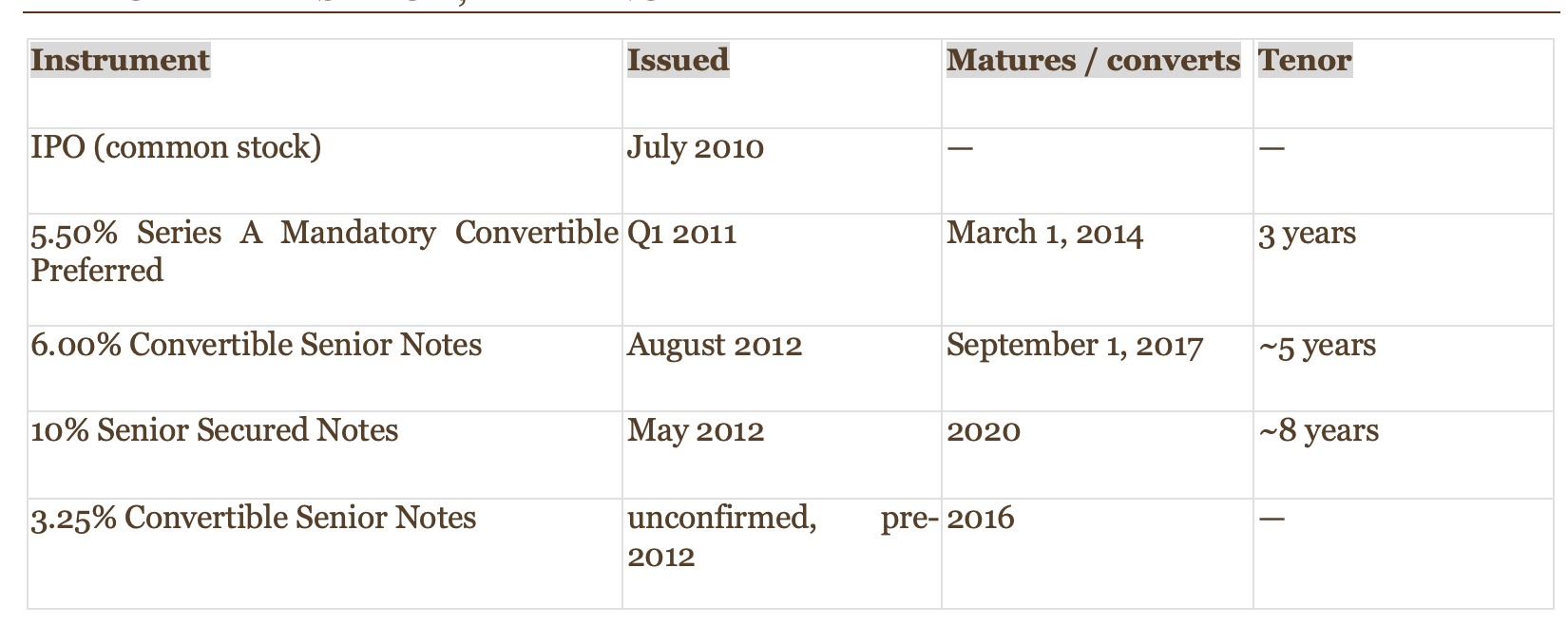
THE CAPITAL STACK, BY TENOR
IV. THE WTO TIMING
Molycorp priced its $650 million secured notes two months after the WTO complaint described in Part One was filed, and closed the Neo acquisition three months after. In 2014, the WTO ruled against China. In 2015, China withdrew the quota system — and Molycorp filed for Chapter 11 bankruptcy in the same year.
V. WHY THIS IS NOT SIMPLY HINDSIGHT BIAS
A caveat is due before proceeding. This account is built entirely from publicly available documentation — SEC filings, prospectuses, press releases, and contemporary reporting. The internal discussions, legal advice, and risk assessments that actually informed Molycorp's and its underwriters' decision to proceed with the raise are not known to this writer, and may have included considerations not reflected in the public record. What follows is a reconstruction from outside the room, not an account of what was discussed inside it.
With that said, the retrospective critique here does not rest on claiming the WTO outcome was obvious or highly probable in May 2012 — dispute settlement processes routinely take years and often fail. It rests on asymmetry. The two outcomes available to Molycorp's creditors were not symmetric: if the complaint failed, the pricing environment underpinning revenue forecasts stayed intact, preserving a status quo that was already priced in. If it succeeded — which is exactly what the complainants had set out to achieve — the mechanism sustaining elevated prices disappeared permanently, with no plausible path back. A capital structure exposed to a binary, irreversible downside arguably warranted more caution than one built on the assumption that 2011-level prices were the new baseline, regardless of the probability assigned to that downside at the time.
Put plainly: the WTO complainants did not need to be likely to succeed for the risk to be relevant — they needed only to be plausible, because the direction of their intent was never in question. The US, EU, and Japan were not filing a complaint hoping for an ambiguous outcome; the entire point of the action was to remove the scarcity premium. Molycorp's 2012 financing decision bet against the explicitly stated aim of a live legal process brought by three of the world's major economic powers.
VI. WHO BORE THE RISK
The parties who structured and approved the 2012 leverage were largely insulated from its ultimate failure. Underwriters — Morgan Stanley, Credit Suisse, J.P. Morgan — earned fees on each raise regardless of outcome. Secured noteholders, including QVT Financial and JHL Capital Group, converted their claims into majority ownership of the reorganized mine and, alongside Shenghe, ultimately profited from it. Holders of the mandatory convertible preferred stock — a security whose buyer base plausibly included convertible arbitrage funds hedging their equity exposure — likely captured the 5.5% cumulative yield largely indifferent to the underlying business outcome.
Common shareholders — including everyone who bought at the 2010 IPO, in the 2012–2013 follow-on offerings, or whose mandatory preferred converted to common stock in March 2014 — had no seniority, no collateral claim, and no seat at the table when the leverage decision was made. Molycorp's stock fell from an all-time high of $79.16 in May 2011 to $0.35 at the point of bankruptcy: a loss of more than 99.5%. This is the class of stakeholder that bore nearly the entire downside of a decision made by others.
VII. THE DEMERGER: ONE COLLATERAL POOL, TWO OUTCOMES
A note on method before this closing section: what follows is a description of effect, not intent. No claim is made here about what any party wanted or foresaw. The point is narrower and does not depend on anyone's state of mind: a particular capital structure, once distressed, sorts itself into predictable outcomes — and that is what happened.
Molycorp elected a contractual 30-day grace period on a $32.5 million interest payment due June 1, 2015, rather than default outright — its own right under the note indenture, not a creditor-initiated action. It used that window to negotiate a restructuring support agreement covering more than 70% of secured noteholders, then filed a voluntary Chapter 11 petition on June 25, 2015, with that agreement already in place.
The $650 million secured notes had been collateralized broadly across the combined enterprise — Mountain Pass plus the Neo subsidiaries pulled into the guarantor pool after the 2012 acquisition — giving the secured noteholders a claim on the whole business, not on either asset specifically. When that debt converted into a majority equity stake in the reorganized company, the entity that emerged from bankruptcy on August 31, 2016 — Neo Performance Materials, purchased by Oaktree Capital Management, the largest creditor — kept the internationally diversified processing and magnetics business built around the 2012 Neo acquisition. Mountain Pass, the asset actually named in the collateral and the one whose price collapse had caused the crisis, was carved out into a separate legal shell, Molycorp Minerals LLC, and put through its own, separate bankruptcy.
That second bankruptcy found no buyer at a March 2017 auction with a $40 million opening bid. Mountain Pass was mothballed from August 2015, at the insistence of Oaktree as a condition of its debtor-in-possession financing, and eventually sold for roughly $20.5 million in July 2017 to a consortium of JHL Capital Group, QVT Financial, and Shenghe Resources — becoming MP Materials, resuming operations in January 2018.
This is the standard mechanical shape of a loan-to-own restructuring: broad collateral plus a debt-for-equity conversion naturally separates a distressed combined enterprise into a keep pile and a discard pile, with the senior creditor class retaining the former. It requires no one to have planned it. It only requires the collateral structure to have been written the way it was written, and the discard pile, in this case, happened to be the company's own founding asset — the one the entire enterprise had originally been built to develop.
Nor did Neo's side of the split deliver the clean escape from Chinese dependency the surviving story is often assumed to represent. Neo Performance Materials continued to operate a heavy rare earth separator inside China after the demerger, and by 2023 derived roughly 30% of revenue and housed over 45% of its workforce there — including its only rare earth bonded magnet manufacturing facilities. It also depended on Russian feedstock for its Estonian operations. This was not a static position left unaddressed for a decade: Neo spent the years between the 2016 demerger and 2024 continuously managing shifting Chinese regulatory requirements and joint-venture structures, including a 2023 decision to relocate its NAMCO catalyst manufacturing operation to an upgraded industrial park in Zibo. What changed only in 2024 was the decision to begin actually divesting Chinese processing assets outright — in a transaction connected to the same Shenghe-linked capital that had by then already rebuilt Mountain Pass — rather than continuing to manage and invest in the China-based operations as an ongoing part of the business. Neither half of the demerged company emerged in 2016 as a non-China alternative. One was orphaned and had to be reconstituted by foreign capital; the other survived by remaining substantially embedded in, and actively managing rather than exiting, the dependency the original 2012 acquisition was supposed to help escape.
VIII. CLOSING: MOLYCORP
Molycorp's collapse is often told as a story of Chinese aggression — a scrappy Western challenger crushed by a hostile foreign monopoly. The record does not support that reading, and it does not need to, because a fuller and more precise account is available without it. China's 2010 export quota cut created the price environment that made Molycorp's rise possible. A private consortium correctly identified Mountain Pass as an undervalued strategic asset in 2008 and was proven right within thirty months, converting $200 million into $2.3 billion in paper gains — and largely exited at the top, its mandate to return capital to its own investors fulfilled. The management and underwriters who took over from there priced $650 million of secured debt in May 2012, two months after the United States, the European Union, and Japan had already filed a formal WTO complaint with the explicit, stated aim of eliminating the very scarcity premium the debt depended on. When the WTO ruled against China in 2014 and the quota system was withdrawn in 2015, the complainants got exactly the outcome they had set out to achieve — and Molycorp, whose capital structure had been built on the opposite assumption, ran out of cash in that same year.
What followed was not asset-stripping in the sense of anyone setting out to strip anything. It was the ordinary, foreseeable mechanics of a broadly collateralized capital structure sorting itself, under distress, into a valuable half that a senior creditor class retained, and a distressed half — the company's own founding asset — that was carved off and sold separately at a steep discount. A standalone Mountain Pass, financed by equity alone, would likely have absorbed the underlying price collapse the way Lynas did: a brutal drawdown, but a company that continued to exist. It is a further irony that Molycorp had already been offered, for over a year, exactly the kind of patient, government-adjacent capital that made that survival possible for Lynas — Sumitomo's 2010 financing package for the NdPr fraction of its production, structured with Japanese state backing against a seven-year offtake commitment — and had let it lapse through 2011, choosing instead the faster, more liquid capital of the public equity markets. What converted a survivable cyclical risk into an existential one, and then into a demerger that separated the enterprise along exactly the lines its own collateral had drawn, was the decision to lever the combined business so heavily to acquire Neo — at peak valuations, against a price mechanism already under formal legal challenge, in a structure that left nearly all of the eventual loss on common shareholders who had no part in making the decision.
Nobody needed to design this outcome. The capital structure did it on its own.
PART THREE: LYNAS
I. ORIGINS: A PUBLIC COMPANY FROM THE START
Lynas began in 1983 as a small Western Australian gold explorer listed on the ASX. In 2000, then-CEO Les Emery identified an opportunity in the Mount Weld rare earth deposit, which Ashton Mining was looking to offload; Lynas acquired it and renamed itself Lynas Corporation Limited in 2001. Nicholas Curtis took over as CEO the same year and ran the company through a feasibility study (completed March 2005, ~A$1 billion estimated capex) and into first production at Mount Weld in 2007.
Unlike Molycorp, which spent 2008–2010 as a private LLC before its IPO, Lynas had been raising capital in public equity markets continuously since 1983 — nearly three decades of public-company governance, disclosure, and shareholder scrutiny by the time the 2010 shock arrived.
II. THE BLOCKED CHINESE BID, 2009
In May 2009, China Non-Ferrous Metal Mining (Group) Co., a Chinese state-owned enterprise, offered Lynas $252 million in exchange for a 51.6% controlling stake. Australia's Foreign Investment Review Board scrapped the deal, explicitly on the grounds that it could threaten rare earth supply to non-Chinese buyers. Lynas raised $450 million through an Australian share sale instead.
This is worth stating plainly because it complicates any account in which no Western institution ever screened for this kind of exposure: a full year before the Senkaku boat incident, an Australian regulator did exactly that, and did it successfully.
III. THE 2011 JARE PACKAGE
In November 2010, Sojitz and Lynas signed a Strategic Alliance Agreement — the forerunner to a binding package finalized on March 30, 2011, structured through a purpose-built vehicle, Japan Australia Rare Earth B.V. (JARE), co-founded by Sojitz and JOGMEC with support from Japan's Ministry of Economy, Trade and Industry.
The structural point worth isolating: Japan's exposure was to volume, not price. The offtake was denominated in tonnes per year over a ten-year term, not indexed to a price forecast. When rare earth prices later collapsed, JARE's return depended on Lynas continuing to produce and ship material — not on 2011-level pricing persisting. This is the structural feature that separates it from Molycorp's price-dependent secured debt.
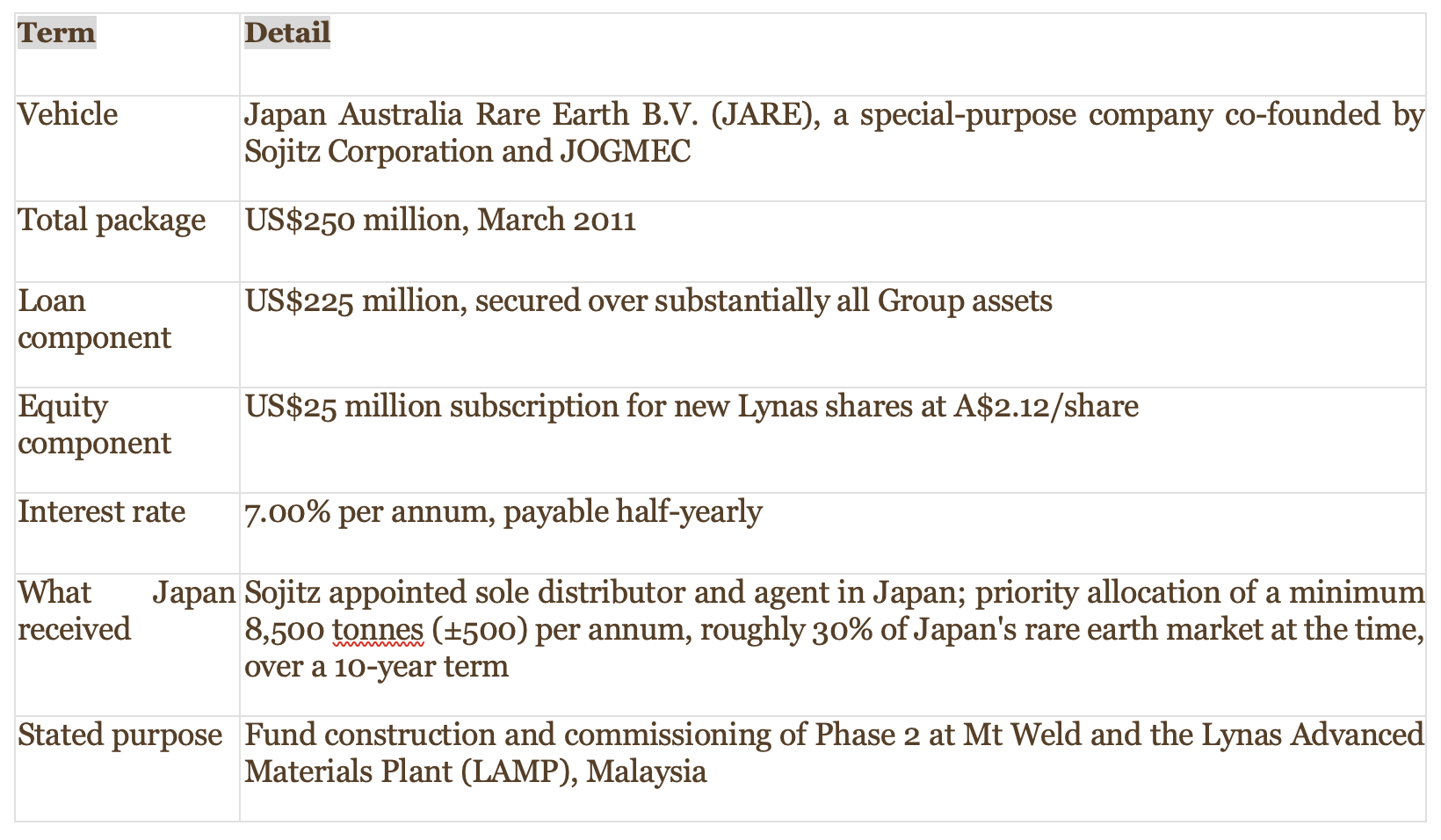
FIGURE 2: LYNAS CAPITAL STRUCTURE
IV. THE CRISIS
Lynas's collapse was, in percentage terms, worse than Molycorp's. Market capitalization fell from roughly A$3 billion in 2011 to roughly A$3 million in 2015 — shares trading at 2.3 Australian cents, a decline of more than 99.9%, compared with Molycorp's 99.5% fall from $79.16 to $0.35.
Three pressures compounded simultaneously. First, the same 2011–2015 rare earth price collapse that sank Molycorp: the NdPr/heavy oxide price fell from roughly US$41.4/kg in July 2014 to US$37.3/kg in June 2015, continuing a multi-year decline from the 2011 peak. Second, the Lynas Advanced Materials Plant (LAMP) in Kuantan, Malaysia — an $800 million facility — faced sustained community opposition and regulatory uncertainty over radioactive waste disposal, dating to 2008 organizing and intensifying through a March 2011 New York Times story and litigation that ran into December 2012. Third, the Group recorded a A$190 million impairment writing down LAMP Phase 1 assets to fair value in the year to June 2014 — net assets fell from A$628.7 million to A$302.0 million in that single year, a decline of A$326.7 million.
Amanda Lacaze took over as CEO in June 2014, inheriting a company by every account fighting for survival.
V. THE RESCUE
The recapitalization was a coordinated package, not a single instrument. Four elements moved together:
1. Operational cost-cutting. Lacaze relocated herself and most remaining staff to Malaysia, closing the Sydney head office and consolidating Sydney/Kuala Lumpur functions — $16 million in annualized savings — alongside a separate $10 million in procurement renegotiation savings. Later reporting put total cost reductions above A$40 million per annum, well in excess of original targets.
2. A genuine rights issue. A 5-for-14 renounceable entitlement offer in September–October 2014 raised approximately A$71 million, alongside a A$12 million institutional placement — roughly A$83 million total, at A$0.08/share, fully underwritten by Patersons Securities. Unlike Molycorp's opportunistic follow-on offerings, this was a genuine pro-rata rights issue, asking existing shareholders to re-underwrite the business alongside new institutional capital.
3. An amended senior debt amortization schedule. Coordinated with the equity raise, the repayment timetable on the JARE facility (then US$215 million outstanding, at 7.00% per annum) was restructured — in Lacaze's words, to "align our debt repayment schedule more closely with the planned growth in profitability."
4. Forbearance at the point of maximum stress. Under a binding term sheet dated March 12, 2015, JARE agreed to defer the principal repayments due March 31 and June 30, 2015 to June 30, 2016 — a deferral of over a year — and agreed that every interest payment due in calendar 2015 would be deposited into a restricted account, available at JARE's own discretion for reuse in the Lynas business. The same term sheet shows Lynas's separate US$225 million unsecured convertible bondholders, led by Mt Kellett Capital Management, agreeing to comparable relief on their own facility in parallel.
Lynas's own FY2015 annual report records the moment plainly: "Both of the Company's debt providers, Japan Australia Rare Earths B.V. and the Mt Kellett led bondholder group, continued to demonstrate their support for the business by extending the term of their facilities and by agreeing to other amendments to the terms of their facilities."
The recovery, once the operational and pricing environment turned, was rapid: FY2016 revenue of $139 million and a $68.5 million loss became FY2017 revenue of $194 million and an $11.2 million loss, as NdPr prices rose from roughly $40/kg in September 2016 to over $90/kg within about a year, and September-quarter 2017 sales reached $88 million, up 108% year-on-year.
VI. FORBEARANCE VERSUS CONVERSION
JARE held the same kind of instrument Molycorp's secured noteholders held senior debt, secured over substantially all of the company's assets, with full legal power to enforce, accelerate, or convert into ownership on default. A purely return-maximizing holder of that position, facing a company that had just lost more than half its net asset value in a year, would ordinarily be assessing recovery value and positioning to take control — which is exactly what Molycorp's noteholders (QVT Financial, JHL Capital Group, JMB Capital Partners) did in 2015, converting their claim into a majority equity stake in the reorganized company.
JARE did the opposite. It deferred principal by more than a year and let contractual interest sit uncollected, at its own discretion, for reinvestment in the business it was owed money by. The difference is legible in the mandate behind the capital, not in the legal instrument itself, which was structurally similar in both cases. JOGMEC exists to secure Japanese industrial supply of rare earths, not to generate an investment return; for JARE, a Lynas that survived and kept producing in 2020 was worth more than a maximized recovery in 2015. Molycorp's noteholders were distressed-debt and arbitrage funds whose mandate was return-maximization, and default gave them the tool — conversion to equity — that best served that mandate.
One qualification is worth adding: JARE's forbearance was not purely a unilateral act of institutional patience. Its senior position sat alongside Lynas's separate US$225 million unsecured convertible bondholder group, led by Mt Kellett Capital Management, and the March 2015 relief was negotiated as a coordinated package between both creditor classes rather than by JARE acting alone. Inter-creditor dynamics of this kind typically mean each side's willingness to grant relief is at least partly conditioned on the other doing the same — a senior lender forcing default when a subordinated class is simultaneously being asked to extend can create its own complications. JARE's mandate likely explains why it was willing to be the anchor of that coordinated forbearance; the existence of the inter-creditor agreement likely explains part of why the relief took the specific, mutual shape it did.
Same instrument. Same enforcement rights. Two different mandates behind the capital, and two different outcomes for the company underneath it.
VII. CLOSING: LYNAS
Lynas's near collapse was, by the numbers, worse than Molycorp's. It faced the identical rare earth price cycle, carried real leverage, and was additionally burdened by a sustained regulatory and community fight over its Malaysian plant that Molycorp never had to contend with. It did not have a cleaner run than Molycorp — it had a different capital structure sitting behind an equally severe crisis, and specifically a lender whose institutional purpose gave it a reason to extend, not enforce, when the test came.
Lynas today is the largest producer of separated rare earth materials outside China. Mountain Pass had to die and be rebuilt under new ownership to reach a comparable position. The difference between those two outcomes was decided in a handful of specific choices — Sumitomo's declined 2010 offer, Molycorp's 2012 leverage decision, JARE's March 2015 forbearance — not in the underlying severity of the crisis both companies faced, which was, if anything, worse at Lynas.
PART FOUR: CONCLUSION
Lay the two companies’ side by side and a single thread runs under every layer: every actor who chose the shortest available time horizon eventually lost the asset; every actor who chose the longest available time horizon eventually kept it. This was true inside Molycorp alone — the 2008 buyout consortium correctly identified Mountain Pass as a generational strategic asset and still exited within thirty months, because that was what its own fund structure required. It was true again through 2011, when Molycorp held the same patient, state-backed architecture that later saved Lynas — Sumitomo's offer for the valuable NdPr fraction of its production — and let it lapse over the course of a year in favour of faster, more liquid public equity. And it was true a final time in 2012, when the company levered itself to the point of no return against a price mechanism three governments were already suing to dismantle.
Lynas was not spared this test. Its collapse was, in percentage terms, worse than Molycorp's, compounded by a regulatory fight Molycorp never had to face. What it had, at the one moment that mattered, was a lender whose reason for existing was never a return — and that lender used the leverage it held to extend the company's life rather than to convert it into ownership. Molycorp's noteholders held the identical instrument and used it for the opposite purpose, because that is what their own capital was for.
None of this required China to do anything beyond setting the table. The 2010 quota policy — whatever its true relationship to a fishing boat collision two months later — created a price environment that drew capital toward rare earths on both sides of the Pacific. What determined which companies were still standing by 2018 was not the severity of that shock, which Lynas absorbed worse than Molycorp did, but the mandate behind the money each company was standing on when the shock arrived.
The West had the same opportunities Japan had. Molycorp had, at different moments, the same opportunities Lynas had. The outcomes diverged anyway, and the reason is visible in the public record: it was decided by what each piece of capital was for.
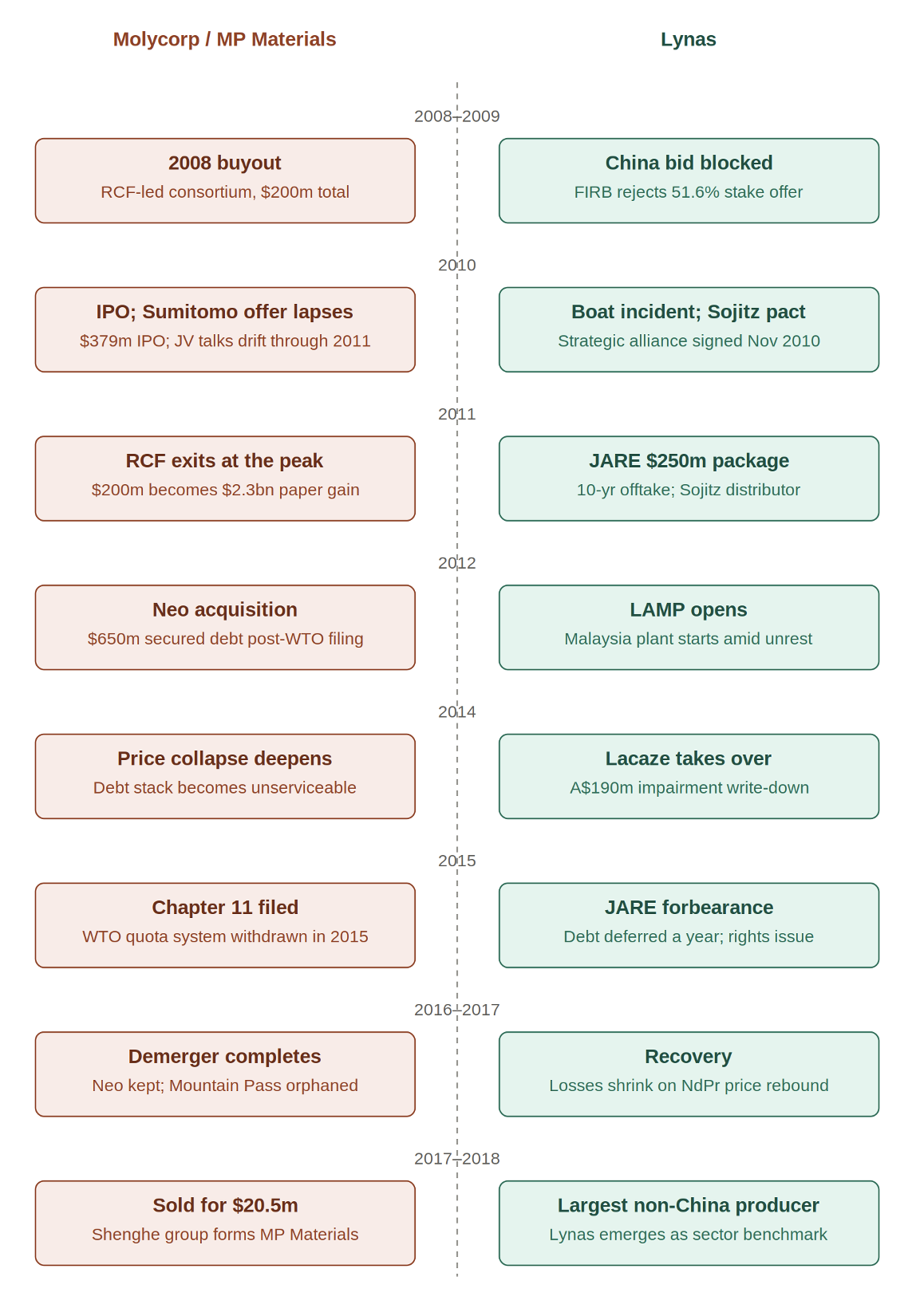
SOURCES
PRIMARY AND REGULATORY FILINGS
Molycorp, Inc. — S-1, S-1/A, 8-K, and 10-K filings, 2010–2015, including prospectuses for the Series A Mandatory Convertible Preferred Stock, the 10% Senior Secured Notes due 2020, the 6.00% and 3.25% Convertible Senior Notes, and the Neo Materials acquisition. U.S. Securities and Exchange Commission, EDGAR (sec.gov/edgar).
MP Materials Corp. — 10-K (FY2023), Form 8-K filings on the U.S. Department of Defense partnership (2025) and the Saudi Arabia/Maaden joint venture. SEC EDGAR.
Lynas Corporation Limited — Financial Report for the year ended 30 June 2014; Interim Report for the half year ended 31 December 2014; Annual Report 2015; Renounceable Rights Issue Prospectus and Capital Raising ASX announcements, September–October 2014. lynasrareearths.com, Reporting Centre.
Japan Organization for Metals and Energy Security (JOGMEC) — news releases on the Sojitz/JOGMEC financing agreements with Lynas (2011), and subsequent JARE investments (2022, 2023). jogmec.go.jp.
Sojitz Corporation — news releases on the Lynas strategic alliance and offtake agreements (2011, 2022, 2023, 2026). sojitz.com.
NEWS AND WIRE REPORTING
Business Wire — Molycorp press releases on the Neo Materials acquisition, the Sumitomo memorandum of understanding, and related financings, 2010–2012.
Bloomberg — "Molycorp Bonds Surge as Peer Gets Equity Funding" (2014); "Qatar-Backed Mining Fund Said to Scrap Expansion Plans on Rout" and related QKR Corp. reporting (2014–2015).
Forbes — Nathan Vardi, "The Money Man Behind America's Rare Earth Minerals" (2010) and "The Rare Earths Stock Market Failure 60 Minutes Forgot" (2015); Tim Treadgold, "Down to Earth: Amanda Lacaze Turns Around Australia's Lynas Corp." (2017); Michael Kanellos, "Three Lessons From The Woeful Tale Of Molycorp" (2015).
Reuters, RTTNews, ProactiveInvestors, and CHEManager — reporting on the Molycorp–Sumitomo financing negotiations and termination, 2010–2011.
Mining.com, Mining Technology, Mining Journal, and The Northern Miner — reporting on Mountain Pass's operating history, the 2008 Resource Capital Funds-led buyout, and the 2015 shutdown.
High Country News — "The U.S.'s only rare-earth mine files for bankruptcy" and "Why rare-earth mining in the West is a bust" (2015).
InvestorNews — "From Survival to Strength: How Amanda Lacaze Transformed Lynas Rare Earths" (2025); coverage of Neo Performance Materials' European magnet plant and China operations.
POLICY, TRADE, AND ACADEMIC SOURCES
CEPR/VoxEU — "Revisiting the China–Japan Rare Earths dispute of 2010."
East Asia Forum — "Did China really ban rare earth metals exports to Japan?" (2013).
Asia Maritime Transparency Initiative (CSIS) — "Counter-Coercion Series: Senkaku Islands Trawler Collision."
World Economic Forum — "How Japan solved its rare earth minerals dependency issue" (2023).
The Diplomat — "Japan's Critical Minerals Resilience Didn't Start in 2010 – or 2026" (2026).
New Security Beat (Wilson Center) — "How to Diversify Mineral Supply Chains – A Japanese Agency has Lessons for All" (2024).
IEEE Spectrum — "The Magnet That Made the Modern World" (2023), on the invention of the NdFeB magnet by General Motors and Sumitomo Special Metals.
Binnemans, K. et al. — "Rare-Earth Economics: The Balance Problem," Journal of Sustainable Metallurgy / JOM (2013, 2018).
COMPANY AND INDUSTRY SOURCES
MP Materials Corp. — corporate history page, mpmaterials.com/history.
Neo Performance Materials — Annual Information Form (2024) and investor materials, neomaterials.com.
Rare Earth Exchanges and Rare Earth Mining — sector analysis on MP Materials, Lynas, and Neo Performance Materials competitive positioning (2026).
Preferred Stock Channel, Justia, and SEC EDGAR contract filings — terms of Molycorp's Series A Mandatory Convertible Preferred Stock and related Traxys sales/buy-back agreements.
Note: this list reflects the sources drawn on while preparing this paper. Figures and quotations have been cross-checked against primary filings where available; where only secondary reporting could be found that is noted in the text itself.
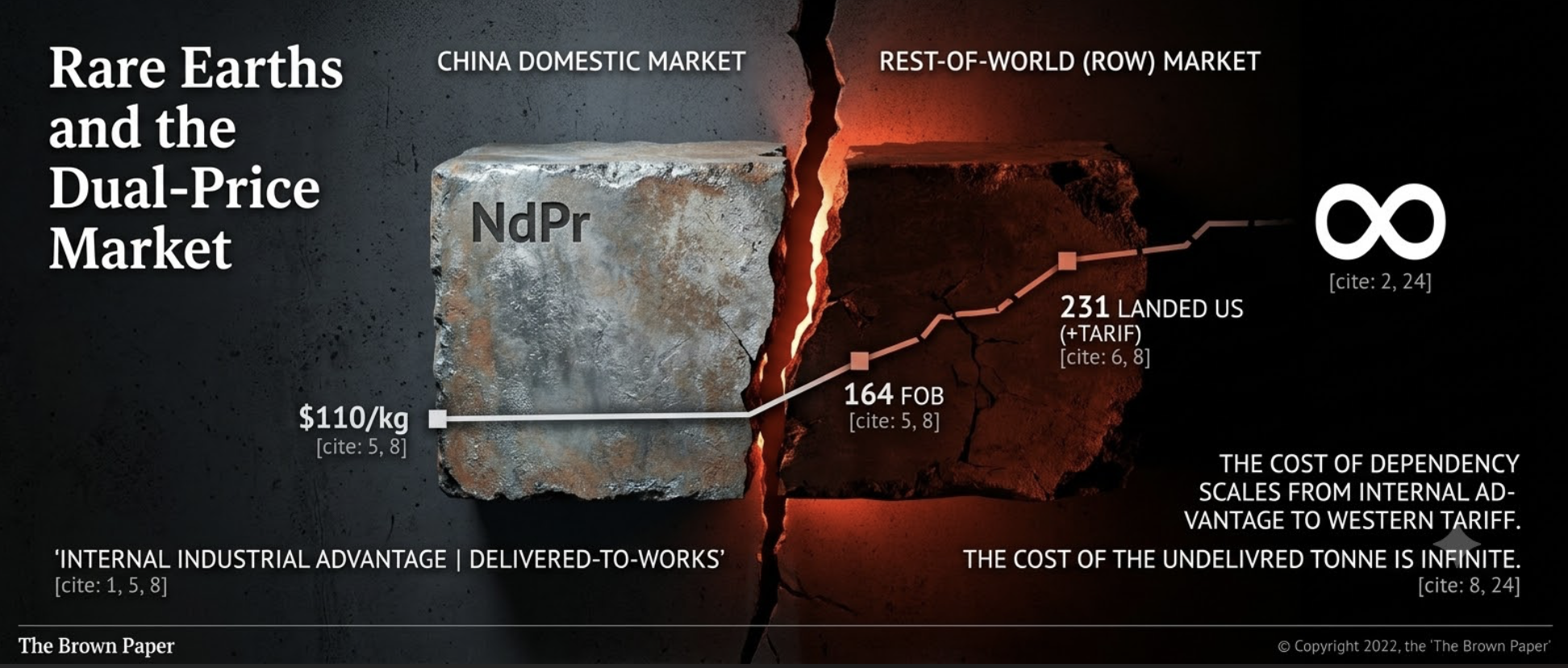
Rare Earths and the Dual-Price Market
A kilogram of neodymium and praseodymium costs $110 inside China. The same kilogram, loaded for export, costs $164. Landed in the United States, it costs $231.
That spread is not a pricing anomaly. It is the cost of dependency, and it is the subject of this paper.
Rare Earths and the Dual-Price Market traces how China's rare-earth market split in two: a domestic price reflecting its own industrial advantage, an export price reflecting everyone else's scarcity. It follows the evidence from the 2011 spike and collapse that killed Molycorp and spared Lynas, through the WTO ruling the West won and came to regret, to the export controls, arrests and cutoffs that show China has no intention of standing that architecture down.
It asks what a distressed acquisition in Tanzania and a tightening feedstock base suggest about how Beijing really sees the West, and the question every OEM sourcing NdPr has already answered, knowingly or not: what are you prepared to pay to avoid finding out the price of doing nothing?
How SMM's FOB Quote Illustrates the Cost of Western Dependency
Rare-earth pricing now matters to anyone who builds EVs, wind turbines, robots, motors, defence systems or industrial platforms, not only to metals traders. The reason is that material which cannot be delivered has no usable price at all.
A chokepoint material
Neodymium-iron-boron magnets are the strongest permanent magnets in commercial production, and their performance depends on two elements, neodymium and praseodymium, which are almost always sourced and traded together as a single alloy input known as NdPr oxide or NdPr metal. These magnets sit inside EV traction motors, wind turbine generators, robotic actuators and precision defence systems, wherever a large amount of magnetic force is required from a small, lightweight component. No substitute technology matches them at scale, which is why NdPr specifically, rather than rare earths as a broad category, is the material chokepoint for electrification.
NdPr, together with a smaller volume of heavy rare earths such as dysprosium and terbium, used to hold magnet performance at high temperatures, is what makes the wider electrification of the global economy possible. These magnets let an electric motor convert stored energy into mechanical force at an efficiency fossil-fuel drivetrains cannot match, and that efficiency gain, paired with continuing improvements in battery energy density, is the basis of the shift now under way across transport, power generation and industrial equipment. Electrification is a step change in energy conversion efficiency, and NdPr magnets are one of the two components, alongside the battery itself, that make it physically possible.
China's refining advantage
China's pricing power does not come from reserves. It comes from processing. China holds an estimated 40% of global rare-earth reserves and around 60% of mining output, but its share of separation and refining capacity, the step that turns raw ore into tradeable oxide, runs above 90%. Refining is the harder step to replicate, and that is where China's advantage sits. Whoever controls refining controls the price. China controls the refining.
A small market with outsized leverage
It is worth stating the size of this market directly. The global rare earth magnet market is worth somewhere in the region of US$15-20 billion a year, depending on which estimate you use. Global copper is worth roughly US$250-300 billion a year, so rare-earth magnets are perhaps one-fifteenth the size.
That comparison is the reason this material is worth writing about. A market smaller than most countries' agricultural exports determines whether EV motors, wind turbine generators, robotics actuators and a meaningful share of precision defence systems can be built at scale.
There is no substitute technology for what NdPr magnets do and no meaningful production base for them outside China. That mismatch between size and leverage is what asks the pricing questions in the rest of this piece worth taking seriously.
Two prices, one market
China's rare-earth market is priced in two ways: delivered-to-works, the price with material already delivered to the buyer's plant in China, and FOB (free-on-board), the price once material is loaded onto a vessel at a Chinese port, ready for export. FOB is the standard basis for international trade because it marks the point at which cost and risk pass from seller to buyer.
SMM as the benchmark
SMM, Shanghai Metals Market, is the industry-standard price-reporting agency for Chinese metals and the highest-liquidity benchmark in this sector. It is not the only price-reporting agency covering rare earths. Argus and a handful of other platforms publish periodic rare earth market insight, and Benchmark Mineral Intelligence introduced its own ex-China price assessments in mid-2025, but Benchmark's ex-China grades are published monthly.
SMM's advantage is frequency and depth: its domestic China spot prices are assessed daily, and its FOB China price points, added from late 2025 into early 2026, are updated weekly. That higher-frequency liquidity is what makes SMM's data usable for the kind of granular, near-real-time comparison this piece relies on, and it is why SMM, not a monthly assessment, is the reference point throughout.
SMM has faced criticism in some quarters for being politically influenced, given its location and proximity to the market it reports on. That criticism is largely unfair. SMM operates within the constraints of where it sits, as any price-reporting agency does, but the evidence suggests it tries to be as independent as the environment allows, and its methodology, specification details, and price-submitter process are more transparent than the criticism usually credits.
The limits of a domestic price
The more difficult problem lies one level up and is not about SMM. A domestic Chinese spot price, however, honestly reported, cannot be representative of a global market because it reflects only transactions within China. The issue is not that the quote is biased. It is that China is the market, to an extent that makes a purely domestic price look like the whole picture when it is only one side of it.
The FOB quote goes some way to addressing that by putting a number on the export side of the transaction for the first time. But going some way is not the same as solving it, and there is a real case that the industry needs an independent, high-liquidity, ex-China benchmark of its own rather than relying on a China-based quote, however well run, to stand in for a market it can only ever half describe.
The domestic blend: SMM-RE-OX-001
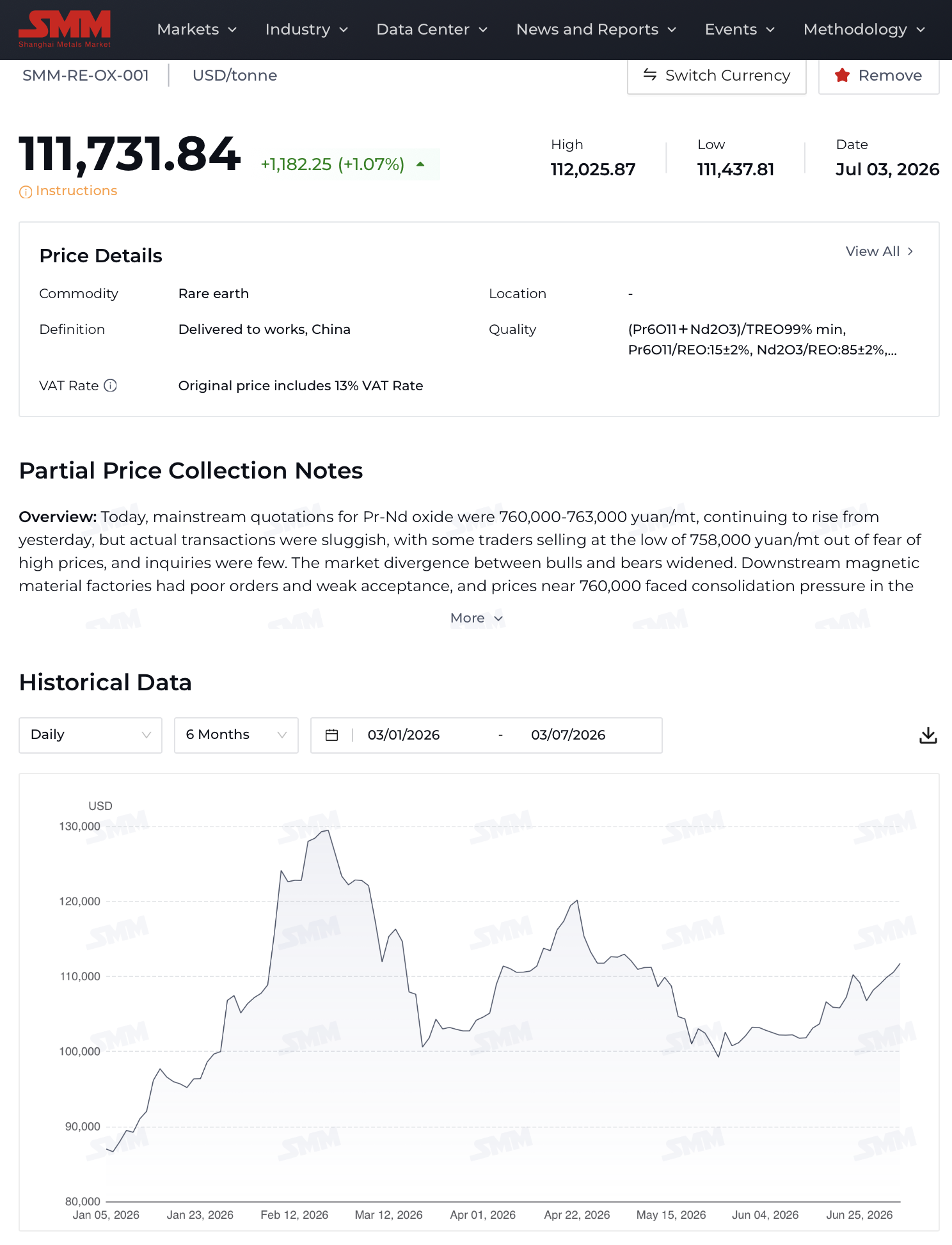
SMM publishes a dedicated Pr-Nd Oxide product, SMM-RE-OX-001, specified to GB/T 31965-2015 as Nd₂O₃/REO 85±2% and Pr₆O₁₁/REO 15±2%. As of 1 July 2026, this 85/15 internal blend traded at approximately US$109.87/kg (US$109,869.92/tonne), delivered to works inside China, VAT-inclusive, under China's standard 13% VAT. This is the cleanest internal China reference point because it is an actual traded basket rather than a synthetic blend built from standalone oxide quotes.
Adjusting for specification and VAT
Two adjustments matter before this figure can be compared to anything traded outside China. The first is specification. The 85/15 Nd/Pr ratio used domestically is not the basket the wider market usually references; most NdPr FOB and offtake pricing is quoted on a 75/25 basis. Inside China, this barely matters because standalone Nd₂O₃ and Pr₆O₁₁ are currently priced close to each other, so an 85/15 basket and a 75/25 basket built from the same internal quotes land in roughly the same place. FOB is different: neodymium carries a large premium over praseodymium there, so comparing an 85/15 domestic quote directly against a 75/25 FOB number is not like-for-like, and any resulting gap is a specification artefact rather than a market signal.
The second is VAT. The domestic 85/15 price is VAT-inclusive; the 13% is paid by the Chinese buyer and forms part of the domestic transaction price, and should not simply be stripped out to create an FOB-comparable number. Rare earths carry no export VAT rebate, so the VAT a domestic buyer pays and the VAT cost an exporter cannot recover sit on different sides of the transaction and are not interchangeable. The domestic price already includes VAT paid by the Chinese buyer, while FOB-side costs are pushed up, not down, because input VAT cannot be reclaimed against rare-earth exports as it can for rebate-eligible products. The build-out from FOB toward landed US cost reflects this second effect; it is not a reversal of the first.
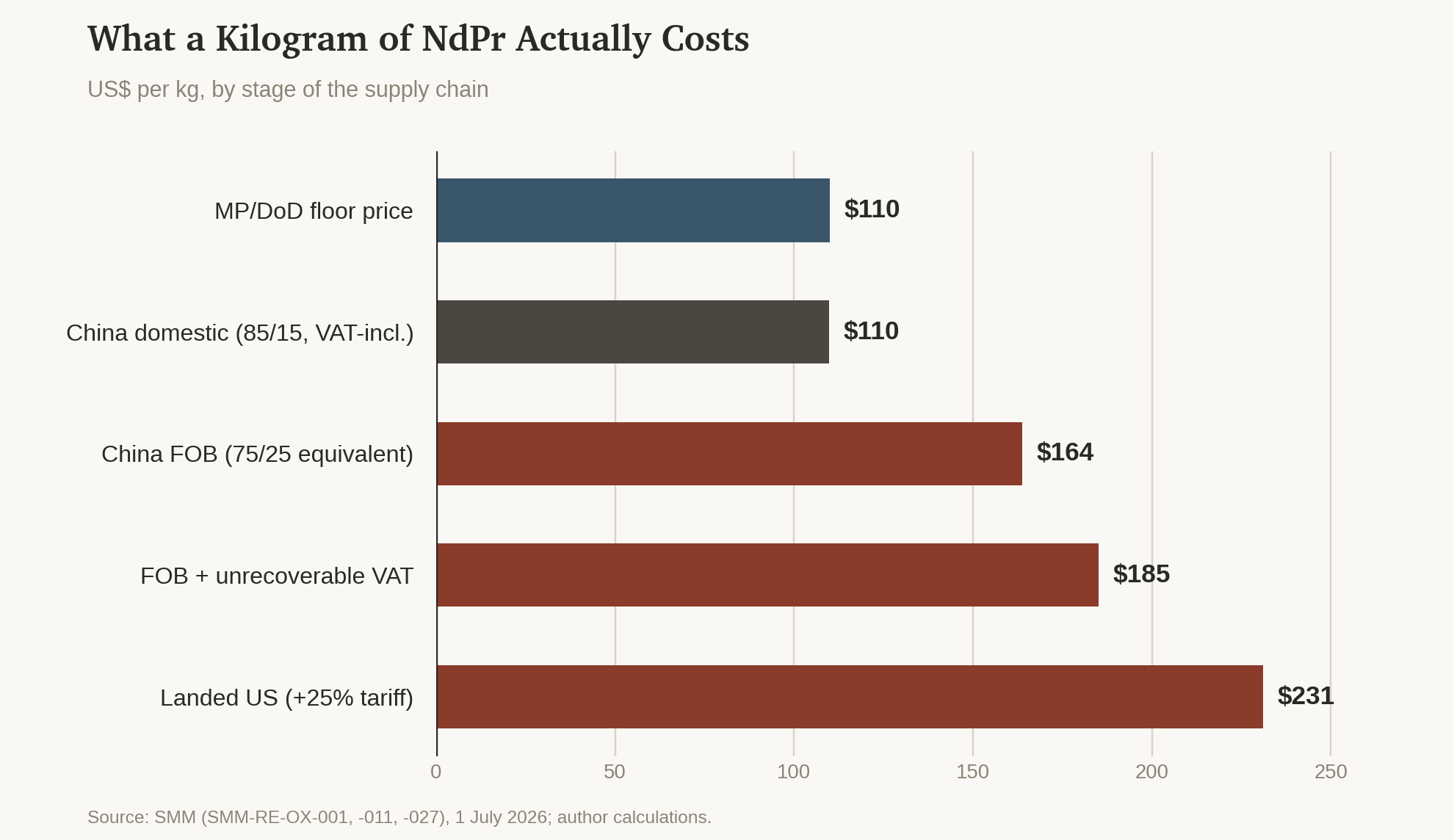
The FOB numbers
The China FOB market tells a different story. As of 1 July 2026, SMM quoted neodymium oxide (SMM-RE-OX-011, FOB China main ports) at US$176/kg and praseodymium oxide (SMM-RE-OX-027, FOB China Port) at US$127/kg. Recalculated as a 75/25 NdPr basket:
0.75 × US$176 + 0.25 × US$127 = US$132.00 + US$31.75 = US$163.75/kg
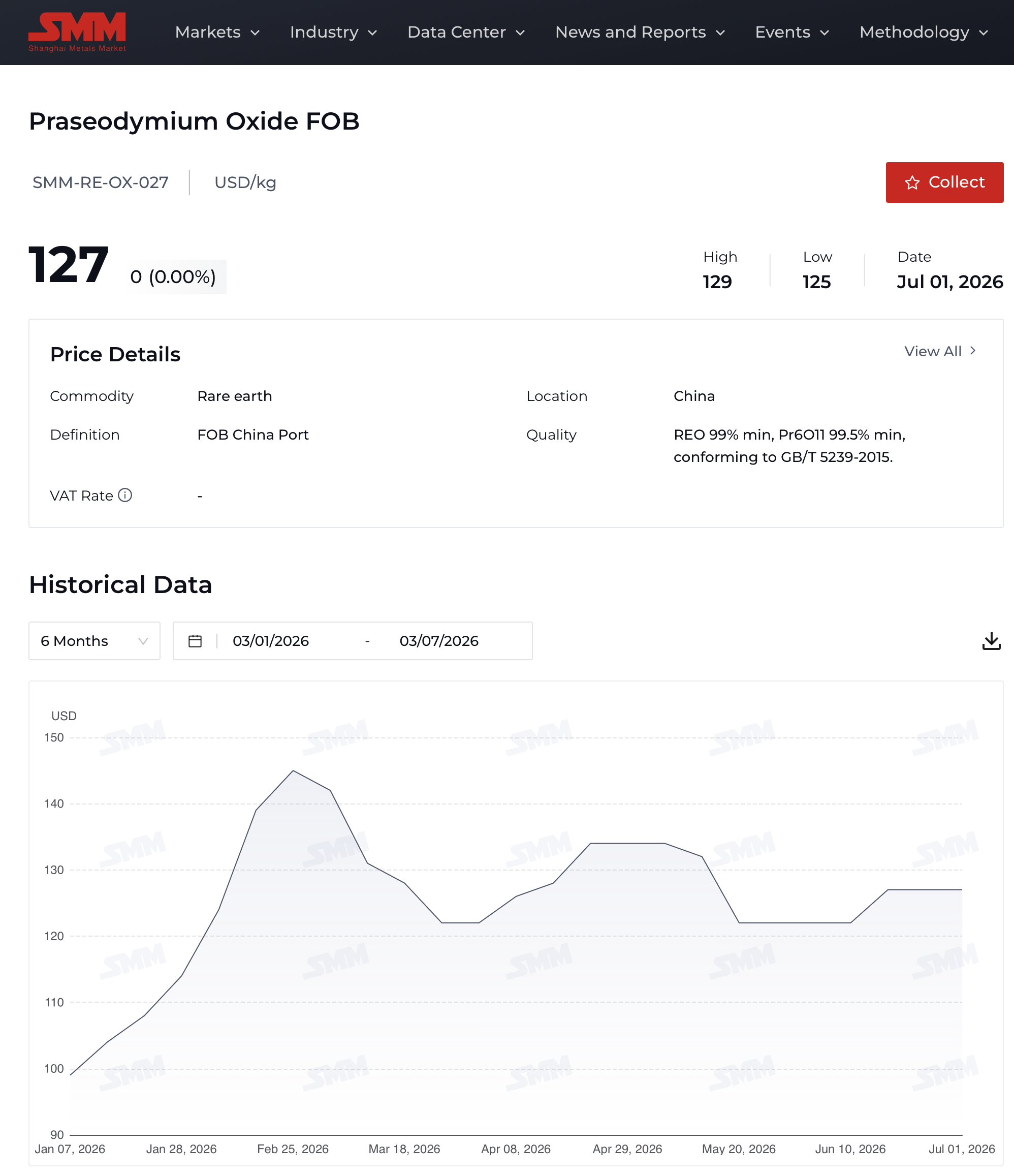
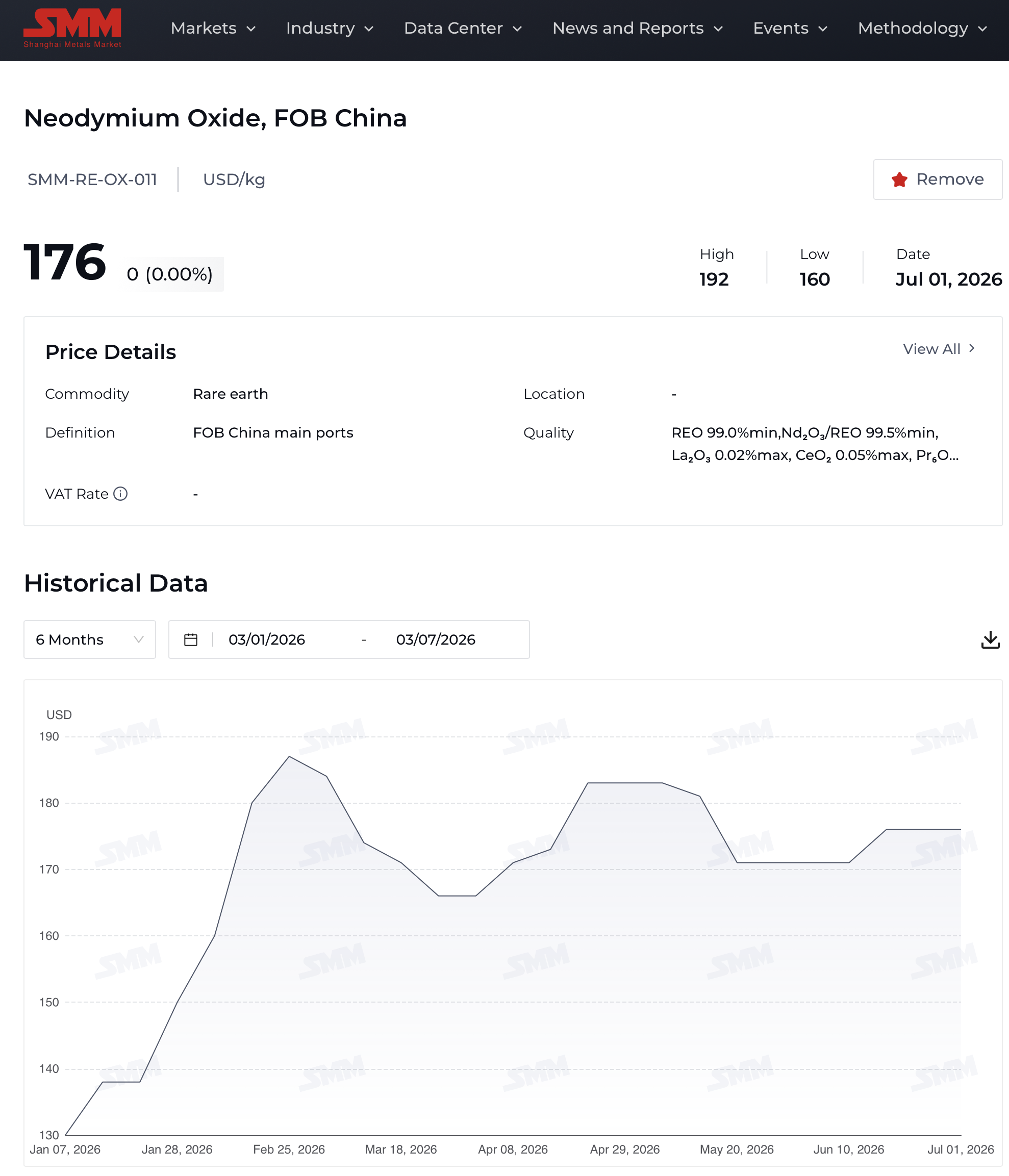
Add unrecoverable VAT exposure, and the cost basis moves toward US$185/kg. Into the United States, with a 25% tariff on top, the landed entry cost can move toward US$231/kg
That is not a typical pricing spread: roughly US$110/kg domestic against US$164/kg FOB-equivalent before VAT and tariff effects, and it shows two markets rather than one. China's internal spot reflects the price inside China's industrial system. China FOB reflects overseas demand competing for
restricted exportable supply. FOB is a real market price, but it is a price formed under restricted supply.
Feedstock under pressure
Until SMM began publishing FOB prices in earnest at the end of 2025, the only rare-earth price quotation available to the market was the Chinese domestic spot price. That price reflects what Chinese buyers are paying for spot tonnes inside China, and read on its own, over a long enough run, it is a reasonable proxy for China approaching the limits of its own capacity, whether that constraint sits in feedstock or in processing.
For most of the past decade, that constraint was rarely a feedstock. China could supply its own market from its own ore with little difficulty, so a domestic price spike more often signalled processing bottlenecks or a genuine demand surge than any shortage of raw material. That has started to change.
Feedstock has become a live issue over the past two years because a material share of China's heavy rare-earth ore, dysprosium and terbium in particular, is sourced from Kachin State in northern Myanmar, and the civil conflict there has repeatedly disrupted those flows, including the loss of the Pangwa and Chipwi mining hub to Kachin forces in October 2024 and further supply interruptions during the fighting around Bhamo since.
Feedstock has also narrowed from the other direction. MP Materials, which had shipped its Mountain Pass concentrate to Shenghe Resources in China for processing, ceased those sales in mid-2025 as part of its DoD-backed floor-price agreement, redirecting output toward its own US processing and magnet capacity instead.
In December 2025, Brazil's Serra Verde, whose Pela Ema deposit is one of the few scalable non-China, non-Myanmar sources of dysprosium and terbium, renegotiated its roughly decade-long Chinese offtake agreements down to expire at the end of 2026, roughly eight years early, clearing the way for Western buyers once its output is freed up; a US$565 million DFC loan and a subsequent US$2.8 billion acquisition by USA Rare Earth followed within months.
None of these three cuts, Myanmar, MP, and Serra Verde, is individually large next to China's total feedstock base, but all three point the same way, and all three are recent. A domestic price spike now carries a second possible reading it did not carry before: not only is China approaching its processing limits, but its own feedstock security is being tested from more than one direction at once, on a border it does not fully control and from suppliers that have chosen to walk away.
The Ngualla exception
There is one acquisition running the other way, and it is worth being precise about what it does and does not change. In September 2025, China's Shenghe Resources completed a takeover of Peak Rare Earths, the owner of the Ngualla deposit in Tanzania, one of the largest NdPr-weighted deposits outside China, for roughly A$158-200 million. Against the Ore Reserve's contained NdPr, which values the resource in the ground at somewhere around US$0.55 to 0.70 per kilogram, a distressed price by any measure, made possible by Peak's collapsed share price, down from over A$1 in 2021 to around A$0.12 before the deal.
But this is not really a counterexample to the feedstock argument, for two reasons. First, Shenghe already held roughly 20% of Peak and 100% of its offtake before the takeover, so this consolidated a position it effectively already controlled rather than opening a new one; Ngualla's concentrate was always contracted to flow into Chinese processing regardless of who owned the equity.
Second, Ngualla is unlikely to be developed soon. Tanzania's government holds only a 16% free-carried interest, but its 2017 mining law tightened equity requirements and restricted the export of unprocessed concentrate, and the in-country processing terms Shenghe would need to finalise before a final investment decision have remained under negotiation into 2026 rather than resolved.
Some recent reporting suggests Shenghe may be content to leave the project mothballed rather than rush to meet Tanzanian in-country processing demands, particularly if China's own restrictions on exporting mining equipment, technology and personnel for critical-minerals projects abroad make that harder to justify. Tanzania has little practical leverage to force the pace: a free-carried minority stake gives it a seat at the table, not control over the timeline, and that will not change unless Tanzania rewrites the terms it negotiated with a different counterparty in mind.
The result is not additional supply for anyone. Ngualla is not adding tonnes to China's own processing pipeline, and it is not adding tonnes to the rest-of-world supply chain either; one of the world's largest NdPr-weighted deposits sits denied to both, which adds to the supply and price pressure described in this piece.
It also leaves Tanzania holding a free-carried stake in a mine that produces nothing, no royalties, no jobs, no processed value, for as long as the standoff over in-country processing terms continues. Read alongside Myanmar, MP and Serra Verde, Ngualla looks less like China building a new pillar of supply and more like China banking a cheap option against a future it is in no hurry to bring forward, at a cost being paid, for now, by Tanzania as much as by anyone else.
None of this is necessarily permanent. The standoff would break if a Western or Tanzanian-aligned party were willing to fund in-country processing on Tanzania's terms rather than wait for Shenghe to do so on its own. But that is not where investor capital is currently going in Africa, at least on paper.
Rest-of-world projects in the queue
Angola's Longonjo project is already at the construction stage with a 2027 commissioning target, backed by financing secured in December 2025 and an offtake agreement with the German magnet maker Vacuumschmelze. Malawi's Kangankunde project reached a final investment decision in August 2025, with Lindian Resources reporting construction progress through its own announcements toward a targeted Q4 2026 first production.
Both projects are further along the development curve and further along the queue for capital and offtake attention than Ngualla currently is. Ngualla sits behind them not because it is a worse deposit, but because it is a better deposit tied up in a worse negotiation.
Export controls as domestic supply security
That tightening feedstock picture points to an easy-to-miss reading of the export controls themselves. The controls are usually discussed as a form of leverage in the US-China trade relationship, and they clearly function that way. But leverage is not the only thing they do, and possibly not even the main thing. With a US$50-US$90 spread between the domestic price and the FOB-equivalent price for the same tonne of NdPr, a Chinese producer facing no export restrictions has every commercial incentive to sell into the export market rather than supply Chinese magnet and EV manufacturers at the lower domestic price.
Export controls, licensing and quotas do not only ration what the West receives; they also cap how much of a tightening domestic supply Chinese producers are permitted to divert abroad in pursuit of that spread. Read that way, the controls look less like a tool built for foreign policy that happens to also secure domestic supply, and more like a domestic supply-security mechanism that China is willing to use for foreign policy when convenient. Without them, and with feedstock now genuinely constrained, there is little reason to think China's own producers would prioritise the domestic market over the export price they can command.
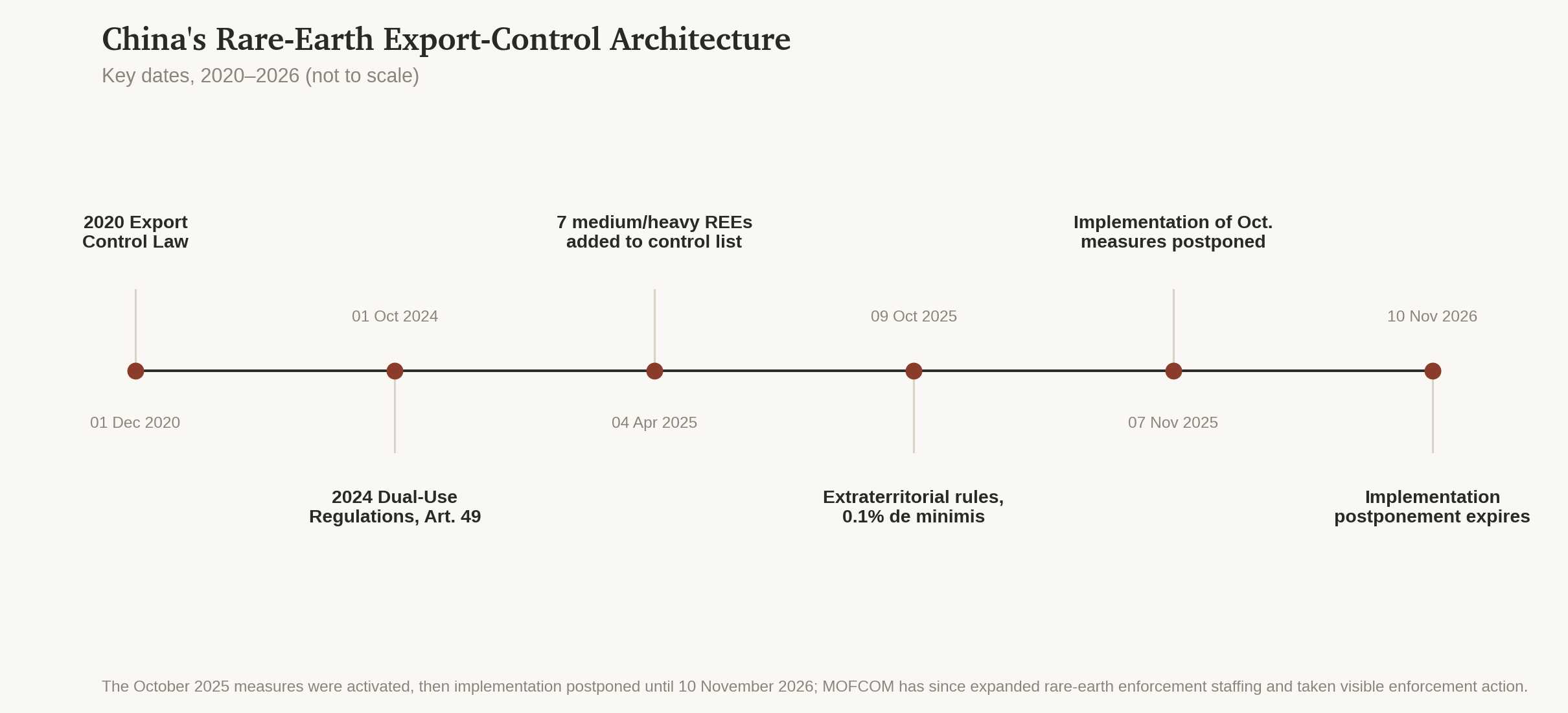
SMM's FOB quote in context
The emergence of SMM's China FOB quote should be read in that context. Western buyers were increasingly finding the daily Chinese domestic spot quote irrelevant as a procurement benchmark: it still reflected China's internal industrial cost base but no longer reflected the price, availability, or permission risk faced by overseas buyers. A delivered-to-works in China price is not the same as an exportable, licensable, deliverable Western supply price, and SMM's FOB quote did not create that split; it acknowledged it. The quote begins to monetise the scarcity component of Western dependency. It is not the full Western cost, since tariffs, protectionism, rules of origin, compliance, financing and strategic inventory can all sit on top of it, but it is the first visible price marker showing that the West is no longer dealing with the same market as China's domestic manufacturers. China's domestic spot shows China's internal industrial advantage, SMM FOB shows the scarcity premium faced by the West, and Western protectionism adds a further layer on top. That is the cost of dependency, and it is why China's rare-earth market now must be read as two markets rather than one.
Why China FOB is both useful and risky
China FOB is useful because it gives OEMs, investors and governments a financial measure of dependency, showing what overseas buyers may have to pay when they rely on Chinese exports of materials that China can restrict, license, delay or refuse. It gives OEMs a way to quantify the cost of failing to secure independent supply.
But China FOB is risky if it becomes the benchmark for building the rest-of-world supply chain. Chinese OEMs compete on China's internal pricing, now anchored to the actual traded blend at roughly US$110/kg. Western, Japanese and Korean OEMs cannot build competitive EVs, wind turbines, robots, motors, defence systems or industrial platforms if their input costs are permanently set by China FOB. China FOB prices the risk; it should not become the target. The target is a rest-of-world supply chain that can eventually compete more closely on pricing with China's domestic market, while still offering sufficient returns to attract investment.
Where the floor sits
History has already tested this. Of the two major non-China NdPr producers that scaled up around the 2011 price spike, only one survived the collapse that followed. Molycorp's Mountain Pass operation restarted into the spike, expanded aggressively, and was funded heavily by debt, with no long-term offtake or price-support structure behind it; when prices fell back, Molycorp collapsed into Chapter 11 bankruptcy. Lynas survived. The difference was not geology or grade, since both were credible deposits; it was structure. Lynas had Japan behind it through JOGMEC and Sojitz, with loan-and-equity support, offtake and a route into Japan's industrial supply chain. Japan was not simply backing a mine; it was backing supply continuity, and that is why Lynas survived the trough: it had more than a resource and a processing plant; it had a buyer-backed structure tied to strategic demand. That is the lesson now being rediscovered in the United States.
The collapse itself deserves a closer look than it usually gets, and here I will give my own reading rather than the more common one. The standard account treats 2011 as straightforward: China restricted exports, prices spiked, competitors entered, China eased off, prices fell, competitors failed. I think the mechanism was more specific than that, and the timing supports it. The US, EU and Japan took China to the WTO over its export quotas in 2012; the WTO ruled against China in March 2014; and China, having exhausted its appeal, dismantled the quota system in stages between January and May 2015. Molycorp filed for Chapter 11 in June 2015, within weeks of China's compliance deadline. That sequence is not proof of intent, but it is more specific than "prices normalised."
My own view is that China had built out mining and processing capacity through the quota years to hedge against exactly the outcome the West was pursuing at the WTO: a ruling that would force the taps back open. When that ruling landed and the quotas came off, the capacity was already there, and it flowed. Whether that was foresight or simply the ordinary lumpiness of Chinese capacity build-out meeting a sudden change in export rules, the effect was the same either way, and the timing is hard to read as coincidence. The West fought for, and won, the legal right to unrestricted Chinese rare-earth exports. What it got, within months, was a price collapse that killed the one meaningful non-China competitor the 2011 crisis had produced, and left China's market position stronger than before the case was filed.
I do not think that lesson was lost on Beijing, and I do not think it has been revised since. In the decade since, China has not, as far as I can tell, treated the West as a market to be cultivated or a supply chain to be shared. It has treated it as a sink: somewhere to place excess capacity when convenient, and somewhere to withdraw supply from when it is not. That reading fits the pattern better than the alternative, and the April 2025 controls, discussed below, support it.
OEM behaviour after 2011 was straightforward. Chinese supply remained available, and once prices normalised, OEMs went back to it. They did not maintain the offtake and pricing support needed to keep non-China alternatives alive, and there was no commercial penalty for ignoring the warning.
This time is different. China's modern export-control architecture rests on the 2020 Export Control Law and the 2024 Regulations on Export Control of Dual-Use Items; Article 49 of the 2024 regulation provides the legal basis for extraterritorial reach. On 4 April 2025, MOFCOM added seven medium- and heavy-rare earths, including terbium, dysprosium, samarium, gadolinium, lutetium, scandium and yttrium, to the control list, and exports now require case-by-case licences with a stipulated 45-working-day review period. On 9 October 2025, MOFCOM went further: it activated extraterritorial jurisdiction, requiring licences even for transfers of controlled rare earths between two countries outside China, and introduced a 0.1% de minimis rule for foreign-made products containing Chinese-origin rare earths alongside a 50% affiliates rule for related entities. Following US-China talks, China postponed implementation of the October measures on 7 November 2025 until 10 November 2026. That is a postponement of implementation, not a suspension of the measures themselves, and expiry of the postponement is not a review.
Why the postponement is not a wind-down
A postponement invites comparison to 2011: pressure, then relief, then a drift back to normal. Nothing in the record since 7 November 2025 supports that reading. The legal architecture, licensing bureaucracy and April 2025 controls remain in force throughout the postponement, and MOFCOM has been staffing up, not standing down, while it runs. Reporting in late 2025 indicated that its Bureau of Industry Security, Import and Export Control was launching its largest recruitment drive in nearly a decade, with the rare-earth control division a specific focus even as the truce with Washington held. Enforcement has followed the hiring. By mid-2026, a Chinese optics company chairman had been placed under compulsory measures over mis declared export documentation, MOFCOM had introduced a public reporting mechanism for strategic-mineral violations effective 1 July 2026, and China had added 10 US entities, including MP Materials and USA Rare Earth, to its export control list.
The clearest signal is Japan. Chinese customs data show that exports of dysprosium oxide to Japan stopped after October 2025, and of terbium oxide a month later, with no shipments of either recorded since. Beijing formalised the restriction through MOFCOM Announcement No. 1 of 2026, tightening licensing for medium- and heavy-rare-earth exports to Japan against the backdrop of remarks by the Japanese government on Taiwan. Two Japanese nationals, both Fuji Electric group employees, were detained in Dalian in May 2026 on suspicion of smuggling goods banned from export, and Japanese officials confirmed on 1 July 2026 that both had since been formally arrested, in mid- and late June respectively, over an alleged breach of China's rare-earth export-control law: one of the first known cases of a foreign national facing formal arrest in China over an alleged rare-earth export violation.
Read together, the Japan case shows China is willing to use this architecture with precision against a specific country and is prepared to do so again. A return to business-as-usual looks unlikely. An OEM that assumes it can wait out this cycle and return to Chinese supply is assuming an option that China is building the machinery, and now demonstrating the willingness, to switch off.
The floor mechanism
That is why OEM-backed offtake and floor structures are no longer discretionary. A floor around US$110/kg looks reasonable: it sits almost exactly on the actual traded 85/15 internal NdPr price of around US$110/kg, and well below the US$164/kg FOB-equivalent.
It is worth being clear about what this floor is and is not. It is not a subsidy intended to run indefinitely, and it is not protectionism dressed up as industrial policy; it is a temporary underwrite, priced close to where China's own domestic market already clears, that exists to get capital-intensive projects financed during the years before they have volume behind them.
It does not institutionalise a permanent scarcity premium; it creates bankability during the capital-intensive build-out phase. The mechanism gives projects the revenue visibility needed to finance assets, amortise capital expenditure and improve metallurgical performance, and as rest-of-world mining, separation and processing scale up, unit costs should compress toward industrial parity.
The floor is a bridge, not a destination: over time it should matter less as volume-driven price discovery takes over, and a floor still in place once that volume exists would be the clearest sign the model had failed.
The Lynas/Japan structure shows the principle in practice. The revised JARE agreement commits to 5,000 tonnes per annum of NdPr through 2038, with a US$110/kg floor price, while preserving Japanese access to long-term non-China supply. Mines and separators need throughput, offtake and scale; a small high-priced market may support a few assets, but it will not create a competitive industrial base. The rest of the world does not need a high-price rare-earth market. It needs a high-volume rare-earth supply chain.
The central tension
Investors need an acceptable risk-adjusted return. OEMs need secure supply at prices that allow them to compete with Chinese finished goods. Governments need resilience, but public money alone cannot create a market, and price reporting agencies can publish indices but cannot create price discovery without physical transactions. OEMs have to pick up the baton. They cannot expect China internal pricing before the non-China supply chain exists, but they also cannot accept China FOB indefinitely and expect to compete with Chinese OEMs.
Europe shows what happens when they do not. Solvay's La Rochelle plant is one of the few operating rare-earth separation facilities outside China, and CEO Philippe Kehren has been explicit that it is running at deliberately low output while it waits for exactly the kind of offtake commitment this section is describing: full-scale expansion, on the order of €100 million, is being held back for orders from automakers that have not yet arrived.
Kehren has separately described the support on offer in Europe as limited compared with what is available in North America, to the point that Solvay is now weighing a US facility alongside, or instead of, further French expansion. He is not an outlier. Other European rare-earth executives have told Reuters they cannot commit to raising output by 2030, and one industry analyst summarised the problem directly: at current price levels, most projects are not profitable without support from governments and automakers together.
That is the central tension in miniature, playing out at the one facility Europe has.
The question is not which material is cheapest today. It is what a manufacturer is prepared to pay during the build-out phase to secure supply that eventually allows it to compete. The China FOB spread helps answer that question: it gives OEMs a number to weigh against the cost of supporting independent supply through offtake, floors, prepayments, equity, inventory, or supply-chain partnerships.
The requirement of physical availability
Price is now secondary to physical availability. China FOB only matters if China is prepared to export. For a modern manufacturer, material that cannot be delivered has no price at all, and once export controls become industrial policy, procurement is no longer just cost optimisation; it becomes operational continuity. The buyer has to ask whether material will be supplied, whether a licence will be granted, whether the end use will be accepted, and whether the customer will be approved. The rest-of-world supply chain is not just competing with China FOB; it is competing with the possibility of no supply at all. OEMs need ex-China material because secure physical access to volume is now a prerequisite for manufacturing continuity.
The architecture is taking shape.
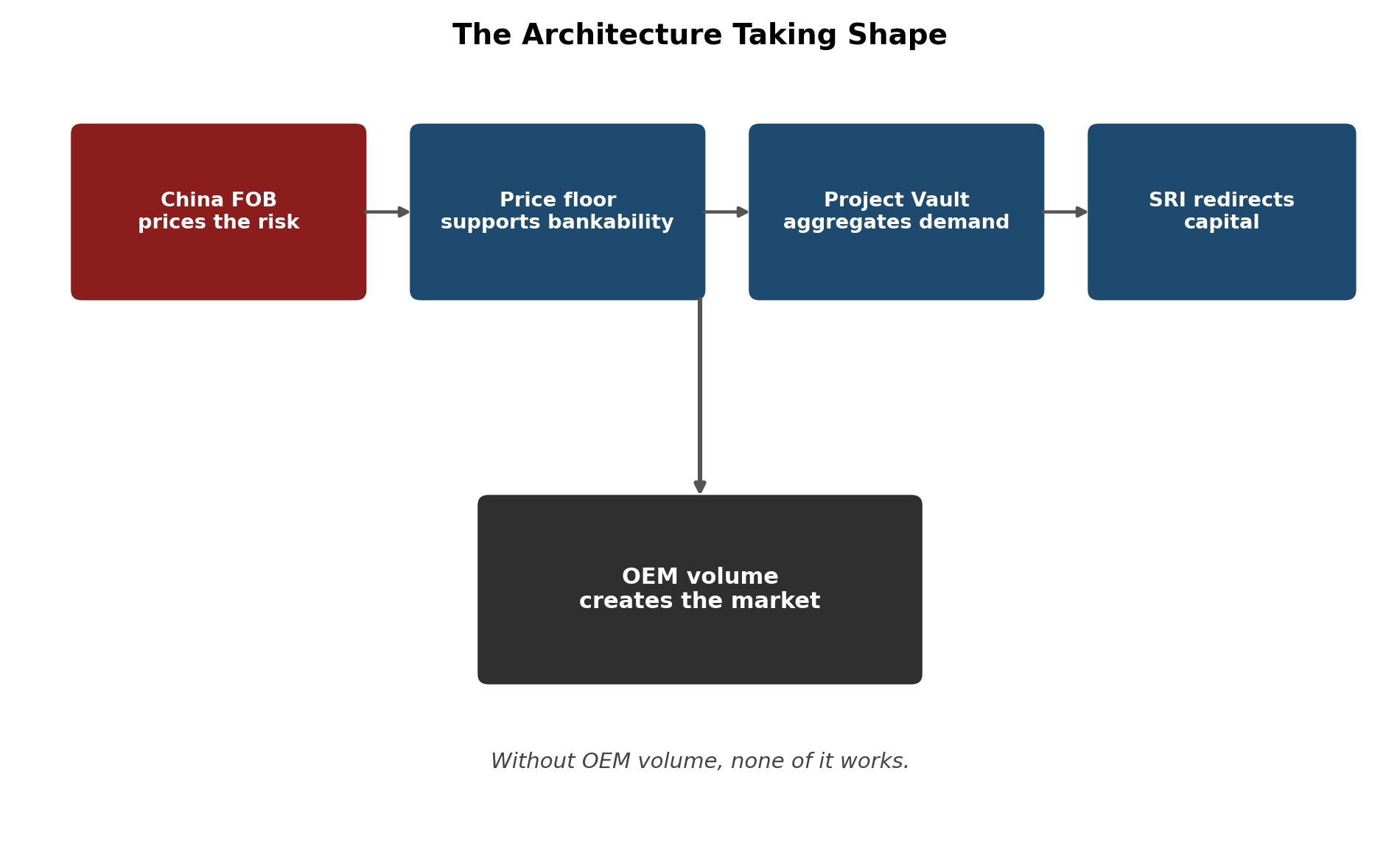
This is where the US approach is more developed than others. Project Vault is intended to aggregate demand and create a physical security buffer; EXIM describes it as a US strategic critical minerals reserve structure, backed by a US$10 billion EXIM loan and nearly US$2 billion in private-sector investment. SRI-type initiatives redirect capital: JPMorgan describes its Security and Resiliency Initiative as a US$1.5 trillion, 10-year plan to finance
and invest in industries critical to economic security and resiliency, including an initial US$10 billion for direct investment in selected companies. The pieces fit together: China FOB prices the risk, a price floor supports bankability, Project Vault aggregates demand and inventory, SRI redirects capital, and OEMs create the volume. Without OEM volume, none of it works.
Japan understood the vulnerability earliest, and its approach worked. Its support for Lynas through JOGMEC and Sojitz was not just support for a mine; it combined finance, offtake, and industrial access, with the objective of ensuring continuity for Japanese manufacturers rather than simple ownership of a mineral resource. The United States is now belatedly trying to replicate that lesson on a larger scale. The contrast with MP Materials is instructive: MP did not restart as a complete Western rare-earth supply chain; it restarted primarily as a miner and concentrate producer, with its output tied to Chinese processing and offtake through Shenghe Resources. That got Mountain Pass operating again, but it did not solve the strategic problem: it gave the United States a mine, not a complete supply chain, and Western geology still depended on Chinese processing, Chinese offtake and Chinese market access.
The current US approach is an attempt to close that gap. The MP/DoD partnership creates a 10-year US$110/kg price-floor commitment for NdPr products and links price support, processing, magnet production and end-user demand. In effect, the United States is now trying to replicate the Japanese lesson: mines do not create supply-chain resilience unless finance, offtake, processing, conversion and end-user demand are tied together. Japan backed a supply chain, MP restarted as a mine, and the US is now trying to close that gap. Europe is waking up, but still leans too heavily on restrictions, targets and compliance rather than incentives, bankable demand and capital formation; restrictions can force demand away from China, but incentives are what pull supply into existence. For now, the direction of flow favours the United States because it is assembling more of the required pieces: demand aggregation, physical reserves, capital redirection, price floors and OEM participation.
Building a benchmark
Price discovery does not require every tonne to trade through an exchange, but it does require enough representative volume to create a credible reference price, which means a defined product, specification and delivery point. A ROW benchmark might be built on NdPr oxide at a clearly stated ratio, most likely 75/25 to align with market convention rather than China's domestic 85/15 norm, with defined purity, compliant origin, standard packaging and delivery to a recognised bonded warehouse, processing hub or industrial cluster. From that anchor, the market can price premiums and discounts for specification, Nd/Pr ratio, purity, origin, qualification, logistics, credit, delivery location and contract duration. The benchmark creates the anchor; the differential prices the real world.
Once that exists, the market can do its real job: deciding which resources are economic. Not every rare-earth resource should become a mine. Some deposits are geologically interesting but commercially irrelevant; others are lower grade but commercially attractive because of mineralogy, scale, infrastructure, jurisdiction, processing route, logistics, or downstream demand. Geology identifies resources. Price discovery determines which resources matter.
Conclusion
China FOB is useful because it shows what dependency costs, but it is not the price at which the rest of the world can build a competitive industrial base. The objective is not to replace Chinese dependency with a permanently high-priced Western market, but to build sufficient physical supply, processing capacity, inventory, OEM demand, and traded volume to create genuine ROW price discovery. That market must reward investment, but it must also produce material at prices that allow Western, Japanese and Korean manufacturers to compete with Chinese finished goods.
None of this happens in a vacuum, and it is worth being direct about what the evidence in this piece points to. The 2011 spike and collapse was not a one-off market correction; the timing around the WTO ruling suggests China had built the capacity to answer a forced reopening before that reopening arrived, and the West's legal victory delivered, within months, the collapse that killed its own nascent competitor. Nothing since has suggested that the lesson was forgotten. Feedstock has tightened from three independent directions at once: Myanmar, MP, and Serra Verde. Rather than easing its export controls in response, China has tightened them, enforced them against a Japanese company's own employees, and cut Japan off from dysprosium and terbium outright. Even where China has bought into the rest-of-world supply chain directly, at Ngualla, the effect has been to freeze the asset rather than develop it, denying supply to both sides rather than adding it to either. Read together, this is not the behaviour of a country treating the West as a market to be cultivated. It is the behaviour of a country that has learned to treat the West as a sink and sees no reason yet to change the lesson it drew in 2015.
Against that, the rest-of-world response so far is uneven. The United States is assembling real architecture, Project Vault, the SRI, the MP/DoD floor, but even there, the floor only works if OEM volume shows up behind it, and it has not fully shown up yet. Europe is further behind still. Solvay is running its one meaningful non-China separation facility below capacity because the automakers it is built to supply have not placed the orders that would justify expanding it, which is the central tension of this entire piece playing out at a single address in France. A floor price, a strategic reserve and a recruitment drive at MOFCOM will all matter less than whether OEMs sign the contracts. That is the one variable in this piece that is not about China at all.
China FOB prices the risk. A bankable ROW floor prices the solution. OEM volume makes the solution real. Material that cannot be delivered has no price, and every OEM still waiting to secure supply has already made that bet; they just haven't priced it yet. Until the rest of the world builds that volume, the dual-price market will keep setting the cost of dependency on its own terms.
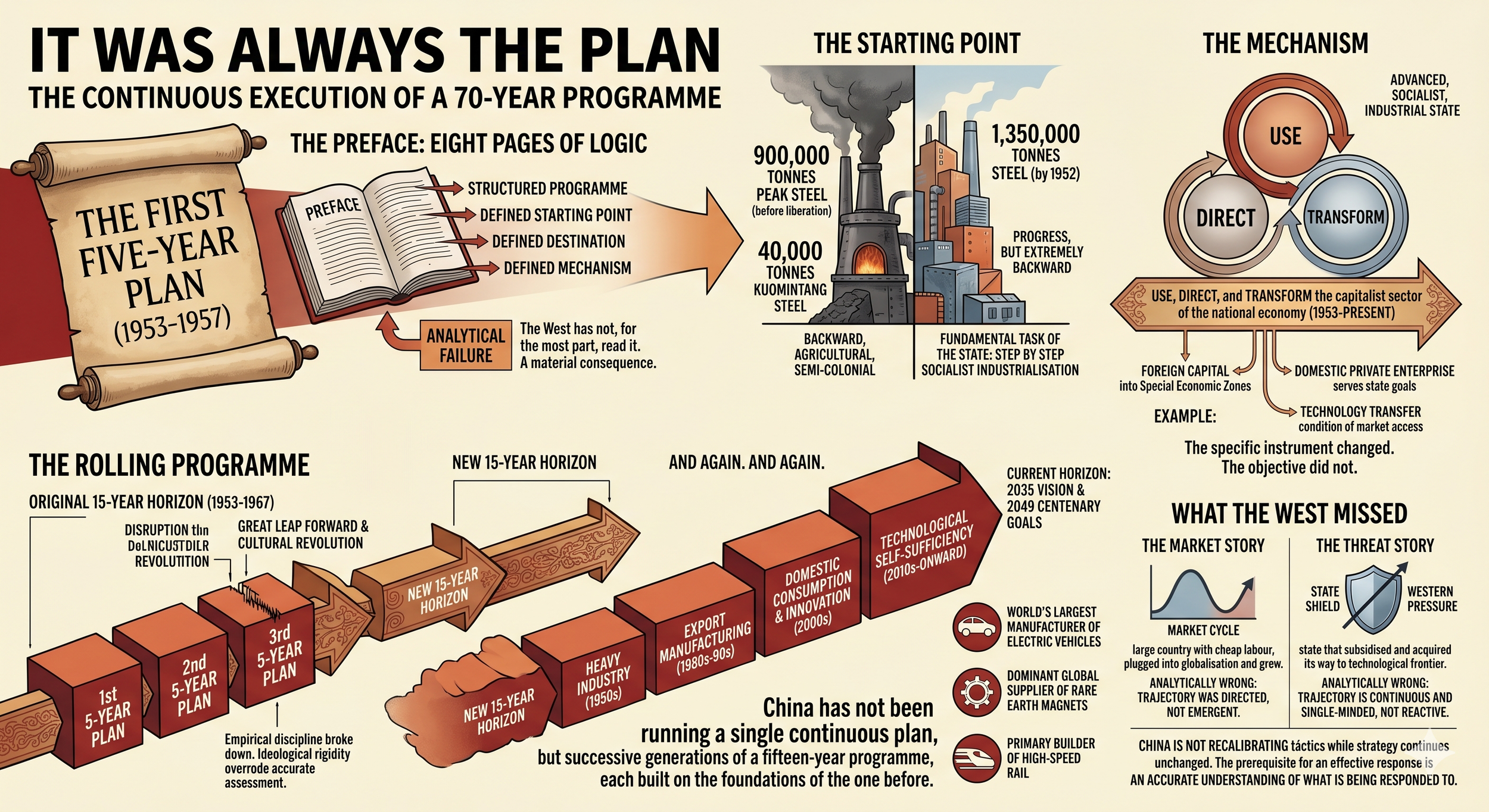
IT WAS ALWAYS THE PLAN
The provided text and the infographic argue that China’s global supply chain dominance is the deliberate execution of a continuous, 70-year strategic framework established in its 1953 First Five-Year Plan.
The core argument rests on three points:
The Generational Mechanism: In 1953, China diagnosed its "backward" economy and designed a repeating 15-year/three-plan rolling architecture to "use, direct, and transform" private and foreign capital toward becoming an advanced industrial state. The current 2035 Vision and 2049 goals are the direct continuation of this structure.
The Compounding Effect: By maintaining institutional memory across decades rather than disrupting policy for short-term political cycles, China systematically advanced from heavy industry to export manufacturing, and finally to technological self-sufficiency in critical minerals, magnets, and electric vehicles.
The Western Analytical Failure: The West misreads China’s rise as either an accidental market story of cheap labor or a reactive threat story responding to Western pressure. Because Western policy mistakes tactical adjustments for strategic shifts, it continuously deploys capital against symptoms rather than the root cause: a 70-year plan executed with absolute continuity.
In 1953, the People’s Republic of China published the First Five-Year Plan for Development of the National Economy. It runs to 231 pages. The preface is eight pages.
Those eight pages contain the complete operating logic of everything China has done in the seventy years since — a structured programme with a defined starting point, a defined destination, and a defined mechanism for getting there.
The West has not, for the most part, read it. That is an analytical failure with material consequences.
THE STARTING POINT
The preface begins with an honest assessment of China's position.
China is described as a “backward, agricultural country” — a “colonial, semi-colonial and semi-feudal state dominated by imperialism.” The numbers are given without softening. Before liberation, annual steel output peaked at just over 900,000 tonnes. In Kuomintang-controlled areas, it was closer to 40,000 tonnes. By 1952, after three years of rehabilitation, output had recovered to 1,350,000 tonnes. The preface records this as progress, then notes that it remains evidence of an “extremely backward state” of the national economy.
There was, by the document’s own admission, no machine-building industry capable of producing the essential means of production. The country that would become the world’s largest manufacturer of electric vehicles, the dominant global supplier of rare earth magnets, and the primary builder of high-speed rail started from a base of 40,000 tonnes of steel and no industrial capability.
The planning that followed was not wishful thinking built on false premises. It was a structured ambition built on accurate diagnosis.
THE DESTINATION
The destination is stated plainly: “an advanced, socialist, industrial state.”
Chapter One defines how the gap would be closed. The Constitution of the People’s Republic of China establishes that the fundamental task of the state is “step by step, to bring about the socialist industrialisation of the country.” The document then states the timeframe:
“It will take a fairly long time to complete this fundamental task of the transition period — approximately fifteen years, or three five-year plans, in addition to the three years of rehabilitation.”
Three five-year plans. Fifteen years. A structured sequence in which each plan knew its role before it was written — the First laying preliminary groundwork, the Second and Third building upon it.
THE MECHANISM
The preface contains one sentence that describes the operating model China has used from 1953 to the present day.
Explaining the rationale for prioritising heavy industrial capital construction, the document states that on this main groundwork, “we shall continue to use, restrict and transform the capitalist sector of the national economy.”
In 1953, “restrict” carried a specific ideological meaning. Private capitalists were tolerated because their capital and expertise were needed, but they were a class to be managed toward eventual elimination. By the late 1950s, private industry had been absorbed into joint state-private enterprises.
Read the sentence with 'restrict' replaced by 'direct'. Use, direct and transform. It accurately describes everything China has done with private and foreign capital in the forty-five years since Deng Xiaoping reopened the economy.
Foreign capital was directed into Special Economic Zones. Domestic private enterprise was permitted where it served state development goals. Technology transfer was extracted as a condition of market access. Private actors were allowed to build until they operated outside state direction, at which point they were brought back into alignment.
The specific instrument changed. The objective did not. The sentence has been in effect for 70 years.
THE ROLLING PROGRAMME
The original fifteen-year programme ran from 1953 to 1967, though the Second and Third Plans were severely disrupted by the Great Leap Forward and the Cultural Revolution — episodes in which empirical discipline broke down and ideological rigidity overrode accurate assessment. The recovery under Deng Xiaoping was a return to the operating principles outlined in the 1953 preface: honest diagnosis, realistic targets, sequenced investment, and external technology when needed.
At the conclusion of the original programme, there was no termination. A new fifteen-year horizon opened, calibrated to where China actually stood rather than where it had been in 1953. And then again. And again.
The content of each successive programme changed. Heavy industry foundations in the 1950s. Export manufacturing and foreign investment absorption in the 1980s and 1990s. Domestic consumption and indigenous innovation in the 2000s. Technological self-sufficiency and competitive leadership from the 2010s onward. The underlying structure did not change: define the fifteen-year horizon, divide it into three sequenced five-year plans, assess and recalibrate at each waypoint, then define the next horizon.
The 2035 Vision and the 2049 centenary goals are the current generation’s version of that original three-plan structure. The language has changed. The architecture has not.
China has not been running a single continuous plan for 70 years. It has been running successive generations of a fifteen-year programme, each built on the foundations of the one before. The compounding effect is now visible in the supply chains that the West is attempting to replicate.
WHAT THE WEST MISSED
The preface acknowledges incomplete statistical data, shortages of technical personnel, and the likelihood that plans will need constant adjustment to actual conditions. It states: “We will make fewer mistakes if we conscientiously study the pioneering experience of the Soviet Union in building socialism.”
Strip the ideological reference, and that is a straightforward statement of programme discipline. Know what you do not know. Adjust continuously to actual conditions. Learn from available evidence.
The advantage China demonstrated is not that it planned, but that the planning function was never subordinated to short-term electoral cycles or dismantled by shifts in doctrine. Each successive five-year plan engaged explicitly with what the previous plan achieved, what fell short, and what the next phase required. The institutional memory was preserved and built upon.
Western democratic systems are not incapable of long-horizon planning. France’s postwar Commissariat Général du Plan, Japan’s MITI, and South Korea’s Economic Planning Board all demonstrated that patient industrial sequencing was achievable. What the Anglophone West did, from the 1980s onward, was dismantle that capacity in the name of market efficiency, as China was refining its own.
The consequences are visible in every supply chain gap, every deferred infrastructure programme, and every strategy document that commits capital but does not deploy it.
THE REAL PROBLEM IS ANALYTICAL
The First Five-Year Plan is a public document. It runs to 231 pages and has been available for nearly seventy years. The preface is eight pages. It states that China intended to become an advanced industrial state, that it would do so through sequenced five-year programmes across a fifteen-year horizon, that it would use, direct and transform private and foreign capital in service of that objective, and that it would adjust continuously to actual conditions.
None of what followed should have been a surprise. It was always the plan.
Western commentary on China’s development tends toward one of two errors. The first treats it as a market story — a large country with cheap labour that plugged into globalisation and grew. The second treats it as a threat story — a state that subsidised and acquired its way to the technological frontier. Both are analytically wrong, and both produce policy responses that address the wrong problem.
The market story misses the fact that the trajectory was directed, not emergent. China did not accidentally become the dominant processor of rare earth elements, the largest manufacturer of solar panels, or the primary builder of high-speed rail. Each position was a staged outcome of sequenced industrial policy, with the state directing capital toward defined objectives across planning horizons no market cycle would have produced.
The threat story misses the fact that the trajectory is continuous and single-minded, not reactive. China is not pivoting in response to Western pressure. It is not recalibrating in response to export controls, tariffs, or diplomatic friction. It is executing, with modifications to the instrument but no modification of the objective, the same programme written down in 1953. The destination has not changed. The path is updated at each five-year waypoint to reflect actual conditions. The direction has not wavered.
This distinction is the one that matters for policy. If China responds to incentives, changing the incentives will change its behaviour. If China is executing a seventy-year programme, changing the incentives will change the tactics while the strategy continues unchanged. The West has spent a decade applying the first assumption to a situation that requires the second.
The prerequisite for an effective response is not more capital, faster permitting, or better industrial policy — though all are necessary. The prerequisite is an accurate understanding of what is being responded to. China is an industrial state executing a generational programme with a defined destination, using every available instrument — private capital, foreign technology, state direction, and export controls over critical materials — in service of that programme.
Until that is understood, Western responses will continue to mistake tactical adjustments for strategic shifts, misread accommodation as permanent softening, and deploy capital against symptoms rather than causes.
The sequence is: understand the philosophy, then build the response. At present, the West is attempting the second without having completed the first.
The First Five-Year Plan for Development of the National Economy of the People’s Republic of China in 1953–1957 was adopted by the First National People’s Congress on 30 July 1955 and published by the Foreign Languages Press, Peking, 1956. All quotations are from the original English-language translation.

The Mobilisation Gap: Critical Minerals and the Test the West Is Failing
In September 1942, the Liberty ship Robert E. Peary was launched four days and fifteen hours after her keel was laid. At peak production, American shipyards were delivering a completed oceangoing cargo vessel approximately every two days. At Willow Run in Michigan, a factory that did not exist in 1940 was producing B-24 Liberator bombers on a moving assembly line before the war was two years old.
These are not figures invoked for nostalgia. They are invoked because they represent the last time the Western industrial world faced a civilisational-scale mobilisation requirement and met it. The question that now demands an honest answer is whether that capacity still exists — and the evidence from the critical minerals sector suggests it does not.
In September 1942, the Liberty ship Robert E. Peary was launched four days and fifteen hours after her keel was laid. At peak production, American shipyards were delivering a completed oceangoing cargo vessel approximately every two days. At Willow Run in Michigan, a factory that did not exist in 1940 was producing B-24 Liberator bombers on a moving assembly line before the war was two years old.
These are not figures invoked for nostalgia. They are invoked because they represent the last time the Western industrial world faced a civilisational-scale mobilisation requirement and met it. The question that now demands an honest answer is whether that capacity still exists — and the evidence from the critical minerals sector suggests it does not.
A Civilisational Event in Slow Motion
The energy transition and the electrification of the global economy are not a commodity cycle. It is not a policy initiative. It is a structural reorganisation of the material basis of industrial civilisation, comparable in strategic consequence to the industrialisation of warfare in the twentieth century.
The numbers alone make the point. Global demand for neodymium-praseodymium oxide — the foundational magnetic material for EV motors, wind turbines, robotics, advanced defence systems, and the full architecture of the electrified economy — is forecast to grow by 10,000 to 15,000 tonnes annually over the next decade. A credible hard-rock rare earth project at commercial scale produces in the order of 2,000 to 2,500 tonnes of NdPr oxide per year. Meeting even that incremental demand growth — without displacing a single tonne of existing Chinese supply, simply keeping pace with new requirements — demands five to seven such projects entering production every year, continuously, for the next decade.
The current pipeline of credible ex-China projects expected to reach commercial production this decade does not approach that requirement. The constraint is not geological. The world is not short of relevant rocks. It is short of financing, permits, construction, operational processing capacity, separation infrastructure, and magnet manufacturing capability outside China's industrial system.
This is the material foundation of the transition economy. And the West cannot currently supply it.
What 1942 Actually Demonstrated
The standard reassurance offered when this comparison is raised is that the West mobilised before and can do so again. The Liberty ships and the Willow Run bombers are cited as proof of latent institutional capacity.
But that reading fundamentally misunderstands what those achievements actually demonstrated.
The mobilisation of 1941 to 1943 did not create industrial capacity from nothing. It redirected and scaled existing industrial capacity in a different form. Ford knew how to build complex mechanical systems on moving assembly lines. The steel mills, the fastener manufacturers, the electrical component suppliers — the entire upstream industrial ecosystem was domestic, operating, and staffed by workers with directly transferable skills. What the war did was provide the political mandate and the capital to redirect that existing capability toward a new output.
The rare earth processing knowledge, the metallurgical workforce, the chemical separation facilities, the magnet manufacturing expertise — these do not exist at a meaningful scale in the West today. They were offshored incrementally over three decades of decisions that were individually rational and collectively catastrophic. There is no Willow Run equivalent waiting to be retooled. The latent capacity that made wartime mobilisation possible was not preserved. It was systematically dismantled in the name of efficiency.
You cannot redirect capacity that no longer exists.
Seven Years of Deliberate Inaction
The dependency was identified. That makes the failure more serious, not less.
On 13 August 2018, the United States signed the FY2019 National Defence Authorisation Act into law. Section 871 prohibited the Department of Defence from acquiring certain rare earth magnets from prohibited countries. The DFARS procurement framework embedded that mandate in April 2019 with a compliance deadline of January 1, 2027. The strategic objective was legislated more than seven years before it was required to be operational.
Seven years is not a short runway. It is long enough to permit the financing, construction, and commissioning of multiple processing facilities. It is long enough to develop a domestic workforce. It is long enough to establish alternative supply chains. It was not used at scale for any of those purposes.
While the United States largely coasted on the assumption that the deadline would eventually force market solutions, China spent the same seven years doing something categorically different. It consolidated its rare earth processing capacity, tightened quota management, built the MOFCOM export licensing infrastructure, and developed the administrative machinery necessary to enforce rather than merely threaten supply restrictions. The April and October 2025 MOFCOM announcements were not the beginning of a policy. They were the operational deployment of one that had been under construction for the better part of a decade.
The subsequent suspension of the October measures following the Xi-Trump Busan summit was not a softening of position. It was a tactical pause to finalise enforcement capability before making controls absolute. China recognised that implementation capacity is as strategically decisive as the mineral resource itself.
The United States identified a vulnerability and legislated awareness of it. China identified the same vulnerability on the other side and spent 7 years making it structural and enforceable. Those are not equivalent activities.
Japan: The Only Successful Template
There is one instructive counter-example, and it is worth examining in detail because it demonstrates that an effective structural response is possible — and because it has been available as a model for fifteen years without being widely adopted.
In 2010, a territorial dispute over the Senkaku/Diaoyu Islands triggered what was effectively an undeclared Chinese rare-earth embargo against Japan. Prices spiked. Supply chains seized. Japanese manufacturers in automotive, electronics, and industrial equipment faced immediate operational consequences. The pain was visceral enough to drive genuine policy change rather than merely legislative acknowledgement.
Japan's response was not simply to find different countries from which to buy the same materials. It pursued simultaneous, parallel workstreams: government-backed strategic stockpiling, long-term offtake agreements with Australia, India, and Kazakhstan built over years rather than in response to a deadline, heavy investment in recycling and material recovery, and — critically — an engineering programme to reduce rare earth content in motors and redesign products to use less or none at all. Honda developed processes to recover rare earths from used vehicle components. Hitachi and others worked on magnet designs with reduced dependence on dysprosium.
Japan treated the problem as an engineering and industrial challenge rather than a sourcing problem—it compressed timelines by running multiple workstreams in parallel rather than sequentially. The 2010 shock gave Japan its forcing function. The lesson was documented, publicly available, and widely discussed. Most Western industrial policy communities absorbed it intellectually and did not replicate it institutionally.
The Real Bottleneck Is Not What You Think
Here is where the argument becomes uncomfortable for institutions rather than governments.
The analytical capacity available to Western industry and government today is extraordinary. Geological modelling, process simulation, supply chain optimisation, environmental impact analysis, and financial structuring — all of these can be executed at speeds and with a fidelity that would have been unimaginable in 1942. The information-processing constraint that genuinely slowed mid-twentieth-century industrial planning has been substantially overcome by the technologies of the past three decades.
There is a particular irony here that deserves to sit at the centre of this discussion. The materials whose secure supply the West cannot organise — the rare earth elements and critical minerals at the heart of this problem — are themselves the input materials for the advanced motors, sensors, computing systems, and industrial automation that represent the leading edge of modern analytical and decision-making capability. The dependency undermines the response. The response requires resolving the dependency. It is a closed loop of strategic irony.
The bottleneck is not analytical. It is institutional.
What the West has built, over decades of risk-averse organisational development, is a system whose primary output is the distribution of accountability rather than the acceleration of decisions. Every sequential gate — the legal review, the compliance sign-off, the committee endorsement, the stakeholder consultation, the ESG screening, the board approval — was individually designed to prevent a specific category of failure. Taken together, they have produced an architecture in which rational actors choose process over velocity every time, because the person who accelerates a decision and is wrong bears full exposure. In contrast, the person who slows down the decision-making process is insulated. Delay becomes the defensible position.
Project Vault, the $12 billion public-private vehicle established to build a distributed US Strategic Critical Minerals Reserve, financed in part through a $10 billion direct loan from EXIM Bank, provides the definitive contemporary illustration. Despite its capitalisation and its strategic mandate, its administration has become mired in the same sequential underwriting architecture designed for peacetime commercial export financing. By treating a strategic civilian inventory as a conventional sovereign credit exposure, the agency has allowed critical procurement decisions to accumulate in regulatory queues. At the same time, market participants stand ready to transact.
A multi-trillion-dollar facilitation framework cannot achieve its objectives if its deployment mechanisms require years to navigate single institutional gatekeepers. The West has confused allocating capital with deploying it. They are not the same activity. China does not cause that confusion.
What January 2027 Will Reveal
The DFARS deadline of January 1, 2027, is now less than eight months away. Meaningful Western industrial mobilisation only accelerated following the April 2025 MOFCOM announcements — leaving approximately eighteen months to accomplish what a seven-year runway did not.
Eighteen months is not enough time to permit, finance, and commission new rare earth processing facilities from scratch. There is not enough time to develop a specialised metallurgical workforce. There is not enough time to build the downstream magnet manufacturing capacity required for defence procurement compliance.
The question that January 2027 will answer is not whether the West can solve this problem before the deadline. It is whether the deadline will produce a genuine reckoning — a forcing function severe enough to dismantle the sequential, siloed institutional architecture that has made rapid mobilisation impossible — or whether it will produce a quiet redefinition of compliance requirements designed to avoid admitting the structural failure.
The Liberty ships were built because the alternative was defeat. The institutional will to move at that speed emerged from an existential forcing function that made the cost of process exceed the cost of speed.
Whether a procurement compliance date constitutes that forcing function is genuinely uncertain. A hot war probably would. A regulatory deadline probably will not — until factories actually stop, defence contractors actually fail procurement mandates, and the abstraction of supply chain dependency becomes the concrete reality of operational suspension.
At that point, the market will not need to be told that these materials are strategically critical. It will already know. The question is whether the West will have built anything by then, or whether it will have written, with great analytical precision, a detailed account of why it did not.
The Price of Waiting: Western Capital and the Critical Minerals Problem
There is a structural paradox at the heart of Western critical mineral strategy. Governments in Washington and Brussels now classify rare earths as essential to defence, electrification, industrial resilience, and national security. Multiple countries have written strategies, held summits, and announced funding initiatives. Yet when the time comes to finance the mines, separation plants, and downstream capacity needed to reduce dependency, the financial framework applied remains largely conventional commodity finance.
That matters because rare earths have not behaved like ordinary commodities for some time, yet Western financial markets still treat them as if they do.
This essay is an analytical interpretation derived from external observation rather than a claim of definitive insider fact. It draws on publicly visible pricing behaviour, policy developments, financing decisions, industrial capacity trends, and market structure to advance a reasoned view of how rare-earth supply chains have evolved. Many of the specific signals discussed are independently verifiable. Still, the argument itself should be read as an evidence-based interpretation of observable developments rather than as a statement of settled fact.
There is a structural paradox at the heart of Western critical mineral strategy. Governments in Washington and Brussels now classify rare earths as essential to defence, electrification, industrial resilience, and national security. Multiple countries have written strategies, held summits, and announced funding initiatives. Yet when the time comes to finance the mines, separation plants, and downstream capacity needed to reduce dependency, the financial framework applied remains largely conventional commodity finance.
That matters because rare earths have not behaved like ordinary commodities for some time, yet Western financial markets still treat them as if they do.
The capital structures applied by Western capital markets to strategic mineral projects were built around cyclical commodity markets, where short-term pricing is assumed to reflect long-term value. That approach worked reasonably well for many bulk commodities. But it has become ineffective when applied to materials increasingly functioning as strategic industrial feedstock. The result is that projects tied directly to supply-chain resilience continue to be assessed primarily on short-term pricing, downside protection, dilution, and conventional project-finance metrics.
The Problem with the Price Signal
The distortion becomes clearer when looking at the pricing of Neodymium Praseodymium Oxide (NdPrO). Throughout 2023 and much of 2024, NdPr prices hovered around USD 50/kg. To many Western financiers, the price indicated oversupply, weak economics, and questionable project viability. Investment appetite contracted accordingly.
But the pricing itself was inside a Chinese-controlled industrial ecosystem responsible for roughly 90% of global magnet production. More importantly, in hindsight, Chinese supply expansion decisions appeared to be linked to long-term industrial development rather than to near-term pricing conditions.
The quoted Chinese NdPr spot price was not a globally neutral market-clearing benchmark generated by competitive international supply and demand. It was a genuine spot price, but one formed within the Chinese internal market and therefore primarily indicative of internal Chinese market dynamics within a vertically integrated state industrial system. In the absence of any credible alternative benchmark, Western financiers nonetheless defaulted to that price as the primary valuation reference for independent ex-China supply chains. In doing so, they committed a fundamental category error: benchmarking a standalone merchant mining asset against a localised clearing price generated within a closed downstream value loop, where China's aggregate profit was captured at the point of finished technology deployment rather than at the mine gate.
An alternative interpretation, based on external observation and established market conventions, is that temporary imbalances sat within a much larger industrial expansion cycle tied to electrification, driven by the adoption of electric vehicles, renewable energy, robotics, factory automation, high-speed rail, grid expansion, and advanced manufacturing. China was not building rare earth capacity in isolation. It was simultaneously expanding many of the industrial systems that would ultimately consume those materials.
China's Self-Reinforcing Industrial Loop
One way of interpreting the system that emerged is as a self-reinforcing industrial loop. Electrification supported further rare-earth capacity expansion and downstream manufacturing investment. Whether deliberate or simply an emergent consequence of the broader strategy adopted, the system increasingly appeared to reinforce itself over time. Additional industrial capacity created additional future demand, which then justified further investment across the supply chain.
Importantly, this interpretation does not require the assumption of a perfectly coordinated long-term master plan. Complex industrial systems often produce reinforcing dynamics that become visible only in hindsight.
What mattered was what vanished from view when Western capital markets' viability assessments for independent rare-earth projects were benchmarked against commodity pricing generated within the Chinese industrial system. A system that was operating on a very different time horizon. The periods of oversupply and weak pricing that damaged financing sentiment for Western rare-earth projects did not reflect a lack of long-term demand. Instead, it reflected temporary surplus capacity generated within a much larger industrial expansion cycle already anticipating future electrification growth.
A Tale of Two Markets
Demand growth for NdPr and other rare earth materials outside China was ultimately driven by many of the same structural forces shaping Chinese transition to full electrification. The difference was scale, sequencing, and industrial positioning.
China expanded capacity earlier, faster, and across a much broader integrated industrial base. The rest of the world increasingly benefited from access to comparatively inexpensive marginal Chinese production rather than building equivalent domestic supply chains and downstream capacity at the same pace.
With hindsight, supply made available to the rest of the world was increasingly being priced more like marginal surplus production than strategically scarce material. If China's primary industrial priority was domestic downstream expansion, then export volumes increasingly reflected capacity beyond immediate internal requirements rather than production developed primarily to serve external markets. Viewed from that perspective, prolonged periods of weak pricing become easier to understand.
In that framework, the pricing environment confronting Western rare earth projects did not fully reflect the long-term strategic value of ex-China supply, but rather the temporary availability of surplus production generated by China's much larger industrial expansion cycle.
It is also important not to overstate intentionality. Relative to the scale of China's broader industrial economy, the rare earth sector itself was, and remains, comparatively small. That alone makes it less convincing to assume that every period of weak pricing or surplus-capacity expansion was designed to suppress future Western rare-earth development. A more plausible interpretation is that the asymmetry emerged largely from the scale, sequencing, and integration of China's broader industrial expansion. Taken in that context, periods of surplus rare-earth production, weak export pricing, and pressure on competing ex-China projects would have been structural outcomes of industrial expansion rather than necessarily the primary strategic objectives themselves.
The asymmetry that developed was not one of differing utilisation priorities. Both China and the rest of the world increasingly require rare earths to support electrification and the transition economy. The difference was that China positioned itself much earlier across the full industrial chain—from mining and separation through to magnet manufacturing and downstream industrial deployment.
As domestic utilisation requirements accelerated, exports of rare earth materials themselves became secondary to supplying China's own industrial system. For the rest of the world, access to those same materials became increasingly critical because they did not develop their own comparable downstream ecosystems.
The period during which the rest of the world benefited from comparatively inexpensive marginal Chinese supply now appears to be ending. As China's industrial demand accelerates due to the demands of electrification, the balance between domestic utilisation and exportable surplus is increasingly tightening. Recent export restrictions and tighter supply controls, therefore, reflect not only geopolitical positioning but also the growing reality that China's own industrial system is absorbing a larger share of available capacity.
This shifting balance was illustrated by the evolution of the Chinese Rare-Earth quota policy from 2023 to 2025. The exceptional three-batch allocation in 2023 was determined by the need to keep pace with accelerating internal industrial demand. Conversely, the subsequent slowdown to two batches, with significantly lower growth in 2024, did not reflect market weakness but rather reflected China's domestic manufacturing capacity increasingly absorbing available production. The final withdrawal of quota disclosure in 2025 removed any remaining pretence that policy was being managed in line with global market needs. This progressive opacity is the logical endpoint of a trajectory where internal absorption transforms an exportable surplus from a routine commercial product into a strategically sensitive asset.
Throughout the period covered by this historic analysis, Western capital markets did not misread the landscape; they evaluated independent developments with perfect commercial rationality as isolated, project-level risks. The true strategic failure lay with Western governments, which fundamentally misread the macro-industrial shift and failed to intervene to alter capital market behaviour. While public policy classified rare earths as strategic infrastructure, the state left the execution entirely to private underwriters bound by short-horizon fiduciary mandates.
The result was that the rest of the world spent many years treating temporary surplus Chinese production as structurally available global supply, when it was marginal capacity sitting outside China's own long-term industrial requirements.
Pensana and Longonjo: A Case Study in Mismatch
The financing trajectory of Pensana and their Angolan Longonjo project clearly illustrates the consequences of this mismatch. Longonjo is a hard-rock NdPr project with several advantages: low strip ratio, hydroelectric power, rail access through the Benguela corridor, and relatively low expected operating costs. It also sits outside China's supply chain.
It is important to distinguish Longonjo from projects such as Serra Verde, which follow a different ionic clay model, and from producers such as MP Materials and Lynas Rare Earths, which were already in production under earlier market conditions.
By the standards of new hard-rock rare earth projects seeking financing in 2023, Longonjo was commercially credible. Yet expected strategic investment support from Western markets failed to materialise. Financing uncertainty increased as NdPr pricing weakened. The geology had not changed. The engineering had not deteriorated. What changed was the sentiment generated by internal clearing dynamics.
The project struggled not because it was technically weak. It struggled because Western capital markets were structurally unwilling to finance strategic supply capacity before physical scarcity became obvious. Capital discipline matters, and not every strategically branded project deserves funding. But the issue here was not distinguishing between good projects and bad ones. The issue was that the financial framework itself remained tied to short-term commodity pricing even as governments increasingly described rare earths as strategic infrastructure.
Faced with a defensive financing environment in London and New York, the project increasingly turned toward regional and sovereign capital. Fundo Soberano de Angola (FSDEA) and African Finance Corporation provided support in 2023 that helped stabilise the project. There was nothing irrational about that. FSDEA was protecting a strategic domestic resource and negotiated terms appropriate to the risks being taken at the time. NdPr pricing was weak, sector sentiment was poor, and financing risk was real.
What matters is what happened next. Within a relatively short period, the same project was discussed under a very different valuation framework following Cascade Investment's 2026 entry into the financing structure. The implied valuation moved materially higher. The project itself had not fundamentally changed. What changed was the geopolitical backdrop to rare-earth supply chains.
By 2025, China's willingness to restrict critical mineral exports and prioritise domestic industrial requirements had forced a broader reassessment across Western markets and governments. Projects such as Longonjo were no longer being viewed simply as mining developments. Increasingly, they were being viewed as strategic industrial assets tied directly to supply-chain resilience, industrial policy, and energy security.
That repricing matters because it exposed something important. The earlier financing friction was not the result of a detailed analysis concluding that Longonjo lacked value. It reflected a system that struggled to price strategic value before geopolitical pressure forced the issue.
The High Cost of Cheap Optionality
The same pattern was seen before elsewhere. Following the collapse of Molycorp, Shenghe Resources secured extensive offtake rights and downstream access linked to Mountain Pass, the only operating rare earth mine in the United States. The Mountain Pass assets were acquired out of bankruptcy in 2017 for approximately USD 20.5 million through a structure involving equity participation, financing support, and forward commercial arrangements.
The key point was not the minority equity stake itself. It was the downstream control. At a time when Western capital markets had largely abandoned the sector, Chinese strategic capital secured influence over future concentrate flows from one of the richest rare-earth deposits outside China. Later, as geopolitical tensions intensified and the United States reassessed supply-chain vulnerability, Mountain Pass increasingly came to be treated as strategic infrastructure rather than simply a mining operation. Nothing underground had changed. What changed was the geopolitical interpretation of the asset.
A similar pattern later emerged with Peak Rare Earths and the Ngualla project in Tanzania. Using gross resource metrics rather than recoverable development inventories, Longonjo's implied valuation equated to roughly USD 1/kg of contained NdPr resource. The acquisition of Peak implied a figure closer to USD 0.12/kg.
These extraordinarily depressed prices become far more striking when viewed in the context of the parallel structural evolution of the market at the time compared to the strategic price floors currently being implemented in the West to insulate producers from localised clearing volatility, and the approximate USD 150/kg FOB pricing currently quoted by the Shanghai Metals Market (SMM) for the same product. When contrasted against these emergent Western supply security benchmarks, the historical acquisition figures demonstrate the staggering scale of the structural discount captured by long-horizon capital during periods of Western policy inertia.
The comparison is imperfect. These are gross contained-resource figures rather than recoverable inventories, and differences in metallurgy, jurisdiction, infrastructure, development stage, and processing complexity remain important. Nevertheless, the contrast remains instructive. It shows how cheaply Chinese companies could accumulate strategic optionality during periods when Western capital markets remained focused on cyclical pricing and short-term commercial returns.
The Scale of the Challenge
The operational consequences of this financial mismatch are stark when set against projected demand. Global NdPr demand is forecast to grow by roughly 10,000 to 15,000 tonnes per year over the next decade. Longonjo Phase 1 is being constructed to produce 20,000 MT of Mixed Rare Earth Carbonate (MREC), containing 2,200 MT of NdPr Oxide annually. Therefore, absorbing only a fraction of projected new demand growth—not replacing existing Chinese supply, but simply keeping pace—requires the equivalent of 5 to 7 Longonjo-scale projects entering production each year.
Currently, the pipeline of ex-China projects credibly expected to reach commercial production this decade falls well short of even that requirement. The binding constraint remains entirely artificial. The world is not short of rocks; it is short of financed, executable processing capacity, separation infrastructure, magnet manufacturing, and long-term industrial coordination outside China's existing system.
The Execution Gap: Allocation Versus Deployment
Confronted with this deficit, Western policy has undergone a massive shift in scale, most visibly through the authorisation of the Security and Resiliency Initiative (SRI)—which targets a headline allocation of $1.5 trillion over the next ten years—and the implementation of supply-side instruments like Project Vault, a $12 billion public-private vehicle designed to establish a distributed U.S. Strategic Critical Minerals Reserve. Financed through a historic $10 billion direct loan from the Export-Import Bank of the United States (EXIM) alongside $2 billion in private-sector capital from manufacturing consortia and institutional partners, the codification of these massive capital facilities is frequently treated in political and financial commentary as an absolute resolution to the dependency problem. This perspective reveals the core strategic error of the current Western model: the profound, ongoing conflation of allocated capital with deployed capital.
The true friction lies within the underwriting machinery itself. A multi-trillion-dollar facilitation framework cannot achieve its objectives if its primary deployment mechanisms require years to navigate single institutional gatekeepers. While a dominant state-directed system treats capital velocity as a core strategic metric—mobilising capacity ahead of demand through immediate, direct credit allocation—the Western counterstrategy remains bound to a sequential deployment model where funds are trickled out only after exhaustive, multi-year commercial de-risking phases.
The operational reality of Project Vault provides the definitive contemporary proof of this institutional drag. Despite its $12 billion capitalisation, the vault's administration has become deeply bogged down in a bureaucratic, glacial decision-making process. EXIM's traditional credit underwriting architecture, mandated compliance loops, and risk-mitigation frameworks are designed for peacetime commercial export financing, not rapid geopolitical supply-chain stabilisation. By treating a strategic civilian inventory as a conventional sovereign credit exposure, the agency has allowed critical physical procurement and storage allocations to languish in regulatory queues, even as market participants stand ready to pre-fund supply certainty.
Conclusion
China established its dominant position by financing future industrial capacity during periods of market weakness, treating infrastructure development as categorically distinct from cyclical commodity investment. The West has finally recognised that financing for strategic supply chains cannot be justified solely by pricing signals from China's domestic market. The emergence of ex-China FOB pricing mechanisms and strategic floor-price structures reflects this evolving awareness.
However, authorising capital remains a trivial legislative act compared to the challenge of compressing institutional underwriting timelines. The lesson of the initial Project Vault deployment and the broader SRI framework is clear: a ten-year timeline is a liability when competing against a competitor operating on immediate industrial horizons. Unless Western institutions can overcome administrative inertia and achieve real-world capital velocity, the coming decade will yield an abundance of beautifully written strategy documents. At the same time, the physical supply chain will remain concentrated in the place it has been for the last 10 years.
THE CONSTRAINT IS NOT COST. IT’S AVAILABILITY.
The rare earth market is no longer defined by uncertainty, but by structure. Pricing, supply and demand dynamics are now sufficiently visible to allow a clear assessment of how the system operates — and where it is constrained.
A separation has emerged between China’s domestic market and the export market that serves the rest of the world. This divergence is not marginal. It reflects a structural difference in cost, availability and access to material, with implications for manufacturing competitiveness, capital allocation and supply security.
At the same time, the economics of new supply outside China are increasingly supported by prevailing market prices. The issue is no longer whether projects can be developed, but whether capital will be deployed at the scale and speed required to deliver them.
This paper examines the pricing structure of the rare earth market, the factors influencing investment decisions, and the role of policy in shaping supply. It sets out the case that the primary constraint facing the sector is not cost, but availability — and that this constraint is already influencing the pace at which dependent industries can develop.
Pricing, capital allocation and the emerging structure of the rare earth market
TWO MARKETS, TWO PRICES
There is no longer ambiguity in the rare earth market. The signals, the economics, and the strategic implications are clear. What is not clear is why the response remains slow. The market is not waiting, and yet policy and capital continue to behave as if they have time.
The starting point is simple. There is not one rare earth market, but two. Inside China, rare earths are priced within a domestic system designed to support downstream industry. NdPr at approximately $98/kg, with 13% VAT applied, results in an input cost of around $110/kg. Outside China, the rest of the world operates in a different reality. It pays export prices of roughly $175/kg, to which logistics, tariffs or VAT are added, resulting in a cost closer to $210–230/kg. This represents a cost difference approaching 100% more than Chinese manufacturers pay.
The mechanism by which these costs are applied differs, but the outcome does not. VAT systems in China and Europe apply tax to the full value of the finished product. In the United States, tariffs are applied once at import, embedded into the raw material cost, and carried through the value chain before sales tax is applied at the final sale. In each case, the end price reflects the accumulated structure. The distinction lies in the underlying cost base.
COST PARITY AND COMPETITIVENESS
Manufacturing competitiveness is determined by input cost. A system operating with input costs of approximately $110/kg is advantaged, over one operating at $220/kg, or twice the price for a comparable input.
There is no scenario where efficiency and engineering can offset that difference. Competing with Chinese production requires closer alignment with Chinese input cost.
The assumption that supplies outside China are inherently uneconomic does not align with observed pricing. The market is already paying ex-China prices of $175/kg and above.
Many projects indicate economic viability at $110–125/kg. Existing producers such as Lynas Rare Earths and MP Materials demonstrate that economic production outside China is achievable. The issue is not economic viability, but capital allocation.
MAKING THE BIFURCATION VISIBLE
The pricing bifurcation between domestic Chinese supply and export markets was understood prior to being directly observable. It became transparent when SMM began publishing FOB prices for neodymium and praseodymium separately in December 2025.
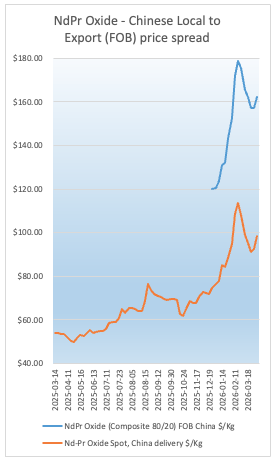
The comparison shown is between FOB China export pricing and Chinese domestic spot pricing on a VAT-exclusive basis. The NdPr price is constructed as an 80/20 composite, consistent with the Chinese domestic specification. SMM reports domestic prices in RMB inclusive of VAT, and USD equivalents on a VAT-exclusive basis. The comparison uses the VAT-adjusted USD series to ensure consistency with FOB pricing. The data is there but requires handling to allow a direct comparison.
This establishes two distinct markets with two different pricing structures.
PRICE FLOORS AND THE COST CURVE
This distinction is relevant to the price floors now being agreed in rest-of-world production.
Several projects have indicated that NdPr prices below approximately $110–125/kg are not economic. This has often been benchmarked against Chinese domestic pricing. However, export pricing indicates that customers outside China are already paying $150–180/kg on an FOB basis, before freight, tariffs or VAT.
The $110–125/kg range is not a uniform threshold. Projects with favourable geology, low strip ratios and simplified processing flowsheets can operate below this level. The Longonjo Project being developed by Pensana in Angola is one such example, with a cost structure supported by low strip ratio, minimal overburden and existing infrastructure. This illustrates that the cost curve is not uniform and that a portion of supply can be competitive at lower levels.
Price floors in rest-of-world supply chains reflect observed market pricing rather than creating a premium. They are based on the price at which material is available outside China on a tax- and tariff-free basis. Their function is to provide revenue visibility sufficient to support capital investment.
CAPITAL ALLOCATION AND SCALE
The rare earth market is relatively small compared to bulk commodities. Returns can be attractive and sufficient in absolute terms, but the sector cannot absorb capital at comparable scale. As a result, projects compete for funding against opportunities that are larger and simpler. They are often rejected not because they are uneconomic, but because they do not offer sufficient scale.
A 20% return on $100 million is not equivalent to a 10% return on $1 billion, particularly where the effort and execution risk are similar. Capital allocation reflects absolute return relative to effort and scale. Incentives are aligned accordingly. In a smaller, more complex and higher perceived risk sector, acceptable returns may not attract capital without either higher margins or reduced risk.
This results in a delay in supply development. Projects are assessed against benchmarks that do not reflect their actual market and against competing opportunities that are not comparable. The outcome reflects capital allocation behaviour rather than project economics.
POLICY AS A SUPPLY CONSTRAINT
China’s control of supply extends beyond production. It especially includes the regulatory framework governing exports.
MOFCOM Order No. 18, introduced in April 2025, established the legal basis for export controls on strategic materials, including rare earth elements. MOFCOM Order No. 63, implemented in November 2025, amends the administrative and enforcement structure of the order with transitional arrangements extended to November 2026, after which the system moves into full effect.
This framework allows China to manage export availability independently of production. Supply to external markets is determined by both capacity and policy.
This introduces an additional constraint. Increased demand does not imply increased availability. Supply available to the rest of the world remains constrained or tightens further if Chinese domestic retention increases.
AVAILABILITY, NOT DEMAND
Rare earths are not a dominant cost component across most manufacturing in which they are a component, but they are a gating input in electric vehicles, offshore wind, robotics and defence. In these sectors, production is constrained by availability rather than demand.
If materials are available only for ten units, production is limited to ten units. Regardless of the price.
In the Defence Sector, the constraint is absolute. System availability is determined by material availability. Substitution is limited and delays are not acceptable.
SYSTEM EXPANSION REQUIREMENTS
Demand for permanent magnets outside China is forecast to increase dramatically with one recent estimate from SP Global, suggesting
“Demand for permanent magnets outside China will rise 50% by 2030. The consumption surge will require a 2-fold increase in rare earth mining, a 4-fold increase in refining, and a 6-fold increase in magnet production.”
Requiring expansion across mining, refining and magnet production. The constraint lies in the rate at which capacity can be developed across each stage and the alignment between them.
A shortfall at any stage constrains the system.
Apart from the strategic case, a strong commercial case for new supply exists. Pricing supports development. The strategic requirement for supply is also clear. The constraint is the rate of capital deployment and project execution
CONCLUSION
If supply does not expand at the required pace, production in dependent sectors will be constrained. This will affect electric vehicles, wind, robotics and defence systems.
The outcome is determined by structure. China currently operates at lower cost and controls export availability. The rest of the world operates at higher cost and depends on external supply. Demand is increasing, but availability is being constrained.
The question is not whether supply can be developed outside China. It must, the question is whether it can be developed in time.
THE INEVITABILITY OF EFFICIENCY
This paper considers the transition economy as a system. It examines how efficiency, scale, and capital allocation interact to shape outcomes, and why the shift toward electrification is better understood as a practical inevitability rather than the policy choice it is currently framed as. It focuses on underlying drivers — system design, resource constraints, and the movement of capital — rather than the political framing that often dominates the discussion.
It traces how differences in efficiency and system design have shaped the relative positions of China and the West, and how those differences influenced the allocation of capital and the development of supply chains. It also examines the role of distortion — where capital is either over-deployed or misallocated — and how this affects the pace and structure of the transition. Despite these distortions, the direction of travel remains consistent, with capital continuing to move toward systems that are more efficient and less constrained.
The intention is not to present a policy argument, but to set out a framework for understanding how the transition is unfolding. The analysis is grounded in observable patterns of behaviour across energy systems, industrial development, and capital allocation, and considers how these elements interact over time to produce outcomes that are structural rather than discretionary.
REFRAMING THE TRANSITION
The transition economy is often framed in political terms — green versus non-green, China versus the West, acceleration versus resistance. These framings describe the debate but do not explain how the current position has been reached. Does the explanation lie elsewhere?
The global economy is reorganising around a more efficient energy system, driven by physics, economics, and capital allocation rather than ideology. Viewed through this lens, the transition to an electrified system is less a policy choice than a practical inevitability
EFFICIENCY, TECHNOLOGY AND ECONOMIC GEOGRAPHY
At its core, the shift is grounded in the relative efficiency of different energy systems. Electric systems convert a higher proportion of energy into useful output, avoid multiple stages of loss, and can be powered from a range of domestic sources. Fossil fuel systems involve losses through extraction, refining, transport and combustion, while depending on continuous fuel input and global supply chains.
Historically, efficiency was not the only determining factor. Fossil fuels offered a decisive advantage in convenience. They are energy-dense, transportable, and supported by established infrastructure. For much of the industrial era, that convenience outweighed the efficiency advantages of electricity, particularly in transport.
The geographic distribution of resources also played a defining role. Oil and gas are unevenly distributed, and their location determined where economic benefits accrued. Countries with reserves, or control over supply routes and processing, captured a disproportionate share of value. The fossil fuel system was shaped by efficiency, convenience, and geography.
Technological development is changing that balance. Advances in battery storage, electric drivetrains, power electronics, and grid infrastructure are reducing the convenience advantage of fossil fuels. As these technologies scale, the disadvantages of electrification diminish, while its efficiency advantages remain.
Where convenience and geography once offset inefficiency, technological progress is allowing the inherent efficiency of electric systems to dominate. Electrification also introduces flexibility in energy generation that is less constrained by the fixed location of hydrocarbon resources, allowing more countries to participate in energy production.
The result is a shift in the economics of energy and the distribution of its benefits. Systems that deliver more useful output per unit of energy, without the historical penalties of inconvenience and geographic constraint, are likely to outcompete those that do not. The transition is therefore rooted in physics, technological progression, and economic geography
CONSTRAINT, SYSTEM DESIGN AND CHINA’S POSITION
China’s position has been shaped by constraint. Unlike many Western economies, its growth was not supported by abundant domestic hydrocarbons. Rapid expansion combined with limited oil and gas resources resulted in increasing reliance on imported energy.
This creates a structural challenge: sustaining growth without a proportional increase in energy imports. The response has been systemic. Electrification of transport, industry and infrastructure, combined with sustained investment in domestic generation — hydro, nuclear and renewables — provides a pathway in which growth is less tightly coupled to imported fuel.
Transport sits at the centre of this system. A large share of oil consumption is in transport, so changes here have system-wide implications. The expansion of high-speed electric rail, the scaling of electric vehicles, and the electrification of urban transport shift energy demand away from imported fuels toward domestically generated electricity. At the same time, this creates a stable demand base for electricity, supporting investment in generation and grid infrastructure, which in turn enables further electrification. Demand and supply develop together, reinforcing the system.
In this context, electrification functions less as an environmental objective and more as a mechanism for enabling growth while managing dependency.
This approach did not develop in isolation. It was supported by scale, sustained capital deployment, and the ability to build interconnected systems rather than discrete projects. Over time, this allowed energy, transport, processing and manufacturing to develop together.
The scale of infrastructure reaching completion in China is often treated as remarkable. What is less frequently acknowledged is that these projects reflect planning and execution cycles measured in decades rather than years. Transport networks, power generation, transmission, and urban systems now coming into service were conceived, financed, and coordinated over extended periods, with delivery sequenced to reinforce system integration. Electrified transport creates stable demand for electricity; generation and grid investment reduce reliance on imported fuels; integrated logistics and urban systems improve throughput and reduce system losses. What appears externally as a wave of megaproject completions is internally the culmination of long‑horizon system design under constraint, sustained by capital committed to efficiency rather than short‑term return.
The cumulative effect is now visible. China occupies a central position in key supply chains that underpin the transition economy, including battery materials, magnet production and electrification technologies. This position is not the result of a single decision, but the outcome of aligning system design with underlying constraints.
Where systems are built in this way, integration follows. Where integration develops at scale, capability concentrates. Where capability concentrates, dependency becomes structural.
China’s position can therefore be understood as the logical outcome of responding early and systematically to constraint.
DEMAND, CAPITAL AND THE WESTERN CONTRIBUTION
China’s development is also linked to external demand. Western economies generated sustained consumption of manufactured goods, supported in part by expanding credit systems. This demand flowed toward China, which became the primary manufacturing base. China applied different economic metrics to pricing, enabling it to offer products at levels Western producers could not justify within their own cost structures.
The resulting revenues were reinvested domestically, supporting industrial expansion, infrastructure development, and system build-out. External demand — enabled by Western credit — contributed to the financing of China’s internal capacity.
This outcome was not inevitable. The same demand could have supported domestic supply chains within Western economies. Instead, it supported their development elsewhere, with long-term structural implications.
Over time, this created an imbalance. The West generated demand but did not consistently allocate capital to build the systems required to supply it. This was not due to a lack of capital. Western economies have significant financial capacity, with programmes committing capital in the trillions of dollars over extended timeframes. The constraint is not capital availability, but how it is allocated.
A substantial portion of capital circulates within financial systems, supporting asset values rather than being directed into infrastructure, supply chains, and industrial capacity. Demand is generated, but the capability to meet it is not always developed domestically.
There are, however, indications that this is beginning to change. Programmes such as JPMorgan Chase’s Security and Resiliency Initiative, alongside efforts such as Project Vault, reflect a shift in capital toward energy systems, critical minerals, and supply chains.
These developments do not change direction, they recognise it. Capital is being reallocated toward more efficient, less constrained systems, irrespective of how the transition is framed publicly.
RHETORIC, DISTORTION AND ACCELERATION
Public rhetoric often suggests hesitation or resistance, yet capital allocation indicates continued investment. Large-scale programmes across energy, infrastructure and supply chains continue to be supported, often across political cycles.
The divergence lies in how the transition is presented. It is framed in political or environmental terms, while the underlying drivers are economic and structural. This creates a gap between what is said and what is being done.
Distortion arises within both systems. In China, capital has been deployed at scale but not always efficiently, with sectors such as property reflecting overinvestment, as seen in the collapse of China Evergrande Group. In Western economies, capital accumulation does not consistently translate into productive deployment. Financial markets expand, while investment in infrastructure, supply chains, and industrial capacity lags. One system risks overbuilding; the other risks underinvestment.
Despite this, the direction of travel remains consistent. Capital continues to move toward systems that are more efficient and less constrained. Additional pressures have accelerated this shift. Urban pollution created immediate domestic constraints in China, while broader environmental and security concerns have reinforced investment elsewhere.
These factors did not determine the direction, but they have increased its pace. Acceleration occurs not because of rhetoric, but despite it.
INEVITABILITY AND CONVERGENCE
Taken together, these elements indicate that the transition to an electrified system is structurally driven. It is grounded in efficiency, supported by scale, and shaped by capital allocation. China recognised this earlier and acted accordingly, while Western economies generated demand but did not capture the supply side at the same pace.
There are now clear indications that capital is being reallocated in that direction. If the transition is a practical outcome of these forces, adoption becomes a matter of timing rather than choice.
The debate may continue, and the framing may evolve, but the underlying trajectory is difficult to reverse. Systems that are more efficient, scalable, and less constrained by resource location are likely to prevail.
FINAL LINE
The transition economy is less a matter of decision than of consequence, shaped by efficiency, scale, and the allocation of capital — a practical inevitability favouring those who recognised and acted on it earliest