

The Toolbox: The West's Rare Earth Tools, and Why the Sum Could Be Greater Than the Parts
Much of the Western commentary on critical minerals reads as resigned. China's lead is treated as a fact to be managed, not a position to be contested, with a defensible niche about as much ambition as anyone claims.
Some of that pessimism is earned. The West did not choose this position. It drifted here over decades of chasing lowest-cost production wherever it existed, while China built the mining and processing base no one else bothered to build. That is a self-inflicted vulnerability, not something to be argued away.
There is a second problem alongside the first, however: insufficient thought has gone into what the rest of the world is good at, and what happens when those strengths are used together rather than separately. Capital markets willing to fund years of uncertainty. Patent systems that protect discoveries. Research — Purdue's chromatography, Japan's magnet science — solving a different problem than China's, rather than attempting to beat China at its own. Sovereign capital, American and Gulf alike, willing to back builds that have not yet proven themselves. The logistics and financial sophistication to sell a differentiated product instead of raw material at the mine gate. None of this alone offsets a fifty-year head start. Assembled deliberately, it is a genuine counter.
This paper does not propose a blueprint for Western critical minerals policy, nor does it claim that any single development — AI-accelerated formulation, modular separation, Africa's clean slate, Japan's patent discipline, Gulf sovereign capital — will reshape the industry alone. It asks one question: has anyone examined these developments together, rather than in isolation, and considered what they amount to as a system rather than a list?
1. The Frame
Western critical minerals policy is, in practice, an attempt to build a smaller version of China: the same objective — lowest unit cost, maximum utilisation, standardised output — at a fraction of the scale. On time and on cost, that bet is unlikely to pay off. China's midstream took decades and hundreds of billions of dollars in state capital to build; no five-year Western programme replicates that arithmetic
The relevant question is not how the West out-Chinas China. It is which architecture fits which segment of demand. Large, integrated, standardised plants are the right instrument where markets, feedstocks, and customers are stable — China's model, built for the world it was built in. Modular, flexible architecture is the right instrument where they are not. That is the frame the rest of this paper follows: not that modularity is superior, but that it suits a growth segment China's infrastructure is poorly positioned to pursue.
That distinction makes this paper's premise a genuine contest rather than a retreat into a defensible niche. The growth this paper concerns exists under different conditions than China's incumbent base — uncertain feedstock, fast-differentiating customers, unsettled policy. Those conditions are where the Western toolkit has an advantage on its own terms: AI-accelerated formulation, modular and feedstock-agnostic separation, capital markets willing to underwrite staged uncertainty, a legal system capable of protecting discoveries, and the logistics and financial sophistication to turn a physical commodity into a differentiated commercial offering. None of this requires the claim that the West could out-produce China on standardised NdFeB, and the paper makes no such claim. It requires only that the growth pool's conditions favour what the West does well — a direct contest for genuine share, fought on ground the incumbent's model is not built to hold.
2. The Growth, Not the Base
The more useful contest is not for China's incumbent base but for the growth. Bloomberg Intelligence's Rare Earths 2026 Outlook Deep Dive, published March 2, 2026, projects China's share of the global NdPr market falling from roughly 90% in 2024 to about 69% by 2030, a 21 percentage point decline, as non-Chinese output more than quadruples over the same period. That near-term growth is not speculative: Bloomberg names the producers directly, citing Lynas's Malaysian refinery ramping toward 10,500 tonnes a year and MP Materials rising to roughly 7,300 tonnes — both expansions already under construction, not capacity assumed into existence. Total NdPr demand is projected to grow around 7% a year through the decade, to roughly 97,000 tonnes by 2030, fifty percent above 2024 consumption, and even with all that new non-Chinese supply, a global shortfall of up to 36% remains a live scenario in Bloomberg's own modelling. The growth being captured is not share taken from an incumbent determined to keep it. It is filling a gap that would otherwise go unmet — a more durable basis for a strategy than direct competition for existing customers.
That forecast, however, is a projection built on currently announced capacity, largely using the same toolkit China itself uses, simply relocated: conventional solvent extraction, mega-plant economics, sited in Australia and Texas rather than Baotou. This is also what occurred the last time this played out. After the 2010 China-Japan rare earth dispute, a comparable wave of non-Chinese investment went into projects such as Lynas, several of which struggled once Chinese exports resumed and prices normalised, because competing with China on China's own terms — cost per tonne of standardised oxide — favours whichever party holds fifty years of accumulated scale. This cycle has a better chance of holding the line Bloomberg projects, and a genuine chance of exceeding it, because the toolkit itself has changed. AI-accelerated formulation and modular, feedstock-agnostic separation are not a cheaper way of running China's game; they are built around a category of demand — fast, bespoke, OEM-specific supply — that China's mega-scale infrastructure is structurally poor at serving regardless of price, because serving it requires reconfiguring for small, differentiated runs rather than standardised campaigns. Analysts routinely identify five-to-ten-year lead times as the principal execution risk standing between announced Western capacity and delivered tonnes. A staged, modular build is designed specifically to compress that timeline: smaller initial commitments reach output sooner, with expansion added once demand is proven rather than gated behind one large upfront construction programme. This is the mechanism by which the West's actual trajectory could outrun Bloomberg's base case — not because more resources exist than the forecast assumes, but because the new toolkit executes faster than the conventional one on which the forecast is implicitly built. This is a forward call the paper is making, not a figure anyone has yet published.
On Bloomberg's own trajectory, non-Chinese NdPr supply must add between 4,000 and 6,500 tonnes of new capacity every year between now and 2030, rising annually rather than remaining flat. Whether that pace is achievable is a separate question this paper does not resolve, but it is the figure to hold against any claim that the forecast itself is conservative.
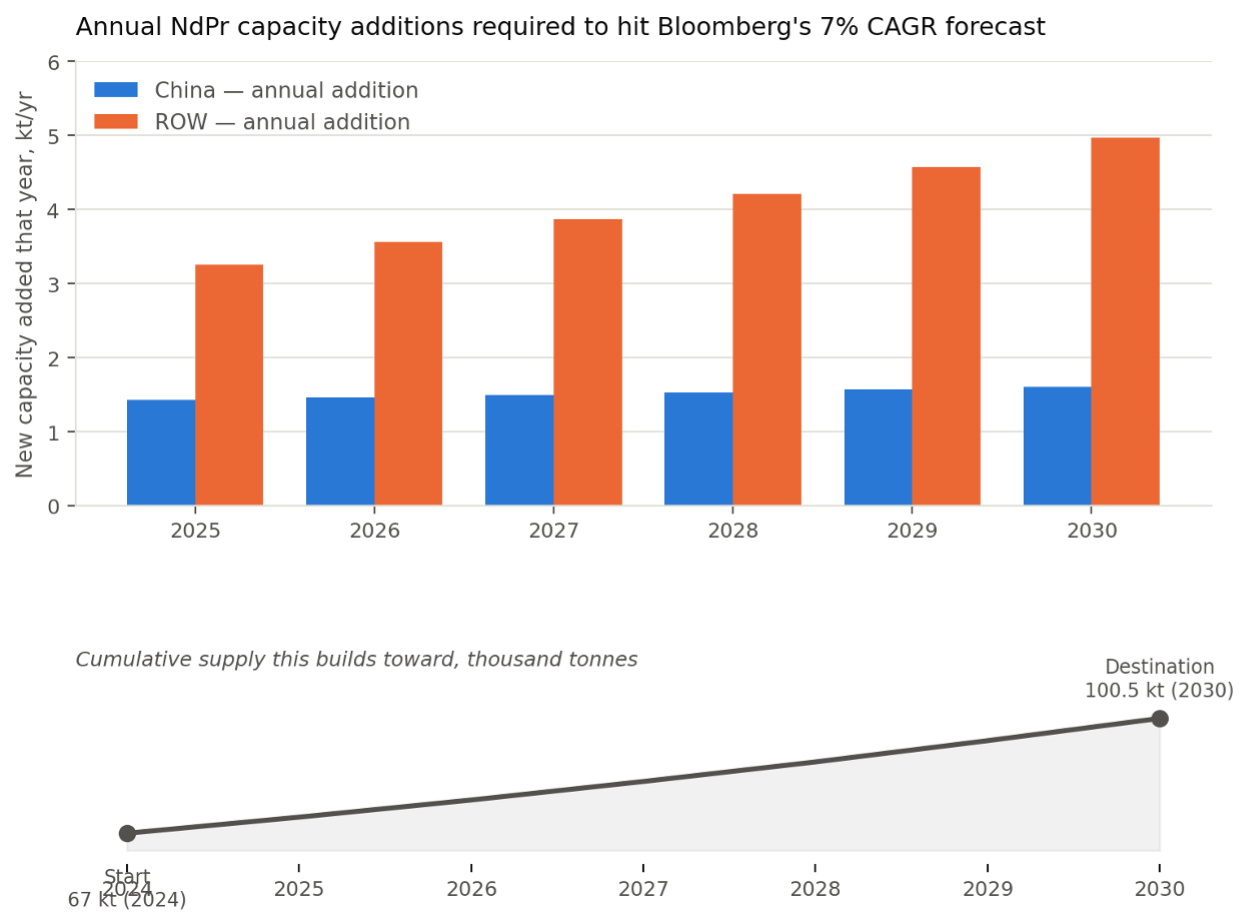
Annual NdPr capacity additions required, China vs rest of world, 2025-2030, with the cumulative total supply trajectory from 67kt to 100.5kt shown below
The volumes worth capturing carry a second advantage the tonnage figures alone do not show: they should carry meaningfully higher margin than the Chinese commodity output alongside which they sit. The Pentagon's guaranteed price floor for MP Materials — $110/kg for NdPr and Dy, against a Chinese benchmark price that has recently run in the $60s to $80s — is a policy-engineered premium for security of supply, not a reflection of production economics; a producer selling into that floor captures margin a Chinese commodity producer never sees on the same tonne. The bespoke, OEM-specific segment carries the same property for a different reason: a customer paying for a formulation built to its exact duty cycle, delivered on its own timeline, from a traceable non-Chinese source, is not shopping on lowest price the way a buyer of standardised NdFeB is. A modest gain in volume share, concentrated in these categories, is worth a disproportionately larger gain in the profit pool than the tonnage figure alone would suggest.
3. The Refinery Lens
A refinery is not profitable because it processes crude oil. It is profitable because it never stops re-optimising: crude selection, configuration, catalyst choice, product slate, customer mix, maintenance timing. The plant functions as an optimisation engine rather than a conversion plant, and the value it creates comes as much from the choices it preserves as from the barrels it runs.
The same distinction applies to rare earth processing. Conventional thinking treats mine, concentrate, separated oxide, metal, and magnet as a chain in which each stage simply adds value. The more accurate frame is that each stage creates optionality — an opportunity to reconfigure, redirect, or hold a choice open — and that optionality carries value independent of the tonnes moving through it.
4. Two Architectures, not a Hierarchy
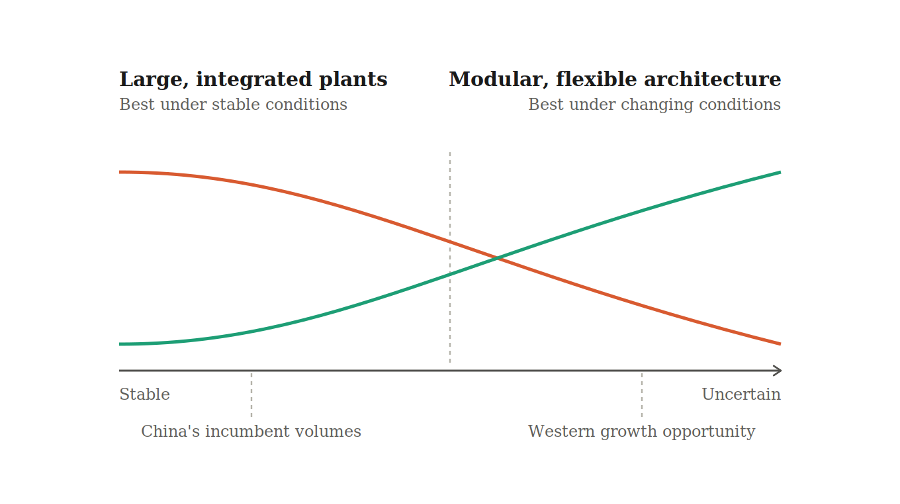
Large integrated plants are the best fit under stable conditions; modular architecture is the best fit under uncertain conditions. The two cross at a midpoint. China's incumbent volumes sit on the stable side; the West's growth opportunity sits on the uncertain side.
China's model — enormous mines, enormous separation plants, deep downstream integration, high utilisation — is the correct answer to a stable, high-volume, standardised problem. The physics favours it: a single large vessel requires less steel, fewer pumps, and fewer instruments per tonne processed than the modular equivalent, and lower heat losses besides. Surface area scales more slowly than volume. This is a genuine advantage, and a paper that passes over it in order to sell modularity is not being straightforward with its reader.
Modular architecture does not out-compete that model on its own terms. It answers a different question: what happens when the market, the feedstock, or the customer is not stable? Large plants optimise for static efficiency — strong performance under known, steady conditions. Modular systems optimise for dynamic efficiency — continued performance as conditions change. Neither is universally correct. The relevant question is which conditions apply, and Western rare earth demand — uncertain feedstock, uncertain policy, a fast-differentiating customer base — is currently of the second kind.
5. What Modularity Actually Buys
The relevant distinction is not cheap capital versus expensive capital. It is capital cost versus capital deployment. A staged build — a smaller initial outlay, with additional tranches committed as demand is proven — is not cheaper than one large plant; it is easier to finance, and it preserves choices that a single up-front commitment would foreclose.
Those choices take several forms: operational (running modules independently), commercial (different products for different customers), feedstock (processing varied inputs), and expansion (adding capacity in fine increments rather than the coarse steps a mega-plant requires — fine-tuning output rather than shutting down the equivalent of an entire medium-sized refinery to reduce capacity by a third). The common thread is that a modular system trades some theoretical peak efficiency for continued value across changing conditions, which is a sound trade only when conditions are, in fact, changing.
6. Where the Growth Actually Is
AI-accelerated materials design is turning bespoke magnet formulation into a production input rather than a research programme. National laboratories and university groups are already using physics-informed machine learning to design compositions with reduced — not eliminated — critical-element content, tuned to a specific performance envelope rather than a generic worst case. The relevant mechanism is inverse design: rather than proposing a composition and testing it, one specifies the target properties, and the model proposes compositions that satisfy them. Multiple compositions can typically satisfy the same target, which is an inconvenience for a research programme but an advantage for a flexible producer, who can execute whichever valid composition its current feedstock and process configuration render cheapest to run.
This is not yet routine industry infrastructure. It is arriving, not arrived, and the paper should say so rather than overstate its case. The direction, however, is genuine, and it points toward a category of demand: OEMs holding their own proprietary formulation, at real production volume, rather than purchasing whatever generic grade the market offers. Not one-off orders, but a new and recurring category of customer.
The proper framing of the payoff is speed and fit, not a blanket cost advantage. Where an OEM's actual duty cycle requires less heavy rare earth than a commodity grade is engineered to withstand — because commodity grades must be built for the worst case, and most buyers never encounter the worst case — a lean, application-specific formulation costs less to produce. Where an application requires more than a commodity grade delivers, the bespoke formulation costs more, and the case rests on performance and turnaround rather than price. Both are genuine claims. They are not the same claim, and the paper keeps them separate rather than compressing them into "far cheaper than China."
This paper's forward call is that the specialised, formulation-specific segment does not remain a niche once speed and acceptable cost are both in place; it grows considerably as a share of the total magnet market. No analyst currently tracks that division for magnets in the way the market is tracked for additive manufacturing, so this is a forecast rather than a reported trend, and it should be presented as such. It is, however, a forecast with a precedent. Additive manufacturing, the clearest recent case of a customisation cost curve crossing a viability threshold, is running at roughly 20 to 24% CAGR through the early 2030s across most forecasts, against 6 to 11% for the permanent magnet market itself — two to three times the growth rate of the host industry in which it sits. The mechanism analysts cite is specific and transferable: HP's Multi Jet Fusion platform is now described as reaching per-part costs competitive with injection moulding at volumes below 10,000 units — not one-off production, not mass manufacturing, but the same OEM-scale band this paper has described throughout. When a flexible process ceases to carry a premium against the standardised alternative at that volume, the standardised alternative begins losing share within that band. There is no reason to assume rare earth magnets are structurally different from every other manufactured good in this respect, and good reason, given how much of current demand is over-engineered relative to actual duty cycle, to expect the effect to be larger here than in most.
7. The Hinge: Separation Has to Meet the Recipe
An AI-generated formulation is useful only if something can produce it without a punishing changeover cost. This is where the separation layer matters, and it is arguably the paper's central and most original claim: the value lies neither in AI alone, which supplies only the ideal specification, nor in flexible separation alone, which supplies only capacity, but in the meeting of the two. AI removes the over-engineering margin built into commodity production. Flexible, modular separation removes the retooling penalty that would otherwise render a lean, precise composition uneconomical outside huge, standardised batches
8. The Technical Case: Separation
Purdue-developed Ligand-Assisted Displacement (LAD) chromatography, commercialised by ReElement Technologies, is the concrete case in point. The claim is that a handful of chromatography columns can replace the hundreds or thousands of mixer-settler stages a solvent-extraction cascade requires — modular, feedstock-agnostic (ore concentrate, recycled magnets, battery material), and deployable in units small enough to site at a mine or a manufacturing plant.
The history here cuts both ways. China itself used ion-exchange chromatography first, in the 1950s and 1960s, before replacing it with solvent extraction because SX cost roughly a tenth as much at industrial scale. Chromatography lost that argument in China more than fifty years ago. What survives in China's current toolkit is chromatography as a polishing step for the hardest separations — an added cost layered on top of an SX-dominated base, not a substitute for it. The Western wager is not that China missed chromatography as a technology. It is that China correctly rejected the first generation of it on cost grounds, and that LAD represents a different chemistry, betting it has solved the capital problem that sank the earlier version.
There is evidence the wager is succeeding, and it is worth citing evidence of the strongest kind: a disclosed commercial transaction, rather than a company's own claim about itself. Vulcan Elements, a magnet manufacturer, has agreed to purchase critical minerals from ReElement at a price both companies describe as significantly below the $110/kg floor the Department of Defense guaranteed to MP Materials for NdPr and Dy — an arm's-length price set by an independent buyer. Add a Pentagon investment aimed at gallium and germanium production, together with a fifty-times lab-to-demonstration scale-up now moving into a 400,000-square-foot Indiana facility, and the trajectory is genuine. It is not yet proof at China-comparable continuous tonnage; even sympathetic outside coverage still frames this as contingent on the technology scaling as promised. The transaction is citable; the superlative is not.
9. The Missing Link: Alloying
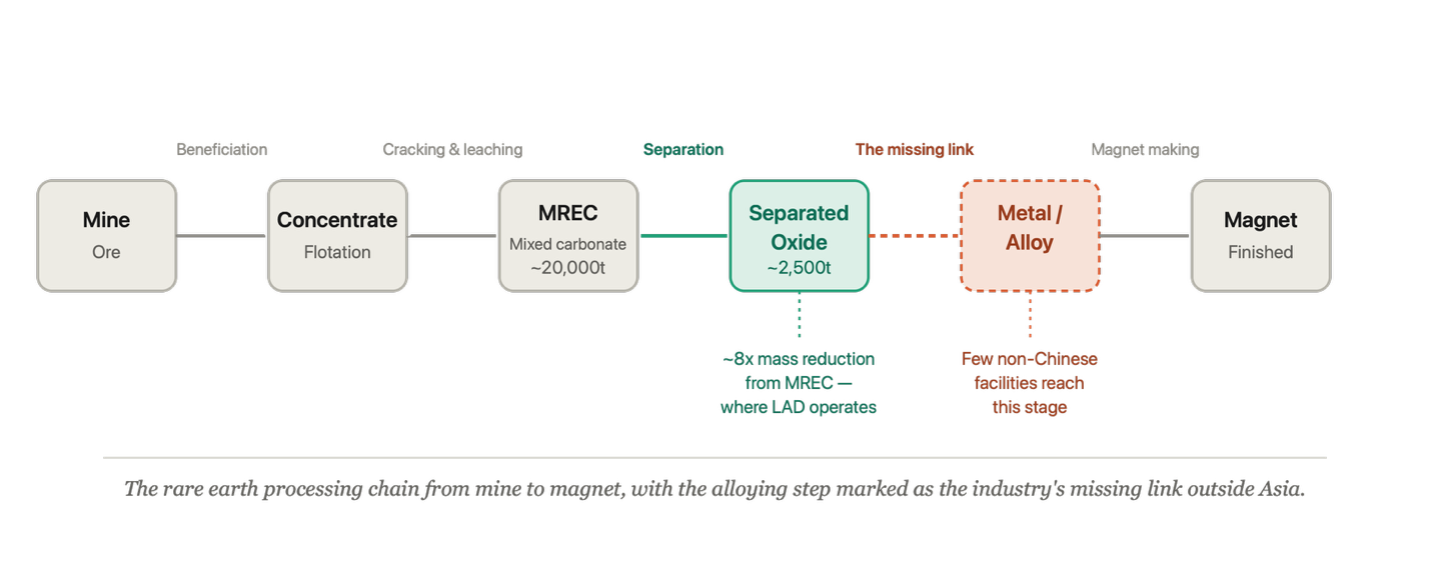
Separation is not the whole chain. Oxide must be reduced to metal and alloyed to the target recipe before it becomes a magnet, and that step is almost as concentrated in Asia as separation itself — only a small number of non-Chinese facilities currently carry oxide through to alloy. A flexible separation platform does not complete the loop by itself.
There is a reassuring aspect to this, however: alloying and casting is conventional metallurgy — vacuum induction melting, strip casting — rather than a novel chemistry requiring a Purdue-scale breakthrough to exist outside China. Building that capacity is a capital and industrial-engineering problem, not a research problem, which means it has a shorter path than separation did. Naming this gap explicitly, rather than passing over it, is what keeps the claim of a "finished magnet" honest.
10. Africa: Built from Scratch, With the Right Tool
The clearest historical parallel for what is at stake is not another mineral but oil. Nigeria produced crude for decades and still ended up importing refined product, because refining capacity concentrated in the US Gulf Coast, Rotterdam, and a handful of other hubs built up over a century of capital and infrastructure that no producer country could easily replicate. The value remained where the refineries already stood, not where the crude originated. It took one determined individual and several billion dollars for Nigeria to break that pattern in its own case, and only within the past couple of years.
Critical minerals refining does not carry that same inertia, at least outside China. The processing capacity that would need to exist for Africa to be shut out of this value chain in the manner it was shut out of oil refining has not yet been built anywhere in the West — the empty space and the tool to fill it are arriving at the same time. A modular, feedstock-agnostic chromatography platform that can be installed in an existing building, rather than requiring a purpose-built mega-plant, is what turns "no sunk costs" from a historical observation into something actionable: whoever builds first here is not obliged to replicate a fifty-year-old capital structure.
This is not hypothetical. Since February 2025, ReElement Technologies and Novare Holdings — a South African investment firm with operations across South Africa, Nigeria, Mozambique, Mauritius, and Zambia — have been developing a $100 million partnership to build Africa's first integrated critical minerals refining platform, using the same LAD chromatography on which this paper is built, with facilities planned near mining sites in South Africa's Gauteng province, the Lobito Corridor in Zambia or Angola, and potentially Lagos, to serve Nigeria's lithium deposits. Novare's relationship with ReElement extends beyond that single deal: it went on to anchor ReElement's $150 million capital raise for the Marion, Indiana facility in June 2025, prompting ReElement's own chief executive to describe the two builds as a single strategy — African capital investing in America's best technology, with that same technology delivering value back to Africa in turn. This is one integrated capital and technology relationship spanning both continents, not two separate wagers.
There is no public confirmation of construction progress on the African leg since the original announcement. The likely explanation is not that capital was withdrawn toward the United States instead, since the same investor stands behind both builds, but that the institutional landscape for African critical minerals projects shifted beneath the original plan. Washington's own Africa strategy escalated sharply in the same window: a December 2025 National Security Strategy recast the US-Africa relationship around "trade, not aid" in the context of critical minerals competition with China; a $553 million DFC loan for the Lobito Atlantic Railway followed that same month; a US-African Union Strategic Investment Working Group was established in January 2026; and a February 2026 Critical Minerals Ministerial produced new bilateral frameworks together with a Glencore-backed consortium deal in the Democratic Republic of Congo. A private plan drawn up before any of this existed may simply be realigning toward the corridor that has since become the anchor of US Africa policy, rather than having been abandoned.
The clearer illustration of why execution matters more than resource ownership lies on the other side of the continent. China's Shenghe Resources completed its acquisition of Peak Rare Earths in September 2025, taking full control of Tanzania's Ngualla deposit, one of the largest and highest-grade undeveloped NdPr resources anywhere, and larger in NdPr content than Longonjo. Despite a commitment made in May 2025 to begin construction in December 2025, no construction date or production timeline had been confirmed under Chinese ownership as of the middle of 2026. This is more consistent with control than with competition: securing the option to keep a major deposit out of Western supply chains without necessarily hastening its development. It sharpens, rather than undermines, this paper's argument. Owning the rock was never the difficult part. Converting it into product quickly is the difficult part, and that is the terrain on which a modular, staged-capital build is designed to compete.
11. Short Chains, Small Lots
China holds a second structural advantage in proximity. Baotou, built around the Bayan Obo mining district, is a deliberately engineered cluster: separation, metal production, magnet materials, and now motor and robotics manufacturers, all sited together under a specific provincial plan running through 2035. Short physical and organisational distance between stages reduces logistics cost and permits tight iteration between adjacent stages in a way no single plant can replicate on its own. Replicating that arrangement in Africa would mean committing to the same decades-long, centralised capital bet this paper has already ruled out on grounds of time and cost. Modularity achieves the same underlying benefit — short chains, rapid iteration — through multiplication rather than concentration: numerous separation nodes distributed at the mines themselves, which is precisely what the ReElement-Novare siting plan already does.
That distributed model rests on a freight-economics case that stands independently of any argument about clustering. Moving 20,000 tonnes of mixed rare earth carbonate concentrate, rather than the roughly 2,500 tonnes of separated oxide it becomes, represents close to an eightfold reduction in the mass that must survive the expensive portion of the journey — rail, port handling, ocean freight. Separating material at the mine means the logistics chain need only carry the tonne that ultimately matters.
That reduction in mass also changes which mode of transport becomes viable. Air freight on established routes — Luanda has genuine cargo capacity via Dubai, with Emirates alone operating roughly 120 tonnes a week into the airport and a transit onward of two to five days — becomes economically trivial once the cargo consists of separated oxide rather than raw concentrate. A few dollars per kilogram in freight cost amounts to a rounding error against oxide values running from roughly $60/kg for NdPr toward $900/kg for terbium. A week door-to-door to Japan, the United States, or Europe, via Dubai or a European hub, is a realistic proposition, and it removes distance from Africa as an objection almost entirely: an African separation facility is no longer at a logistical disadvantage relative to one in the United States or Europe, provided the value-adding step occurs locally rather than shipping raw concentrate abroad.
That speed produces a cash-flow benefit on both sides of the trade, not merely an operational one. A supplier collecting revenue within a week, rather than six to eight, ties up less working capital in goods in transit and reduces exposure to price movements between production and sale. A buyer facing a reliable one-week lead time need not hold the same level of safety stock it would carry against a six-to-eight-week supply chain, which matters for a material this costly to warehouse. It is also what allows the AI-plus-modular-production speed argument to be complete rather than theoretical: a fast, bespoke formulation delivers its full value only if delivery is fast as well.
12. Speed as a Hedge
Structuring the sale as CIF — or, for air freight, the technically correct equivalent, CIP — rather than FOB captures that value commercially, rather than leaving it to the buyer to arrange independently. The seller books freight margin in addition to product margin, converts the promise of rapid delivery into an enforceable contract term rather than a capability the buyer must simply trust, and removes the friction of an unfamiliar shipping route for a customer attempting to diversify away from an established Chinese relationship. Under CIF or CIP terms, risk transfers to the buyer at the point of loading rather than on arrival: the seller is bundling and pricing freight and insurance rather than carrying risk for the entire journey, and the commercial benefit to the buyer lies in convenience and a known landed cost rather than in the transfer of risk.
Speed matters more here than in most commodities for a specific reason, and it is not a general point about risk appetite. The instrument almost every other physical commodity trade uses to bridge this particular gap does not yet exist for rare earths. No listed NdPr futures contract exists outside China: pricing runs on Chinese spot exchanges and published index assessments rather than a liquid, exchange-traded market. CME Group announced in early 2026 that it was developing the first such contract, describing it as the missing piece of the puzzle for the sector as a whole, though as of this writing no launch date has been confirmed, and this should be verified against whatever is true by the time this is read. For an oil cargo, a price movement during a six-week voyage is something party can hedge away in the futures market without touching the physical trade. For a rare earth cargo, there is nothing with which to hedge. A CIF quote struck against the day's index price, for a shipment that will not land for six to eight weeks, amounts to an uncovered bet that the market will not move significantly in the interim, and NdPr has moved 40% within a matter of months before. A CIP quote struck the same way, landing within roughly a week, barely qualifies as a bet at all, since there is scarcely time for the index to move. Speed here is not an approximation of a hedge. At a week's transit, it performs the hedge's actual function, in a market that otherwise lacks one.
There is a further, more specific commercial opening in current market pricing, distinct from the hedging point. Fastmarkets and SMM data from April 2026 show FOB China neodymium oxide trading near $183/kg against CIF Rotterdam near $255/kg, a premium of roughly 39%, considerably larger than freight and insurance alone would explain. Industry analysis of the equivalent cerium spread states explicitly that the gap reflects not only logistics, but the additional procurement complexity introduced by China's export licensing regime — a scarcity premium for material that has cleared Chinese export controls, rather than a shipping cost. A non-Chinese producer carries no such friction and could plausibly offer delivered pricing at a genuine discount to the current CIF Rotterdam benchmark while still earning a normal margin at origin — a second, purely commercial reason for non-Chinese supply to be price-competitive, distinct from any strategic premium for provenance.
13. Financing the Model
That absence of a futures market also explains why single, large offtake agreements have become the default financing structure across this sector: MP Materials selling into the Pentagon's price floor, Shenghe's claim on the entirety of Ngualla's output. With no futures market to provide lenders revenue certainty, a locked-in offtaker is the only substitute currently on offer. This is precisely why the diversified, small-lot model described in this section requires the kind of deep-pocketed equity discussed below: it is not simply a matter of replacing one customer with many, but of doing so in a market with no financial hedge to rely on while that diversified base establishes itself.
Small-lot, fast, delivered sales also change the kind of customer a producer requires. Once shipping cost no longer forces concentration into a single large buyer, there is no logistical reason to sell an entire mine's output to one offtaker. A producer can instead serve many customers in parallel, each paying for precisely what it needs, without granting any single buyer the leverage that comes from taking the entire output. This is the commercial payoff of the logistics argument as a whole: better margins, distributed across a diversified book, rather than one blended bulk discount.
That model carries a genuine cost, however. A single large offtake agreement is the simplest way to provide lenders with the revenue certainty against which a debt package is underwritten — the role that Shenghe's full Ngualla offtake, or the DoD floor, plays for MP Materials. Trading that certainty for a diversified, higher-margin buyer base makes financing more difficult, not less, at least until a track record is established. Deep-pocketed equity must substitute for that certainty: sponsors capable of absorbing completion risk and cost overruns without a locked-in anchor contract standing behind the debt. Gulf sovereign capital offers a current example of precisely this kind of patient equity. The Qatar Investment Authority has moved from a $180 million stake in the critical-minerals investment firm TechMet to a $500 million position in Ivanhoe Mines' operations in the Democratic Republic of Congo, with a November 2025 memorandum of understanding that names downstream refining and smelting capacity explicitly as an area of collaboration — alongside Saudi Arabia's Manara Minerals and the United Arab Emirates' International Resources Holding pursuing comparable positions, and Qatari royal-linked vehicles such as Al Mansour Holding active at even larger scale across the continent. These funds characteristically take minority financial stakes rather than operational control, which is precisely the profile of patient capital a lender wants standing behind a project rather than a strategic operator competing for control of it.
14. The Precedent: What Japan Already Proved
The notion that AI is required to prove that lean, application-specific composition works understates the record. Japanese firms proved the concept commercially more than a decade before AI entered the picture. Grain boundary diffusion — placing heavy rare earth only where it is needed, rather than alloying it through the entire magnet — was developed by Shin-Etsu and Hitachi Metals and commercialised as early as 2014, holding coercivity and remanence steady while reducing dysprosium content by several percentage points. Japan required no model to identify the waste in the dysprosium budget; the country found it by hand and then defended the discovery. Proterial, Hitachi's successor, together with Seiko Epson and TDK, holds hundreds of active patents in this space between them, and that fortified position is now cited explicitly as the model the United States and Europe are attempting to emulate.
What Japan never solved is the layer with which this paper is concerned. Japanese magnet excellence rests on continued dependence on externally separated feedstock, which is why Japan financed Lynas from 2010 to 2011, following China's export restrictions that exposed the gap. Composition optimisation has been proven for over a decade. Flexible, non-Chinese separation capacity to supply it is still being built, only now.
Nor is this uncontested ground. Chinese researchers state plainly that the next competitive front lies in materials engineering rather than mining, employing machine learning for precisely the kind of microstructure and composition work this paper describes, and stating that the contest has shifted from extraction to processing science. China possesses the resources and the manufacturing base to move quickly on whatever its own laboratories discover. The Western advantage does not lie in inventing superior chemistry to China's. It lies in converting a given formulation, discovered anywhere, into sovereign, OEM-scale product fastest, because a production system built from the outset around changeover as its default mode can achieve this in a way a system sized and financed for continuous, standardised campaigns structurally cannot, regardless of which country's scientists discovered the recipe first.
15. Durability: Securing What AI Finds
Japan's advantage was never simply the discovery; it was the discipline of patenting and defending it for two decades. The AI-accelerated version of this strategy is durable only if it comes with the same discipline, and there is a live legal complication that should be acknowledged rather than assumed away. No major jurisdiction currently permits an AI system to be named as an inventor, and the United States revised its own guidance on how much AI involvement an invention may carry and remain patentable as recently as November 2025. In practice, this means the formulations on which this paper is built are patentable where a human can demonstrate documented conception — reviewing, selecting, and refining what the model proposes — and may not be where the process runs from input to output with no human judgment recorded along the way. This is a discipline a company must choose to apply; it is not an automatic feature of using AI, and it is a condition for durability rather than an afterthought.
16. The Objection, Named
Optionality carries a price, and the paper is stronger for naming it before a reader does. Modular systems carry duplicated overhead, lower peak utilisation, and a slower cost-learning curve than a mega-plant run at full output — not a deficiency to be explained away, but the cost of a system built for adaptability rather than throughput, in the same way a four-wheel-drive vehicle costs more than a saloon. The premium is worth paying where feedstock, customer, and policy conditions are genuinely uncertain, which describes the West's position now. It ceases to be worth paying once conditions mature and stabilise, which describes closer to where China has operated for a decade. Naming both sides of that line is what keeps the argument analysis rather than advocacy.
17. The Groves Precedent
Leslie Groves, in the Manhattan Project, purchased optionality with speed and effectively unlimited capital, funding gaseous diffusion, electromagnetic separation, and plutonium production in parallel, at considerable duplicative cost, because the value of not committing to a single path exceeded the cost of pursuing three simultaneously under wartime uncertainty. The modular rare earth build purchases the same optionality with time and staged capital instead of speed and unlimited capital. A different currency, but the same trade.
18. Close
Nothing in this paper should be read as a single prediction that stands or falls as a whole. It presents a set of independent opportunities, each genuine on its own terms: AI-accelerated inverse design becoming routine production infrastructure rather than a research programme; modular chromatography solving, at commercial scale, the capital problem that defeated ion exchange fifty years ago; the alloying gap closing through ordinary industrial investment rather than a further scientific breakthrough; Africa's separation build-out outpacing resource ownership through execution speed; small-lot logistics and Gulf sovereign capital financing a diversified commercial model in place of a single anchor offtaker; Japanese-style patent discipline applied to whatever the AI discovers. None of these depends on the others being true. The West's position could be constructed from three of them, or five, or all six landing to varying degrees across different companies and geographies; the argument does not require a clean sweep.
None of this constitutes a claim that any single one of these developments will reshape the industry on its own; that was never the argument. It is a suggestion that they have mostly been analysed in isolation — AI treated as a materials-science story, modularity as an industrial-design story, Africa's build-out, Japan's patents, and Gulf capital each covered by whoever happens to follow that particular subject. Read together, they compound rather than sit side by side: Japan's proof that composition optimisation is commercially genuine, met by AI that converts a decade of careful engineering into a routine calculation; a modular separation platform built to execute whatever that calculation produces; Africa and Gulf capital supplying the clean slate and the patient money to build it quickly, in parallel rather than in sequence. The claim is not that any single piece changes the outcome. It is that the interaction between pieces still being tracked separately may be where the true position lies.
The argument does require more than none of them, however. Should every one of these wagers fail to materialise — should the AI remain a laboratory exercise, should LAD chromatography meet the same obstacle that defeated the first generation of ion exchange, should the alloying capacity never be built, should Africa's facilities remain announcements, should the financing never arrive, should formulations be discovered but never protected — the result would not be failure so much as a return to the default pace: Bloomberg's base case, five-to-ten-year lead times, incremental share gains measured in single percentage points a year, and China's incumbent advantage compounding for another decade largely undisturbed. Not catastrophic, but slow, and slow is its own kind of answer, given how much of this paper's case rests on speed being the one advantage the West can genuinely claim.
The West's capacity is being built at the very moment AI is converting bespoke formulation from a research programme into a routine production input. That timing constitutes the opportunity, rather than a coincidence to note in passing building modular rather than monolithic infrastructure is what allows it to be captured rather than merely observed. It follows a pattern already visible elsewhere. Mobile money did not catch up with fixed-line banking across parts of Africa; it bypassed the generation incumbents were occupied defending. The West's lateness in rebuilding a rare earth midstream may follow the same pattern: nothing sunk to defend, at precisely the moment the industry's underlying logic is shifting from who can run the largest campaign to who can convert a recipe into product fastest, for a customer that commodity production was never built to serve.
The objective was never to minimise the cost of production. It is to maximise the lifetime value of the enterprise under uncertainty, value created not only through process efficiency but through the choices kept open along the way. Which of those choices are ultimately exercised remains an open question. This paper maps what some of the choices are, it does not guarantee that anyone takes them